Kirjojen hintavertailu. Mukana 11 717 486 kirjaa ja 12 kauppaa.

Kirjahaku

Etsi kirjoja tekijän nimen, kirjan nimen tai ISBN:n perusteella.

16 kirjaa tekijältä Richard E. Wagner

Deficits, Debt, and Democracy

Deficits, Debt, and Democracy

Richard E. Wagner

Edward Elgar Publishing Ltd
2012
sidottu
This timely book reveals that the budget deficits and accumulating debts that plague modern democracies reflect a clash between two rationalities of governance: one of private property and one of common property. The clashing of these rationalities at various places in society creates forms of societal tectonics that play out through budgeting. The book demonstrates that while this clash is an inherent feature of democratic political economy, it can nonetheless be limited through embracing once again a constitution of liberty. Not all commons settings have tragic outcomes, of course, but tragic outcomes loom large in democratic processes because they entail conflict between two very different forms of substantive rationality; the political and market rationalities. These are both orders that contain interactions among participants, but the institutional frameworks that govern those interactions differ, generating democratic budgetary tragedies. Those tragedies, moreover, are inherent in the conflict between the different rationalities and so cannot be eliminated. They can, as this book argues, be reduced by restoring a constitution of liberty in place of the constitution of control that has taken shape throughout the west over the past century. Economists interested in public finance, public policy and political economy along with scholars of political science, public administration, law and political philosophy will find this book intriguing. Contents: Preface 1. Budgeting: The Elusive Quest for Fiscal Responsibility 2. Budgeting and Political Economy: A Theoretical Framework 3. Budget Deficits, Ricardian Equivalence, and Macro-Micro Supervenience 4. Property Rights, Societal Tectonics, and the Fiscal Commons 5. Parliamentary Assemblies as Peculiar Market Bazaars 6. Taxation, Fiscal Politics, and Political Pricing 7. Regulation as Alternative Taxation 8. Public Finance for a Constitution of Liberty Bibliography Index
Public Debt as a Form of Public Finance

Public Debt as a Form of Public Finance

Richard E. Wagner

Cambridge University Press
2019
pokkari
Economists commit a category mistake when they treat democratic governments as indebted. Monarchs can be indebted, as can individuals. In contrast, democracies can't truly be indebted. They are financial intermediaries that form a bridge between what are often willing borrowers and forced lenders. The language of public debt is an ideological language that promotes politically expressed desires and is not a scientific language that clarifies the practice of public finance. Economists have gone astray by assuming that a government is just another person whose impulses toward prudent action will restrict recourse to public debt and induce rational political action.
James M. Buchanan and Liberal Political Economy

James M. Buchanan and Liberal Political Economy

Richard E. Wagner

Lexington Books
2017
sidottu
James M. Buchanan and Liberal Political Economy: A Rational Reconstruction examines the contemporary meaning and significance of James M. Buchanan’s body of work. The book uses Buchanan’s past contributions to explore the present and future relevance of his scholarly contributions and insights. It seeks mainly to explain what insight for their work contemporary scholars might acquire by becoming familiar with some of Buchanan’s formulations. Buchanan was one of the most creative and prolific scholars of political economy during the post-war period. Not only was his body of work so immense that it could not be contained within 20 volumes of Collected Works, but also Buchanan’s scholarship made such strong contact with law, ethics, and political science that he could easily have served as a poster-child for the programs in Politics, Philosophy, and Economics which have been gaining momentum in recent years. Buchanan spoke for a style of economics that made wide and firm contact with the full range of the humane studies. This book emphasizes those features of Buchanan’s thought that seem relevant for contemporary scholarship within the broadly liberal tradition of political economy.
James M. Buchanan and Liberal Political Economy

James M. Buchanan and Liberal Political Economy

Richard E. Wagner

Lexington Books
2019
nidottu
James M. Buchanan and Liberal Political Economy: A Rational Reconstruction examines the contemporary meaning and significance of James M. Buchanan’s body of work. The book uses Buchanan’s past contributions to explore the present and future relevance of his scholarly contributions and insights. It seeks mainly to explain what insight for their work contemporary scholars might acquire by becoming familiar with some of Buchanan’s formulations. Buchanan was one of the most creative and prolific scholars of political economy during the post-war period. Not only was his body of work so immense that it could not be contained within 20 volumes of Collected Works, but also Buchanan’s scholarship made such strong contact with law, ethics, and political science that he could easily have served as a poster-child for the programs in Politics, Philosophy, and Economics which have been gaining momentum in recent years. Buchanan spoke for a style of economics that made wide and firm contact with the full range of the humane studies. This book emphasizes those features of Buchanan’s thought that seem relevant for contemporary scholarship within the broadly liberal tradition of political economy.
Deficits, Debt, and Democracy

Deficits, Debt, and Democracy

Richard E. Wagner

Edward Elgar Publishing Ltd
2013
nidottu
This timely book reveals that the budget deficits and accumulating debts that plague modern democracies reflect a clash between two rationalities of governance: one of private property and one of common property. The clashing of these rationalities at various places in society creates forms of societal tectonics that play out through budgeting. The book demonstrates that while this clash is an inherent feature of democratic political economy, it can nonetheless be limited through embracing once again a constitution of liberty. Not all commons settings have tragic outcomes, of course, but tragic outcomes loom large in democratic processes because they entail conflict between two very different forms of substantive rationality; the political and market rationalities. These are both orders that contain interactions among participants, but the institutional frameworks that govern those interactions differ, generating democratic budgetary tragedies. Those tragedies, moreover, are inherent in the conflict between the different rationalities and so cannot be eliminated. They can, as this book argues, be reduced by restoring a constitution of liberty in place of the constitution of control that has taken shape throughout the west over the past century. Economists interested in public finance, public policy and political economy along with scholars of political science, public administration, law and political philosophy will find this book intriguing. Contents: Preface 1. Budgeting: The Elusive Quest for Fiscal Responsibility 2. Budgeting and Political Economy: A Theoretical Framework 3. Budget Deficits, Ricardian Equivalence, and Macro-Micro Supervenience 4. Property Rights, Societal Tectonics, and the Fiscal Commons 5. Parliamentary Assemblies as Peculiar Market Bazaars 6. Taxation, Fiscal Politics, and Political Pricing 7. Regulation as Alternative Taxation 8. Public Finance for a Constitution of Liberty Bibliography Index
Politics as a Peculiar Business

Politics as a Peculiar Business

Richard E. Wagner

Edward Elgar Publishing Ltd
2016
sidottu
'While market activity and political activity are often analyzed independently of each other, Wagner demonstrates their interdependence. His novel analysis shows that politics has a level of complexity well beyond the way it is typically depicted in the social sciences, and shows that political activity has more in common with market activity than is commonly recognized. The book offers a wide range of insights and pushes readers to take a more nuanced view of politics.'- Randall G. Holcombe, Florida State University, USEconomists typically treat government as something outside the business realm, a sort of 'Lord of the Manor'. Richard Wagner argues that this is the wrong approach and can ultimately be destructive to capitalism and to society.Modern governments are a peculiar form of business enterprise. They face the same problems as regular businesses, such as ascertaining demand and organizing production, and act within the system in a way that can lead to a parasitical relationship with the market. Largely rooted in political economy, this book develops new theoretical ideas and formulations to explain why democracy is a difficult form of government to maintain. The author explores how and why limited governments can morph into a system of destructive politics, and looks at ways to escape this process.This dynamic book will be useful for public choice scholars, economists, political scientists, and lawyers who are interested in political economy in its various guises.
Politics as a Peculiar Business

Politics as a Peculiar Business

Richard E. Wagner

Edward Elgar Publishing Ltd
2017
nidottu
'While market activity and political activity are often analyzed independently of each other, Wagner demonstrates their interdependence. His novel analysis shows that politics has a level of complexity well beyond the way it is typically depicted in the social sciences, and shows that political activity has more in common with market activity than is commonly recognized. The book offers a wide range of insights and pushes readers to take a more nuanced view of politics.'- Randall G. Holcombe, Florida State University, USEconomists typically treat government as something outside the business realm, a sort of 'Lord of the Manor'. Richard Wagner argues that this is the wrong approach and can ultimately be destructive to capitalism and to society.Modern governments are a peculiar form of business enterprise. They face the same problems as regular businesses, such as ascertaining demand and organizing production, and act within the system in a way that can lead to a parasitical relationship with the market. Largely rooted in political economy, this book develops new theoretical ideas and formulations to explain why democracy is a difficult form of government to maintain. The author explores how and why limited governments can morph into a system of destructive politics, and looks at ways to escape this process.This dynamic book will be useful for public choice scholars, economists, political scientists, and lawyers who are interested in political economy in its various guises.
Rethinking Public Choice

Rethinking Public Choice

Richard E. Wagner

EDWARD ELGAR PUBLISHING LTD
2022
sidottu
Innovative in its approach, Rethinking Public Choice reviews the concept of public choice since the 1950s post-war period and the application of economics to political practices and institutions, as well as its evolution in recent years attracting contributions from political science and philosophy.
Fiscal Sociology and the Theory of Public Finance

Fiscal Sociology and the Theory of Public Finance

Richard E. Wagner

Edward Elgar Publishing Ltd
2007
sidottu
This book advances a social-theoretic treatment of public finance, which contrasts with the typical treatment of government as an agent of intervention into a market economy. To start, Richard Wagner construes government not as an agent but as a polycentric process of interaction, just as is a market economy. The theory of markets and the theory of public finance are thus construed as complementary components of a broader endeavor of social theorizing, with both seeking to provide insight into the emergence of generally coordinated relationships within society. The author places analytical focus on emergent processes of development rather than on states of equilibrium, and with much of that development set in motion by conflict among people and their plans. Some of the book's defining characteristics include:Budgets emerge through organizationally constituted political entrepreneurshipGovernment is construed as a process of interaction and participation and not as a unitary entity of interventionGovernment and markets are incorporated into a unified theory of property which is traced to human nature and its requirements for both autonomy and solidarity.Richard Wagner's book will be of interest to researchers in public finance, public choice, Austrian economics, political science and public policy.
Fiscal Sociology and the Theory of Public Finance

Fiscal Sociology and the Theory of Public Finance

Richard E. Wagner

Edward Elgar Publishing Ltd
2009
nidottu
This book advances a social-theoretic treatment of public finance, which contrasts with the typical treatment of government as an agent of intervention into a market economy. To start, Richard Wagner construes government not as an agent but as a polycentric process of interaction, just as is a market economy. The theory of markets and the theory of public finance are thus construed as complementary components of a broader endeavor of social theorizing, with both seeking to provide insight into the emergence of generally coordinated relationships within society. The author places analytical focus on emergent processes of development rather than on states of equilibrium, and with much of that development set in motion by conflict among people and their plans. Some of the book's defining characteristics include:Budgets emerge through organizationally constituted political entrepreneurshipGovernment is construed as a process of interaction and participation and not as a unitary entity of interventionGovernment and markets are incorporated into a unified theory of property which is traced to human nature and its requirements for both autonomy and solidarity.Richard Wagner's book will be of interest to researchers in public finance, public choice, Austrian economics, political science and public policy.
PARCHMENT, GUNS AND CONSTITUTIONAL ORDER

PARCHMENT, GUNS AND CONSTITUTIONAL ORDER

Richard E. Wagner

Edward Elgar Publishing Ltd
1993
nidottu
In this far-reaching and insightful monograph, Richard Wagner exposes the failure of the United States constitution to overcome the tyranny of the majority so feared by the Founding Fathers. Recognising that to the extent a written parchment is enforceable, it is through the construction of a self-supporting balance of private interests, Professor Wagner sketches a balance between the principles of good constitutional order and the placement of guns of self-interest necessary for the preservation of the rights to life, liberty and property. He concludes his analysis with an assessment of the prospects of converting the rent-seeking state into an entrepreneurial state self-interestedly committed to classical liberal principles of constitutional order.The author clearly demonstrates why the tyranny of the majority cannot be prevented by constitutional parchment unless the institutions of society are designed to offer complementary support to limited government and the rule of law. Parchment, Guns and Constitutional Order offers a solution designed to harness the political process to that objective.
Economic Policy in a Liberal Democracy

Economic Policy in a Liberal Democracy

Richard E. Wagner

Edward Elgar Publishing Ltd
1995
nidottu
In Economic Policy in a Liberal Democracy, Richard E. Wagner offers an approach to welfare economics and economic policy appropriate for a classically liberal society.Professor Wagner explains how welfare economics has been unable to fulfil the aspirations of its advocates because it assumes that the consequences of policy measures are sufficiently knowable to achieve specific and intended outcomes. The standard vision of the corrective state, where the state intervenes to repair economic failures and to achieve beneficial consequences, is revealed to be incoherent because the state lacks the competence to influence economic outcomes. Once the full complexity of the economy is recognized, policy measures are shown to generate a plethora of unintended consequences. What emerges instead is a focus on policy for creating and maintaining a constitutional framework that maintains and supports the liberal order in which people organise their activities.
To Promote the General Welfare: Market Processes vs. Political Transfers

To Promote the General Welfare: Market Processes vs. Political Transfers

Richard E. Wagner

Mercatus Center at George Mason University
2019
nidottu
Volumes have been written about the welfare state, covering everything from taxation and regulation to bureaucracy and Social Security. But what are the institutions that make such a state possible, and what alternatives exist to create a better outcome? First published in 1989 and now reprinted with a new preface from the author, To Promote the General Welfare explores this question and demonstrates that economic and political theory are inextricably linked. In this book, Wagner suggests that the current welfare state results from an institutional framework in which governments, acting on behalf of dominant political coalitions, attempt to redistribute wealth through piecemeal welfare legislation. But this government intervention runs counter both to economic theory, which states that such intervention is likely to be offset by market processes, and to political theory, which examines the incentives that shape collective choices. Wagner proposes an alternative institutional framework that restrains government power and creates a contractarian state. This book will be of interest to Austrian and public choice economists and, more generally, to all concerned with the expanding reach of the welfare state.
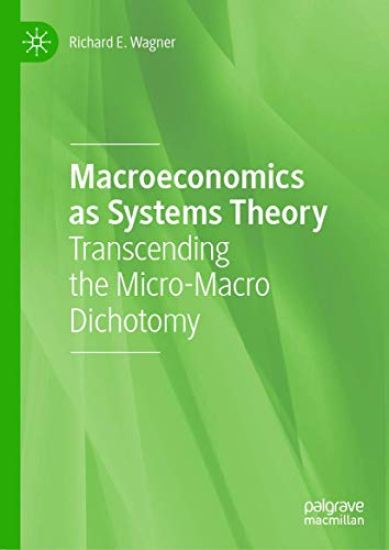
Macroeconomics as Systems Theory

Macroeconomics as Systems Theory

Richard E. Wagner

Springer Nature Switzerland AG
2020
sidottu
This book examines macroeconomic theory from an analytical framework provided by theories of complex systems, in contrast to conventional theories founded on aggregation. The resulting difference in analytical perspectives is huge: the macro level of society is not pursued through aggregation over micro entities. To the contrary, the micro-macro relation is treated as one of parts-to-whole, and this relation is approached from within an ecological scheme of thought. A society is a complex ecology of plans. That ecology, however, is not reducible to a single plan. Conventional macro theory presents a national economy as a collection of such aggregate variables as output, employment, investment, and a price level, and seeks to develop theoretical relationships among those variables. In contrast, the social-theoretic approach to macro or social theory in this book treats the standard macro variables as having been shaped through social institutions, conventions, and processes that in turn are generated through interaction among economizing persons. The object denoted as macro is thus of a higher order of complexity than the object denoted as micro.
Macroeconomics as Systems Theory

Macroeconomics as Systems Theory

Richard E. Wagner

Springer Nature Switzerland AG
2021
nidottu
This book examines macroeconomic theory from an analytical framework provided by theories of complex systems, in contrast to conventional theories founded on aggregation. The resulting difference in analytical perspectives is huge: the macro level of society is not pursued through aggregation over micro entities. To the contrary, the micro-macro relation is treated as one of parts-to-whole, and this relation is approached from within an ecological scheme of thought. A society is a complex ecology of plans. That ecology, however, is not reducible to a single plan. Conventional macro theory presents a national economy as a collection of such aggregate variables as output, employment, investment, and a price level, and seeks to develop theoretical relationships among those variables. In contrast, the social-theoretic approach to macro or social theory in this book treats the standard macro variables as having been shaped through social institutions, conventions, and processes that in turn are generated through interaction among economizing persons. The object denoted as macro is thus of a higher order of complexity than the object denoted as micro.