Kirjojen hintavertailu. Mukana 11 244 527 kirjaa ja 12 kauppaa.

Kirjahaku

Etsi kirjoja tekijän nimen, kirjan nimen tai ISBN:n perusteella.

238 kirjaa tekijältä Richard Edwards

Edwards's Great West and her Commercial Metropolis, embracing a general view of the West, and a complete history of St. Louis ... With portraits and biographies of ... old settlers, etc.
Title: Edwards's Great West and her Commercial Metropolis, embracing a general view of the West, and a complete history of St. Louis ... With portraits and biographies of ... old settlers, etc.Publisher: British Library, Historical Print EditionsThe British Library is the national library of the United Kingdom. It is one of the world's largest research libraries holding over 150 million items in all known languages and formats: books, journals, newspapers, sound recordings, patents, maps, stamps, prints and much more. Its collections include around 14 million books, along with substantial additional collections of manuscripts and historical items dating back as far as 300 BC.The GENERAL HISTORICAL collection includes books from the British Library digitised by Microsoft. This varied collection includes material that gives readers a 19th century view of the world. Topics include health, education, economics, agriculture, environment, technology, culture, politics, labour and industry, mining, penal policy, and social order. ++++The below data was compiled from various identification fields in the bibliographic record of this title. This data is provided as an additional tool in helping to insure edition identification: ++++ British Library Edwards, Richard; 1860. 8 . 10412.g.5.
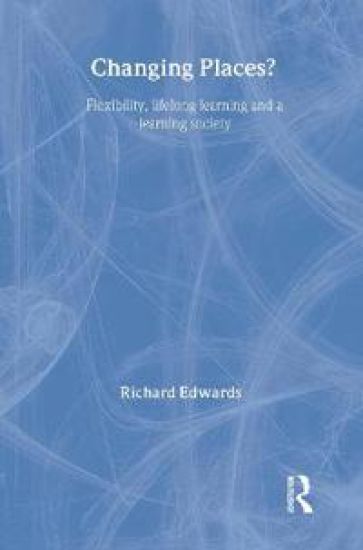
Changing Places?

Changing Places?

Richard Edwards

Routledge
1997
sidottu
Flexibility has become a central concept in much policy and academic debate. Individuals, organizations and societies are all required to become more flexible so that they can participate in the ongoing processes of change involved in lifelong learning. This book explores how the notion of a learning society has developed over recent years: the changes that have given rise to the requirement for flexibility, and the changed discourses and practices that have emerged in the education and training of adults. With the growth in interest in adults as learners, (primarily to support economic competitiveness), the closed field of adult education has now been displaced by a more open discourse of lifelong learning. This involves not only changing practices such as moving towards open and distance-based learning, but also changing workplace identities. Learning settings are therefore changing places in a number of senses: they are places in which people change; they are subject to change; and they are changing to include the home and workplace as well as more formal settings. This book takes an unusually critical standpoint: it challenges contemporary trends, explores the uncertainties and ambivalences of the processes of change, and is suggestive of different forms of engagement with them. It will prove an important text for policy makers, workplace trainers and those working in the field of adult, further and higher education. Richard Edwards is currently a Senior Lecturer in post compulsory education at the Open University.
Changing Places?

Changing Places?

Richard Edwards

Routledge
1997
nidottu
Flexibility has become a central concept in much policy and academic debate. Individuals, organizations and societies are all required to become more flexible so that they can participate in the ongoing processes of change involved in lifelong learning. This book explores how the notion of a learning society has developed over recent years: the changes that have given rise to the requirement for flexibility, and the changed discourses and practices that have emerged in the education and training of adults. With the growth in interest in adults as learners, (primarily to support economic competitiveness), the closed field of adult education has now been displaced by a more open discourse of lifelong learning. This involves not only changing practices such as moving towards open and distance-based learning, but also changing workplace identities. Learning settings are therefore changing places in a number of senses: they are places in which people change; they are subject to change; and they are changing to include the home and workplace as well as more formal settings. This book takes an unusually critical standpoint: it challenges contemporary trends, explores the uncertainties and ambivalences of the processes of change, and is suggestive of different forms of engagement with them. It will prove an important text for policy makers, workplace trainers and those working in the field of adult, further and higher education. Richard Edwards is currently a Senior Lecturer in post compulsory education at the Open University.
Rights at Work

Rights at Work

Richard Edwards

Brookings Institution
1994
nidottu
"With growing international competition, American firms have been gaced with increasing pressures to produce better products, cut costs, and improve efficiency. As a result, American employers have changed many of their long-standing labor priorities. Work-force stability has become less important; long-term commitments have become less attractive; and labor costs, especially fringe benefits, have come under increased scrutiny. With this large reorganization of work forces and priorities, Americans are again faced with the significant questions of what rights workers have—and should have—in the workplace.In the current environment, employers have a greater need for highly motivated, hard-working, skilled employees, and have often developed innovated forms of management to enlist these worker's support. So too, national legislation has granted workers new rights in recent years, such as mandatory early notification of plant closings, greater rights for workers with disabilities, and increased protection for older workers. State legislators have also enacted expanded protection for workers, and state courts have been rewriting basic legal doctrines governing workers' rights in ways that favor employees.In this book, Richard Edwards explores workers' rights and the institutions that have defined and are now enforcing them. He looks closely at the decline of American unions and its effect on traditional rights. As unions have been transformed from major institutional players in the American economy to much more marginal brokers enrolling only a small minority of American workers, political support for workers' rights has diminished. Edwards also traces the American state courts' and the ongoing revision of the legal interpretations of employment contracts and employers' promises, a development which he believes may revolutionize traditional employment law. Rights at Work cuts through the debate between employers' groups and workers' advocates to find a new common ground. Edwards argues that a new system of employment relations offers a ""win-win"" opportunity, and he proposes some innovative public policy strategies that could protect workers' rights while enhancing employers' ability to succeed in a highly competitive global market."
The World around the Chinese Artist

The World around the Chinese Artist

Richard Edwards

Centre for Chinese Studies Publications
2000
nidottu
In Chinese painting there is no clear desire to separate the subjective world and the objective world. Rather, there is a constant, conscious play between the physical reality of the world and the subjective vision of the artist. The artist is continually imitating the world—sometimes more, sometimes less—but he never denies its appearance to the point of total abstraction; nor, in the other extreme, does he claim for the physical world an existence independent of his own involvement. The World around the Chinese Artist explores this special relationship between the self and the landscape in Chinese art through studies of painters Hsia Kuei (12th–13th centuries), Shen Chou (15th–16th centuries), and Shih-t’ao (17th–18th centuries). Each of these three was important in his own time and deemed a master by later critics. Hsia Kuei was Painter-in-attendance in the Academy of Painting during the reign of Emperor Ning-tsung, and he was concerned with presenting a directly observable view of a physically believable landscape. Shen Chou can be described as the inheritor of Yüan ideals and the recipient of traditional training, yet he developed his own style and sensitivity characterized by walking the hair-line between involvement in and detachment from the world he observed. Shih-t’ao was a Buddhist priest and Confucian who viewed narrow adherence to the past as unacceptable slavery and countered it with conscoius rebellion, painting with special notions of style, independence, and individuality that included freedom and abstraction.
Great Plains Homesteaders

Great Plains Homesteaders

Richard Edwards

University of Nebraska Press
2024
pokkari
Great Plains Homesteaders tells the epic story of how millions of people, white and Black, women and men, young and old, and of many different religions, languages, and ethnic groups, moved to the Great Plains to claim land. Most were poor, so the government’s offer of “free” farms through the Homestead Act of 1862 seemed a godsend. The settlers found harsh growing conditions and many perils-including exploitation by railroads and banks, droughts, prairie fires, and bitter winters-yet they persisted. The settlers successfully “proved up” nearly a million claims between the 1860s and the 1920s. They filled up the immense grassland, transforming it into productive farms, the beginning of the region’s agriculture. They also created a distinct culture that continues to shape their estimated fifty million descendants living today. Every homesteader’s experience was different, as particular and distinct as the people were themselves. Yet their collective story, with all its hardships and toil, its ambitions and setbacks, its fresh starts and failures and successes, is central to the American experience.
A Reasonably Simple How to Guide for C#.Net Programmers of All Ages: How to use C#.Net with an Access database and SQL Server databases to create ASP,
This book is about creating both an Access database and A SQL Server database, creating a table with both and populating the table with information. All done with C#. Net Code, the book then shows you how to take that information and turn it into ASP, APSX, HTA and HTML Webpages.
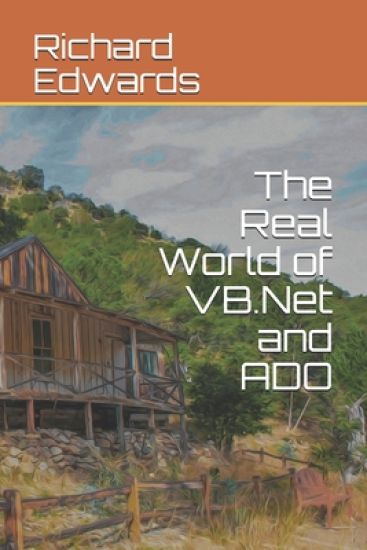
The Real World of VB.Net and ADO

The Real World of VB.Net and ADO

Richard Edwards

Independently Published
2019
nidottu
Some books were meant to be written. Just not by me.Hey, if I can't make you laugh, how can I possibly convince you that you need to purchase this book. Truth is, you've probably already made your decision. But if you choose not to purchase this book, here's what you'll be missing: Examples of using early, mixed and late binding. How to use the Datalinks program to assist in creating connection string, Examples of mixing up ADODB.Connection, ADODB.Command and ADODB.Recordset in different ways, code examples of how an ADODB.Recordset can be used with the OLEDBDataAdapter to produce a Dataset or DataTable or DataView. Working with Providers, Drivers and ISAMS. Fixing the text ISAM Schema.ini file so you can use any delimiter you want. And all of the boringly interesting stuff that you only need to know when your ego gets you in trouble. (In-other-words, all the stuff I needed to know but hadn't remembered where to find it when I needed it while on assignment somewhere out in the middle of nowhere with no internet connection.
The World of Supporting the It Customer: A book of thanks, description and tricks and tips
I'm going to begin this book by saying I have a very deep respect for the men and women who everyday go to work, sit at a desk, put a headset on, log into the queues and start their day helping people throughout the world with customer support. While I wouldn't want to wish the job on anyone, it takes a special kind of person with a heart of gold, the personality of a saint and the determination to not have a hot head get under his or her skin and try ruining an otherwise perfect day. You people are amazing With that said, this book is about the millions of people whose sole purpose in life is to keep people happy at their own expense. Yes, they are trained to handle irate and frustrated customers with the understanding that the person on the other end of the call is just mad or don't understand why something isn't working as promised but the rage, four letter words and violent threats still hurts. In case you are wondering who I am, well, I'm the old fart who stopped counting how many times I've been around the block. I've seen, worked and supported the people who take your information, ask some very specific questions about why you're calling, determine the severity of your call and assign the call to the appropriate queue. I'm the guy who worked tier level three support during the launch of Windows XP. I'm also the guy who handled 3000 cases at Microsoft while being part of the support group for the Visual Basic Enterprise edition. I earned the reputation of handling the toughest cases and the go to guy when my fellow support specialist got stuck resolving an issue. As for me personally, I'm a Vietnam Veteran who served my time in Vietnam between 1969 and 1970. And I've been problem solving since I was born in 1949. Yep, I'm 70 years old and I'm constantly learning something new every day. Even right now. Retirement is not my new religion. I began my IT career at Microsoft back in 1996 handling cases with many others holding degrees - I have none - who were supporting the Enterprise version of Visual Basic from 4.0 to 6.0. I never officially support .Net. By the time that product was being launched, Microsoft was beginning to thin out their customer support teams by replacing us with offshore teams elsewhere in the world. I have no regrets. I needed that push out the door to finally realize I could stand on my own two feet and a consultant and a professional software developer. Programming and creating tools that have impacted a wide range of customers throughout the world is something I'm very proud of and constantly coming up with solutions that help others solve problems keeps me young. Problem is, I probably am the one person who knows too much about the IT customer service and support. So, I'm struggling a little to reduce what I know. Cutting some of the boring and mundane daily grind and will be focusing on the how and why customer support is one of the greatest jobs anyone can have. I've decided that this book will be written from the perspective of someone looking for a new job. I think I accomplished it. To all of you who worked in IT customer support, thank you for your dedication and service. Merry Christmas all
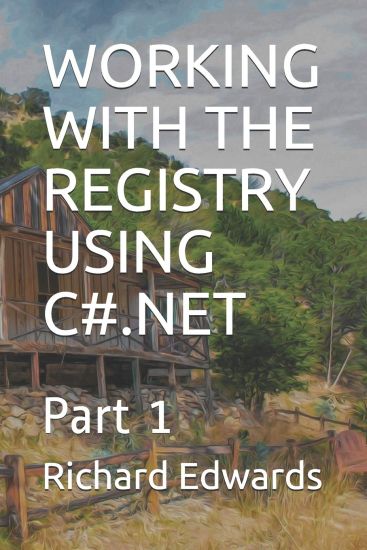
Working with the Registry Using C#.Net: Part 1

Working with the Registry Using C#.Net: Part 1

Richard Edwards

Independently Published
2019
nidottu
The book is part one of a series of books on learning how to write registry code. While mentioned, the bulk of this code in this book deals with using the Microsoft.Win32 namespace which pretty much uses the COM APIs that was used with VB4, VB5, VB6 and C++ to read and write registry information into the registry.There is a ton of code in this book and it will show you how to enumerate through keys, read registry values and work with the registry Values and their data types: REG_SZ, REG_EXPAND_SZ, REG_MULTI_SZ, REG_BINARY, REG_DWORD and REG_QWORD.
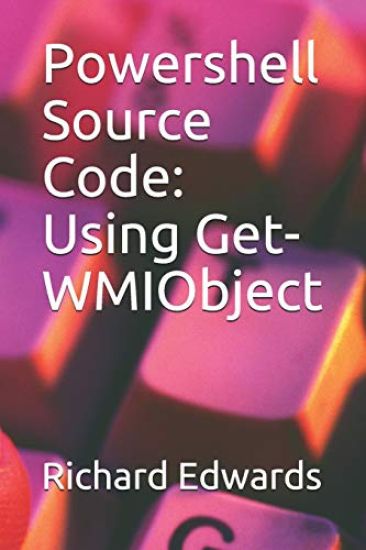
Powershell Source Code: Using Get-WMIObject

Powershell Source Code: Using Get-WMIObject

Richard Edwards

Independently Published
2018
nidottu
PowerShell Source Code is one of a group of books with a specific purpose in mind. Provide you with over 90 pages of solid, workable code you can cut and paste. You can create ASP, ASPX, Delimited Files, Excel, HTA HTML, XML, and XSL programs within minutes after purchasing this book.
PowerShell Sour ce Code: Get CIMInstance

PowerShell Sour ce Code: Get CIMInstance

Richard Edwards

Independently Published
2018
nidottu
PowerShell Source Code is one of a group of books with a specific purpose in mind. Provide you with over 90 pages of solid, workable code you can cut and paste. You can create ASP, ASPX, Delimited Files, Excel, HTA HTML, XML, and XSL programs within minutes after purchasing this book.
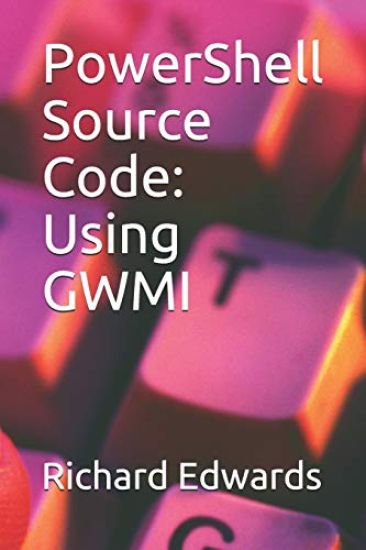
PowerShell Source Code: Using GWMI

PowerShell Source Code: Using GWMI

Richard Edwards

Independently Published
2018
nidottu
PowerShell Source Code is one of a group of books with a specific purpose in mind. Provide you with over 90 pages of solid, workable code you can cut and paste. You can create ASP, ASPX, Delimited Files, Excel, HTA HTML, XML, and XSL programs within minutes after purchasing this book.
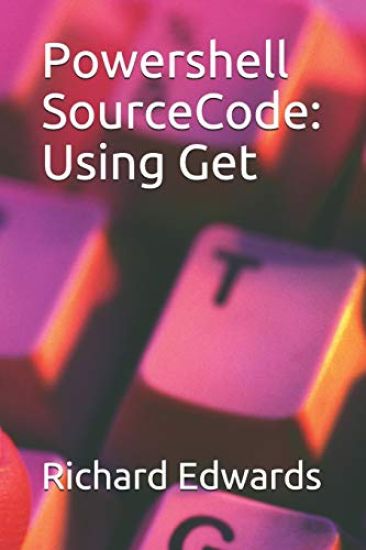
Powershell SourceCode: Using Get

Powershell SourceCode: Using Get

Richard Edwards

Independently Published
2018
nidottu
PowerShell Source Code is one of a group of books with a specific purpose in mind. Provide you with over 90 pages of solid, workable code you can cut and paste. You can create ASP, ASPX, Delimited Files, Excel, HTA HTML, XML, and XSL programs within minutes after purchasing this book.