Kirjojen hintavertailu. Mukana 12 556 021 kirjaa ja 12 kauppaa.

Kirjahaku

Etsi kirjoja tekijän nimen, kirjan nimen tai ISBN:n perusteella.

29 kirjaa tekijältä Richard J. Bernstein

The New Constellation

The New Constellation

Richard J. Bernstein

MIT Press
1992
pokkari
During the last two decades Richard Bernstein has established a worldwide reputation as one of the few philosophers able to bridge different traditions of thought and to clarify, through sympathetic criticism, the key intellectual issues of our time. In these 10 essays he explores the ethical and political dimensions of the modernity/postmodernity debates.Bernstein argues that modernity/postmodernity should be understood as a pervasive mood - what Heidegger calls a Stimmung - one that is amorphous, shifting, and protean but that nevetheless exerts a powerful influence on our current ways of thinking and acting. Focusing on such thinkers as Heidegger, Derrida, Foucault, Rorty, and Habermas, Bernstein seeks to demonstrate the strengths and weaknesses of their work and to highlight the ways in which they have contributed to the formation of a new and distinctive constellation of ideas and themes.Richard J. Bernstein is Vera List Professor of Philosophy at the New School for Social Research.The Essays: Philosophy, History, and Critique. The Rage Against Reason. Incommensurability and Otherness Revisited. Heidegger's Silence? Ethos and Technology.Foucault: Critique as a Philosophic Ethos. Serious Play: The Ethical-Political Horizon of Derrida. An Allegory of Modernity/Postmodernity: Habermas and Derrida. One Step Forward, Two Steps Backward: Rorty on Liberal Democracy. Rorty's Liberal Utopia, Reconciliation/Rupture.
Freud and the Legacy of Moses

Freud and the Legacy of Moses

Richard J. Bernstein

Cambridge University Press
1998
sidottu
Freud's last book, Moses and Monotheism, was published in 1939 during one of the darkest periods in Jewish history. This difficult book has frequently been vilified and dismissed because Freud claims that Moses was not a Hebrew but an Egyptian, and that the Jews murdered Moses in the wilderness. Richard Bernstein argues that a close reading of Moses and Monotheism reveals an underlying powerful coherence in which Freud seeks to specify the distinctive character and contribution of the Jewish people. It is this character that has enabled the Jewish people to survive despite persecution and virulent anti-Semitism, and Freud proudly identifies himself with it. In his analysis of Freud's often misunderstood last work, Bernstein goes on to shows how Freud expands and deepens our understanding of a religious tradition by revealing its unconscious dynamics.
Freud and the Legacy of Moses

Freud and the Legacy of Moses

Richard J. Bernstein

Cambridge University Press
1998
pokkari
Freud’s last book, Moses and Monotheism, was published in 1939 during one of the darkest periods in Jewish history. This difficult book has frequently been vilified and dismissed because Freud claims that Moses was not a Hebrew but an Egyptian, and that the Jews murdered Moses in the wilderness. Richard Bernstein argues that a close reading of Moses and Monotheism reveals an underlying powerful coherence in which Freud seeks to specify the distinctive character and contribution of the Jewish people. It is this character that has enabled the Jewish people to survive despite persecution and virulent anti-Semitism, and Freud proudly identifies himself with it. In his analysis of Freud’s often misunderstood last work, Bernstein goes on to shows how Freud expands and deepens our understanding of a religious tradition by revealing its unconscious dynamics.
Habermas and Modernity

Habermas and Modernity

Richard J. Bernstein

JOHN WILEY AND SONS LTD
1985
nidottu
Jurgen Habermas is one of the leading and one of the most challenging social theorists of our time. During the past several decades he has been developing a systematic critical analysis of modernity - its historical origins, pathologies and future prospects. He is a thinker who has been uncannily attuned to the basic moods and vital concerns of contemporary culture. He stubbornly resists those who claim that Western rationality is exhausted, that the Enlightenment legacy is dead and that the project of modernity is a failure. He has elaborated a comprehensive theory of rationality and the rationalisation processes of modernisation - one which highlights the intersubjective character of communicative action. His ambitious and carefully argues intellectual project invites - indeed commands - rigorous critical scrutiny. This collection of critical essays draws together leading thinkers from a variety of fields in order to assess some of Habermas's major theses concerning the philosophical, cultural and social conditions of modernity. In his substantial reply to these critics Habermas clarifies and defends his view, specifying a range of new problems which demand further analysis. This book is an invaluable resource for understanding Habermas's work and an essential text for anyone who is interested in current debates about the nature of, ad prospects for, contemporary societies and modern culture.
The New Constellation

The New Constellation

Richard J. Bernstein

Polity Press
1991
nidottu
In this major new work, Bernstein explores the ethical and political dimensions of the modernity/post-modernity debate. Bernstein argues that modernity / post-modernity should be understood as a kind of mood - one which is amorphous, shifting and protean but which exerts a powerful influence on our current thinking. Focusing on thinkers such as Heidegger, Derrida, Foucault, Habermas and Rorty, Bernstein probes the strengths and weaknesses of their work, and shows how they have contributed to the formation of a new mood, a new and distinctive constellation of ideas. This new constellation has put ethical and political issues back on the philosophical agenda, forcing us to confront anew, the Socratic question 'How should I live?'
Hannah Arendt and the Jewish Question

Hannah Arendt and the Jewish Question

Richard J. Bernstein

Polity Press
1996
nidottu
Hannah Arendt is increasingly recognised as one of the most original social and political thinkers of the twentieth century. In this important book, Richard Bernstein sets out to show that many of the most significant themes in Arendt's thinking have their origins in their confrontation with the Jewish Question. By approaching her mature work from this perspective, we can gain a richer and more subtle grasp of her main ideas. Bernstein discusses some of the key experiences and events in Arendt's life story in order to show how they shaped her thinking. He examines her distinction between the Jewish parvenu and the pariah, and shows how the conscious pariah becomes a basis for understanding the independent thinker. Arendt's deepest insights about politics emerged from her reflections on statelessness, which were based on her own experiences as a stateless person. By confronting the horrors of totalitarianism and the concentration camps, Arendt developed her own distinctive understanding of authentic politics - the politics required to express our humanity and which totalitarianism sought to destroy. Finally, Bernstein takes up Arendt's concern with the phenomenon of the banality of evil. He follows her use of Eichmann in order to explore how the failure to think and to judge is the key for grasping this new phenomenon. Hannah Arendt and the Jewish Question offers a new interpretation of Arendt and her work - one which situates her in her historical context as an engaged Jewish intellectual.
Radical Evil

Radical Evil

Richard J. Bernstein

Polity Press
2002
nidottu
At present, there is an enormous gulf between the visibility of evil and the paucity of our intellectual resources for coming to grips with it. We have been flooded with images of death camps, terrorist attacks and horrendous human suffering. Yet when we ask what we mean by radical evil and how we are to account for it, we seem to be at a loss for proper responses. Bernstein seeks to discover what we can learn about the meaning of evil and human responsibility. He turns to philosophers such as Kant, who coined the expression 'radical evil', as well as to Hegel and Schelling. He also examines more recent explorations of evil, namely the thinking of Freud and Nietzsche on the moral psychology of evil. Finally, he looks at the way in which three post-Holocaust thinkers – Emmanuel Levinas, Hans Jonas, and Hannah Arendt – have sought to come to grips with evil "after Auschwitz." Bernstein's primary concern throughout this challenging book is to enrich and deepen our understanding of evil in the contemporary world, and to emphasize the vigilance and personal responsibility required for combating it. Radical Evil will be essential reading for students and scholars of philosophy, social and political theory, and religious studies.
The Abuse of Evil

The Abuse of Evil

Richard J. Bernstein

Polity Press
2005
nidottu
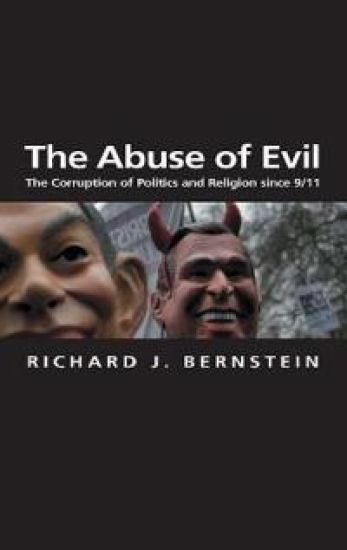
Since 9/11 politicians, preachers, conservatives and the media are all speaking about evil. In the past the dicourse about evil in our religious, philosophic and literary traditions has provoked thinking, questioning and inquiry. But today the appeal to evil is being used as a political tool to obscure compex issues, block serious thinking and stifle public discussion and debate. We are now confronting a clash of mentalities, not a clash of civilisations. One mentality is drawn to absolutes, moral certainties, and simplistic dichotomies of good and evil. The other seriously questions an appeal to absolutes in politics and criticizes the simplistic division of the world into the forces of evil and the forces of good. In The Abuse of Evil Bernstein challenges the claim that without an appeal to absolutes, we lack the grounds for acting decisively in fighting our enemies. The post 9/11 abuse of evil corrupts both democratic politics and religion. The stakes are high in this clash of mentalities in shaping how we think and act in the world today - and in the future.
The Pragmatic Turn

The Pragmatic Turn

Richard J. Bernstein

Polity Press
2010
sidottu
In this major new work, Richard J. Bernstein argues that many of the most important themes in philosophy during the past one hundred and fifty years are variations and developments of ideas that were prominent in the classical American pragmatists: Charles S. Peirce, William James, John Dewey and George H Mead. Pragmatism begins with a thoroughgoing critique of the Cartesianism that dominated so much of modern philosophy. The pragmatic thinkers reject a sharp dichotomy between subject and object, mind-body dualism, the quest for certainty and the spectator theory of knowledge. They seek to bring about a sea change in philosophy that highlights the social character of human experience and normative social practices, the self-correcting nature of all inquiry, and the continuity of theory and practice. And they-especially James, Dewey, and Mead-emphasize the democratic ethical-political consequences of a pragmatic orientation. Many of the themes developed by the pragmatic thinkers were also central to the work of major twentieth century philosophers like Wittgenstein and Heidegger, but the so-called analytic-continental split obscures this underlying continuity. Bernstein develops an alternative reading of contemporary philosophy that brings out the persistence and continuity of pragmatic themes. He critically examines the work of leading contemporary philosophers who have been deeply influenced by pragmatism, including Hilary Putnam, Jürgen Habermas, Richard Rorty, and Robert Brandom, and he explains why the discussion of pragmatism is so alive, varied and widespread. This lucid, wide-ranging book by one of America's leading philosophers will be compulsory reading for anyone who wants to understand the state of philosophy today.
The Pragmatic Turn

The Pragmatic Turn

Richard J. Bernstein

Polity Press
2010
nidottu
In this major new work, Richard J. Bernstein argues that many of the most important themes in philosophy during the past one hundred and fifty years are variations and developments of ideas that were prominent in the classical American pragmatists: Charles S. Peirce, William James, John Dewey and George H Mead. Pragmatism begins with a thoroughgoing critique of the Cartesianism that dominated so much of modern philosophy. The pragmatic thinkers reject a sharp dichotomy between subject and object, mind-body dualism, the quest for certainty and the spectator theory of knowledge. They seek to bring about a sea change in philosophy that highlights the social character of human experience and normative social practices, the self-correcting nature of all inquiry, and the continuity of theory and practice. And they-especially James, Dewey, and Mead-emphasize the democratic ethical-political consequences of a pragmatic orientation. Many of the themes developed by the pragmatic thinkers were also central to the work of major twentieth century philosophers like Wittgenstein and Heidegger, but the so-called analytic-continental split obscures this underlying continuity. Bernstein develops an alternative reading of contemporary philosophy that brings out the persistence and continuity of pragmatic themes. He critically examines the work of leading contemporary philosophers who have been deeply influenced by pragmatism, including Hilary Putnam, Jürgen Habermas, Richard Rorty, and Robert Brandom, and he explains why the discussion of pragmatism is so alive, varied and widespread. This lucid, wide-ranging book by one of America's leading philosophers will be compulsory reading for anyone who wants to understand the state of philosophy today.
Violence

Violence

Richard J. Bernstein

Polity Press
2013
sidottu
We live in a time when we are overwhelmed with talk and images of violence. Whether on television, the internet, films or the video screen, we can’t escape representations of actual or fictional violence - another murder, another killing spree in a high school or movie theatre, another action movie filled with images of violence. Our age could well be called “The Age of Violence” because representations of real or imagined violence, sometimes fused together, are pervasive. But what do we mean by violence? What can violence achieve? Are there limits to violence and, if so, what are they? In this new book Richard Bernstein seeks to answer these questions by examining the work of five figures who have thought deeply about violence - Carl Schmitt, Walter Benjamin, Hannah Arendt, Frantz Fanon, and Jan Assmann. He shows that we have much to learn from their work about the meaning of violence in our times. Through the critical examination of their writings he also brings out the limits of violence. There are compelling reasons to commit ourselves to non-violence, and yet at the same time we have to acknowledge that there are exceptional circumstances in which violence can be justified. Bernstein argues that there can be no general criteria for determining when violence is justified. The only plausible way of dealing with this issue is to cultivate publics in which there is free and open discussion and in which individuals are committed to listen to one other: when public debate withers, there is nothing to prevent the triumph of murderous violence.
Violence

Violence

Richard J. Bernstein

Polity Press
2013
nidottu
We live in a time when we are overwhelmed with talk and images of violence. Whether on television, the internet, films or the video screen, we can’t escape representations of actual or fictional violence - another murder, another killing spree in a high school or movie theatre, another action movie filled with images of violence. Our age could well be called “The Age of Violence” because representations of real or imagined violence, sometimes fused together, are pervasive. But what do we mean by violence? What can violence achieve? Are there limits to violence and, if so, what are they? In this new book Richard Bernstein seeks to answer these questions by examining the work of five figures who have thought deeply about violence - Carl Schmitt, Walter Benjamin, Hannah Arendt, Frantz Fanon, and Jan Assmann. He shows that we have much to learn from their work about the meaning of violence in our times. Through the critical examination of their writings he also brings out the limits of violence. There are compelling reasons to commit ourselves to non-violence, and yet at the same time we have to acknowledge that there are exceptional circumstances in which violence can be justified. Bernstein argues that there can be no general criteria for determining when violence is justified. The only plausible way of dealing with this issue is to cultivate publics in which there is free and open discussion and in which individuals are committed to listen to one other: when public debate withers, there is nothing to prevent the triumph of murderous violence.
Praxis and Action

Praxis and Action

Richard J. Bernstein

University of Pennsylvania Press
1971
pokkari
From the Introduction: This inquiry is concerned with the themes of praxis and action in four philosophic movements: Marxism, existentialism, pragmatism, and analytic philosophy. It is rare that these four movements are considered in a single inquiry, for there are profound differences of emphasis, focus, terminology, and approach represented by these styles of thought. Many philosophers believe that similarities among these movements are superficial and that a close examination of them will reveal only hopelessly unbridgeable cleavages. While respecting the genuine fundamental differences of these movements, this inquiry is undertaken in the spirit of showing that there are important common themes and motifs in what first appears to be a chaotic babble of voices. I intend to show that the concern with man as an agent has been a primary focal point of each of these movements and further that each contributes something permanent and important to our understanding of the nature and context of human activity.
Beyond Objectivism and Relativism

Beyond Objectivism and Relativism

Richard J. Bernstein

University of Pennsylvania Press
1983
pokkari
Drawing freely and expertly from Continental and analytic traditions, Richard Bernstein examines a number of debates and controversies exemplified in the works of Gadamer, Habermas, Rorty, and Arendt. He argues that a "new conversation" is emerging about human rationality-a new understanding that emphasizes its practical character and has important ramifications both for thought and action.
Philosophical Profiles

Philosophical Profiles

Richard J. Bernstein

University of Pennsylvania Press
1986
pokkari
Philosophical Profiles brings together ten important essays by Richard Berstein. Each focuses on the work of a thinker or group of thinkers at the center of contemporary developments in philosophy, including Hannah Arendt, John Dewey, Hans-Georg Gadamer, Jurgen Habermas, G.W.F. Hegel, Alasdair MacIntyre, Herbert Marcuse, and Richard Rorty.
Pragmatic Encounters

Pragmatic Encounters

Richard J. Bernstein

CRC Press Inc
2017
nidottu
Richard J. Bernstein is a leading exponent of American pragmatism and one of the foremost philosophers of the twentieth century. In this collection he takes a pragmatic approach to specific problems and issues to demonstrate the ongoing importance of this philosophical tradition. Topics under discussion include multiculturalism, political public life, evil and religion. Individual philosophers studied are Kant, Arendt, Rorty, Habermas, Dewey and Trotsky. Each of the sixteen essays, many of which are published here for the first time, offers a way of bridging contemporary philosophical differences. This book will be of interest to scholars of philosophy and those researching social and political theory.
Ironic Life

Ironic Life

Richard J. Bernstein

Polity Press
2016
sidottu
"Just as philosophy begins with doubt, so also a life that may be called human begins with irony" so wrote Kierkegaard. While we commonly think of irony as a figure of speech where someone says one thing and means the opposite, the concept of irony has long played a more fundamental role in the tradition of philosophy, a role that goes back to Socrates Ð the originator and exemplar of the urbane ironic life. But what precisely is Socratic irony and what relevance, if any, does it have for us today? Bernstein begins his inquiry with a critical examination of the work of two contemporary philosophers for whom irony is vital: Jonathan Lear and Richard Rorty. Despite their sharp differences, Bernstein argues that they complement one other, each exploring different aspects of ironic life. In the background of Lear’s and Rorty’s accounts stand the two great ironists: Socrates and Kierkegaard. Focusing on the competing interpretations of Socratic irony by Gregory Vlastos and Alexander Nehamas, Bernstein shows how they further develop our understanding of irony as a form of life and as an art of living. Bernstein also develops a distinctive interpretation of Kierkegaard’s famous claim that a life that may be called human begins with irony. Bernstein weaves together the insights of these thinkers to show how each contributes to a richer understanding of ironic life. He also argues that the emphasis on irony helps to restore the balance between two different philosophical traditions philosophy as a theoretical discipline concerned with getting things right and philosophy as a practical discipline that shapes how we ought to live our lives.
Ironic Life

Ironic Life

Richard J. Bernstein

Polity Press
2016
nidottu
"Just as philosophy begins with doubt, so also a life that may be called human begins with irony" so wrote Kierkegaard. While we commonly think of irony as a figure of speech where someone says one thing and means the opposite, the concept of irony has long played a more fundamental role in the tradition of philosophy, a role that goes back to Socrates Ð the originator and exemplar of the urbane ironic life. But what precisely is Socratic irony and what relevance, if any, does it have for us today? Bernstein begins his inquiry with a critical examination of the work of two contemporary philosophers for whom irony is vital: Jonathan Lear and Richard Rorty. Despite their sharp differences, Bernstein argues that they complement one other, each exploring different aspects of ironic life. In the background of Lear’s and Rorty’s accounts stand the two great ironists: Socrates and Kierkegaard. Focusing on the competing interpretations of Socratic irony by Gregory Vlastos and Alexander Nehamas, Bernstein shows how they further develop our understanding of irony as a form of life and as an art of living. Bernstein also develops a distinctive interpretation of Kierkegaard’s famous claim that a life that may be called human begins with irony. Bernstein weaves together the insights of these thinkers to show how each contributes to a richer understanding of ironic life. He also argues that the emphasis on irony helps to restore the balance between two different philosophical traditions philosophy as a theoretical discipline concerned with getting things right and philosophy as a practical discipline that shapes how we ought to live our lives.
Why Read Hannah Arendt Now?

Why Read Hannah Arendt Now?

Richard J. Bernstein

Polity Press
2018
sidottu
Recently there has been an extraordinary international revival of interest in Hannah Arendt. She was extremely perceptive about the dark tendencies in contemporary life that continue to plague us. She developed a concept of politics and public freedom that serves as a critical standard for judging what is wrong with politics today. Richard J. Bernstein argues that Arendt should be read today because her penetrating insights help us to think about both the darkness of our times and the sources of illumination. He explores her thinking about statelessness and refugees; the right to have rights; her critique of Zionism; the meaning of the banality of evil; the complex relations between truth, lying, power, and violence; the tradition of the revolutionary spirit; and the urgent need for each of us to assume responsibility for our political lives. This short and very readable book will be of great interest to anyone who wants to understand the forces that are shaping our world today.