Kirjojen hintavertailu. Mukana 11 451 127 kirjaa ja 12 kauppaa.

Kirjahaku

Etsi kirjoja tekijän nimen, kirjan nimen tai ISBN:n perusteella.

3 kirjaa tekijältä Richard J. Goodrich

Contextualizing Cassian

Contextualizing Cassian

Richard J. Goodrich

Oxford University Press
2007
sidottu
Richard J. Goodrich examines the attempt by the fifth-century ascetic writer John Cassian to influence and shape the development of Western monasticism. Goodrich's close analysis of Cassian's earliest work (The Institutes) focuses on his interaction with the values and preconceptions of a traditional Roman elite, as well as his engagement with contemporary writers. By placing The Institutes in context, Goodrich demonstrates just how revolutionary this foundational work was for its time and milieu.
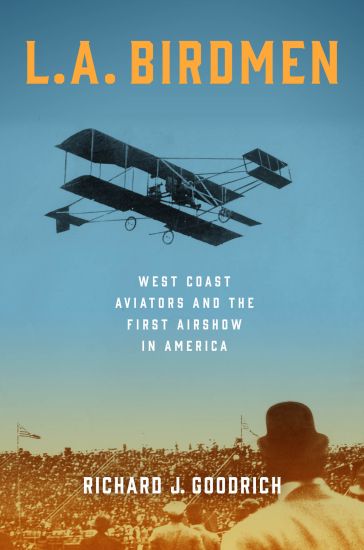
L.A. Birdmen

L.A. Birdmen

Richard J. Goodrich

GLOBE PEQUOT PRESS
2024
sidottu
Although most credit Wilbur and Orville Wright with America’s first powered flight, two months before the brothers lifted off the sands of Kitty Hawk, a French immigrant named August Greth flew the California Eagle, an airship of his own design, across the skies of San Francisco. While the Wrights claimed they had invented a flying machine, Greth and the California aviators proved it in front of thousands of spectators at state fairs and festivals across the country. L.A. Birdmen is the fascinating and forgotten story of America’s first aviators—Californians like August Greth, Tom Baldwin, Roy Knabenshue, John Montgomery, and James Zerbe. Possessing a rare blend of ingenuity, creativity, and bravery, these pilots captured the world’s attention in 1910 when Los Angeles hosted America’s first international airshow. Inspired by a flying exhibition held in Reims, France, Los Angeles promoter Dick Ferris convinced the city to host a competing event—a show that featured the world’s best pilots and machines and would firmly establish Los Angeles as the center of American aviation. Featuring a fierce competition between French pilot Louis Paulhan and American Glenn Curtiss, the Los Angeles International Aviation Meet was a revelation: the pilots shattered existing aviation records, refuted those who doubted the viability of heavier-than-air flying machines, and performed death-defying stunts. The ten days of flying received national newspaper coverage and attracted more than 100,000 visitors, including future industry leaders like Glenn Martin and William Boeing. L.A. Birdmen offers a high-flying account of the West Coast contribution to aviation, a little-recognized chapter in the story of American flight. In the first decade of the twentieth century, these dashing aviators—not the Wrights—were the public face of American aviation.
Comet Madness

Comet Madness

Richard J. Goodrich

PROMETHEUS BOOKS
2023
sidottu
Halley’s Comet visits the earth every seventy-five years. Since the dawn of civilization, humans had believed comets were evil portents. In 1705, Edmond Halley liberated humanity from these primordial superstitions (or so it was thought), proving that Newtonian mechanics rather than the will of the gods brought comets into our celestial neighborhood. Despite this scientific advance, when Halley’s Comet returned in 1910 and astronomers announced that our planet would pass through its poisonous tail, newspapers gleefully provoked a global hysteria that unfolded with tragic consequences. In Comet Madness, author and historian Richard J. Goodrich examines the 1910 appearance of Halley’s Comet and the ensuing frenzy sparked by media manipulation, bogus science, and outright deception. The result is a fascinating and illuminating narrative history that underscores how we behave in the face of potential calamity – then and now. As the comet was nearing closer to Earth, scientists and journalists alike scrambled to get the story straight as citizens the world over panicked. Popular astronomer Camille Flammarion attempted to allay fears in a newspaper article, but the media ignored his true position that passage would be harmless; weather prophet Irl Hicks, publisher of an annual, pseudo-scientific almanac, announced that the comet would disrupt the world’s weather; religious leaders thumbed the Bible’s Book of Revelation and wondered if the comet presaged the apocalypse. Newspapers, confident that there was gold in these alternate theories, gave every crackpot a megaphone, increasing circulation and stoking international hysteria. As a result, workmen shelved their tools, farmers refused to plant crops they would never harvest, and formerly reliable people stopped paying their creditors. More opportunistic citizens opened “comet insurance” plans. Others suffered mental breakdowns, and some took their own lives. Comet Madness reveals how humans confront the unknown, how scientists learn about the world we inhabit, and how certain people—from outright hucksters to opportunistic journalists—harness fear to produce a profit.