Kirjojen hintavertailu. Mukana 11 717 486 kirjaa ja 12 kauppaa.

Kirjahaku

Etsi kirjoja tekijän nimen, kirjan nimen tai ISBN:n perusteella.

4 kirjaa tekijältä Richard J. Perry

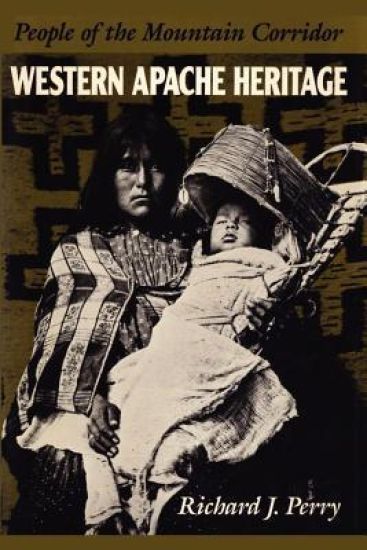
Western Apache Heritage

Western Apache Heritage

Richard J. Perry

University of Texas Press
1991
pokkari
Mention "Apaches," and many Anglo-Americans picture the "marauding savages" of western movies or impoverished reservations beset by a host of social problems. But, like most stereotypes, these images distort the complex history and rich cultural heritage of the Apachean peoples, who include the Navajo, as well as the Western, Chiricahua, Mescalero, Jicarilla, Lipan, and Kiowa Apaches. In this pioneering study, Richard Perry synthesizes the findings of anthropology, ethnology, linguistics, archaeology, and ethnohistory to reconstruct the Apachean past and offer a fuller understanding of the forces that have shaped modern Apache culture.While scholars generally agree that the Apacheans are part of a larger group of Athapaskan-speaking peoples who originated in the western Subarctic, there are few archaeological remains to prove when, where, and why those northern cold dwellers migrated to the hot deserts of the American Southwest. Using an innovative method of ethnographic reconstruction, however, Perry hypothesizes that these nomadic hunters were highly adaptable and used to exploiting the resources of a wide range of mountainous habitats. When changes in their surroundings forced the ancient Apacheans to expand their food quest, it was natural for them to migrate down the "mountain corridor" formed by the Rocky Mountain chain.This reconstruction of Apachean history and culture sheds much light on the origins, dispersions, and relationships of Apache groups. Perry is the first researcher to attempt such an extensive reconstruction, and his study is the first to deal with the full range of Athapaskan-speaking peoples. His method will be instructive to students of other cultures who face a similar lack of historical and archaeological data.
Apache Reservation

Apache Reservation

Richard J. Perry

University of Texas Press
1993
pokkari
"Indian reservations" were the United States' ultimate solution to the "problem" of what to do with native peoples who already occupied the western lands that Anglo settlers wanted. In this broadly inclusive study, Richard J. Perry considers the historical development of the reservation system and its contemporary relationship to the American state, with comparisons to similar phenomena in Canada, Australia, and South Africa.The San Carlos Apache Reservation of Arizona provides the lens through which Perry views reservation issues. One of the oldest and largest reservations, its location in a minerals- and metals-rich area has often brought it into conflict with powerful private and governmental interests. Indeed, Perry argues that the reservation system is best understood in terms of competition for resources among interest groups through time within the hegemony of the state. He asserts that full control over their resources-and hence, over their lives-would address many of the Apache's contemporary economic problems.
From Time Immemorial

From Time Immemorial

Richard J. Perry

University of Texas Press
1996
pokkari
Around the globe, people who have lived in a place "from time immemorial" have found themselves confronted by and ultimately incorporated within larger state systems. During more than three decades of anthropological study of groups ranging from the Apache to the indigenous peoples of Kenya, Richard J. Perry has sought to understand this incorporation process and, more importantly, to identify the factors that drive it. This broadly synthetic and highly readable book chronicles his findings.Perry delves into the relations between state systems and indigenous peoples in Canada, the United States, Mexico, and Australia. His explorations show how, despite differing historical circumstances, encounters between these state systems and native peoples generally followed a similar pattern: invasion, genocide, displacement, assimilation, and finally some measure of apparent self-determination for the indigenous people-which may, however, have its own pitfalls.After establishing this common pattern, Perry tackles the harder question-why does it happen this way? Defining the state as a nexus of competing interest groups, Perry offers persuasive evidence that competition for resources is the crucial factor in conflicts between indigenous peoples and the powerful constituencies that drive state policies.These findings shed new light on a historical phenomenon that is too often studied in isolated instances. This book will thus be important reading for everyone seeking to understand the new contours of our postcolonial world.
Killer Apes, Naked Apes, and Just Plain Nasty People

Killer Apes, Naked Apes, and Just Plain Nasty People

Richard J. Perry

Johns Hopkins University Press
2015
sidottu
We like to think that science always illuminates. But the disturbing persistence of the concept of biological determinism-the false idea that human behavior is genetically fixed or inherently programmed and therefore is not susceptible to rapid change-shows that scientific research and concepts can be distorted to advance an inhumane and sometimes deadly political agenda. It was biological determinism that formed the basis of the theory of eugenics, which in turn led to the forced sterilization of "misfits" and the creation of Nazi death camps. In Killer Apes, Naked Apes, and Just Plain Nasty People, anthropologist Richard J. Perry delivers a scathing critique of determinism. Exploring the historical context and enduring popularity of the movement over the past century and a half, he debunks the facile and the reductionist thinking of so many popularizers of biological determinism while considering why biological explanations have resonated in ways that serve to justify deeply conservative points of view. Moving through time, from the prevalence of overt racism in the late nineteenth and early twentieth centuries to "human nature" arguments, from the rise of sociobiology in the 1970s to the current fixation on evolutionary psychology, the book argues that both history and cross-cultural studies amply demonstrate the human capacity for growth and self-determination. Clearly written, conversational, and rationally argued, this book promotes sound and careful research while skewering the bogus ideological assertions that have been used to justify colonialism, slavery, gender discrimination, neoliberal economic policies, and the general status quo.