Kirjojen hintavertailu. Mukana 11 244 527 kirjaa ja 12 kauppaa.

Kirjahaku

Etsi kirjoja tekijän nimen, kirjan nimen tai ISBN:n perusteella.

4 kirjaa tekijältä Richard Kenneth Atkins

Charles S. Peirce's Phenomenology

Charles S. Peirce's Phenomenology

Richard Kenneth Atkins

Oxford University Press Inc
2019
sidottu
No reasonable person would deny that the sound of a falling pin is less intense than the feeling of a hot poker pressed against the skin, or that the recollection of something seen decades earlier is less vivid than beholding it in the present. Yet John Locke is quick to dismiss a blind man's report that the color scarlet is like the sound of a trumpet, and Thomas Nagel similarly avers that such loose intermodal analogies are of little use in developing an objective phenomenology. Charles Sanders Peirce (1839-1914), by striking contrast, maintains rather that the blind man is correct. Peirce's reasoning stems from his phenomenology, which has received little attention as compared with his logic, pragmatism, or semiotics. Peirce argues that one can describe the similarities and differences between such experiences as seeing a scarlet red and hearing a trumpet's blare or hearing a falling pin and feeling a hot poker. Drawing on the Kantian idea that the analysis of consciousness should take as its guide formal logic, Peirce contends that we can construct a table of the elements of consciousness, just as Dmitri Mendeleev constructed a table of the chemical elements. By showing that the elements of consciousness fall into distinct classes, Peirce makes significant headway in developing the very sort of objective phenomenology which vindicates the studious blind man Locke so derides. Charles S. Peirce's Phenomenology shows how his phenomenology rests on his logic, gives an account of Peirce's phenomenology as science, and then shows how his work can be used to develop an objective phenomenological vocabulary. Ultimately, Richard Kenneth Atkins shows how Peirce's pioneering and distinctive formal logic led him to a phenomenology that addresses many of the questions philosophers of mind continue to raise today.
Peirce on Inference

Peirce on Inference

Richard Kenneth Atkins

OXFORD UNIVERSITY PRESS INC
2023
sidottu
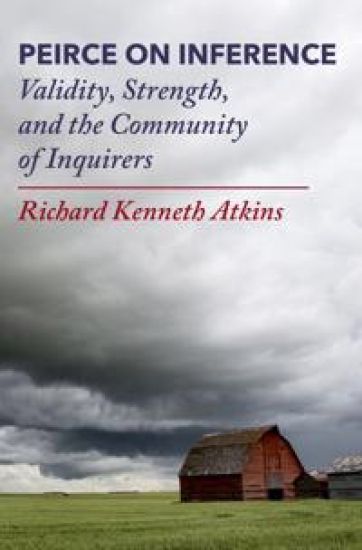
Above all other titles, Charles Sanders Peirce (1839-1914) prized that of logician. He thought of logic broadly, such that it includes not merely formal logic but an examination of the entire process of inquiry. His works are replete with detailed investigations into logical questions. Peirce is especially concerned to show that valid inferential processes, diligently followed, will eventually root out error and alight on the truth. Peirce on Inference draws together diverse strands from Peirce's lifelong reflections on logic in order to develop a comprehensive perspective on Peirce's theory of inference. Peirce argues that each genus of inference--deduction, induction, and abduction--has a different truth-producing virtue. An inference is valid just in case the procedure used in fact has the truth-producing virtue claimed for it and the person making the inference adheres to the procedure. In successive chapters, this book shows how Peirce supports the thesis that these genera of inference have the truth-producing virtues claimed for them and how Peirce responds to objections. Among the objections given consideration are the liar paradox, Hume's problem of induction, Goodman's new riddle of induction, that this may be a chance world, and that we are incapable of conceiving the true hypothesis. The book defends several controversial theses, including that Peirce does not so strongly object to Bayesianism as is sometimes claimed and that prior to 1900 Peirce had no explicit theory of abduction. It also proposes a novel account of abduction.
Puzzled?!

Puzzled?!

Richard Kenneth Atkins

Hackett Publishing Co, Inc
2015
nidottu
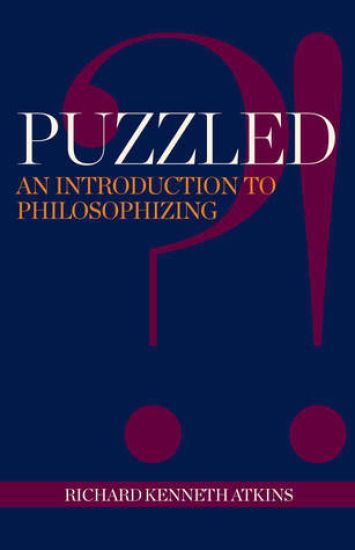
Puzzled?! seamlessly fuses two traditional approaches to the study of philosophy at the introductory level. It is thematic, examining fundamental issues in epistemology, metaphysics, philosophy of religion, and more. It is also historical, introducing major philosophical arguments that have arisen throughout the history of Western philosophy. But its real innovation lies elsewhere. Each of its twelve chapters begins with a traditional argument of a thoroughly puzzling kind: a valid philosophical argument with highly plausible premises but a surprising conclusion. The remainder of the chapter shows how major innovations in the history of philosophy arise as logical responses to that argument. Written with a light touch, Puzzled?! nevertheless offers a rigorous introduction to the ideas it explores and to the foundations of critical thinking itself. It will serve as effectively as a main or supplementary text in an introduction to critical thinking as it will in Philosophy 101.
Puzzled?!

Puzzled?!

Richard Kenneth Atkins

Hackett Publishing Co, Inc
2015
sidottu
Puzzled?! seamlessly fuses two traditional approaches to the study of philosophy at the introductory level. It is thematic, examining fundamental issues in epistemology, metaphysics, philosophy of religion, and more. It is also historical, introducing major philosophical arguments that have arisen throughout the history of Western philosophy. But its real innovation lies elsewhere. Each of its twelve chapters begins with a traditional argument of a thoroughly puzzling kind: a valid philosophical argument with highly plausible premises but a surprising conclusion. The remainder of the chapter shows how major innovations in the history of philosophy arise as logical responses to that argument. Written with a light touch, Puzzled?! nevertheless offers a rigorous introduction to the ideas it explores and to the foundations of critical thinking itself. It will serve as effectively as a main or supplementary text in an introduction to critical thinking as it will in Philosophy 101.