Kirjojen hintavertailu. Mukana 11 342 296 kirjaa ja 12 kauppaa.

Kirjahaku

Etsi kirjoja tekijän nimen, kirjan nimen tai ISBN:n perusteella.

6 kirjaa tekijältä Richard L. Lippke

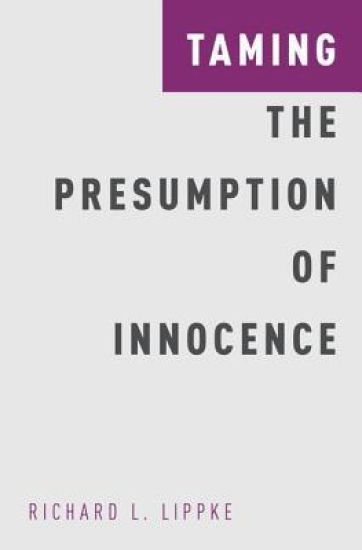
Taming the Presumption of Innocence

Taming the Presumption of Innocence

Richard L. Lippke

Oxford University Press Inc
2016
sidottu
The notion that an individual accused of a crime is presumed innocent until proven guilty is one of the cornerstones of the American criminal justice system. However, the presumption of innocence creates a number of practical and theoretical issues, particularly regarding pre-trial and post-trial processes. In Taming the Presumption of Innocence, Richard L. Lippke argues that the presumption of innocence should be contained to the criminal trial. Beyond the realm of the trial, legal professionals, investigators, and the general public should carry out their respective roles in the criminal justice process without making any presumptions about guilt or innocence whatsoever. Rather than eschewing the significance of the presumption of innocence, the book defends its role within its proper context, the criminal trial. According to Lippke, other aspects of the criminal justice system such as investigation, lawmaking, and treatment of ex-offenders should be conducted in such a way that reflects the fallibility and unpredictability of the system without involving the issue of presumed guilt or innocence. Lippke dispels the idea that the presumption of innocence can be used to remedy some of the current issues in the practice of criminal justice, and instead proposes engaging in deeper, more substantive reforms of the American criminal justice system. The first monograph dedicated exclusively to the presumption of innocence, Taming the Presumption of Innocence will be an ideal text for students and scholars of criminology, criminal justice, and legal theory.
Rethinking Imprisonment

Rethinking Imprisonment

Richard L. Lippke

Oxford University Press
2007
sidottu
Drawing on philosophical arguments, criminological evidence, and the legal literature on prisoners' rights, Rethinking Imprisonment defends a normative theory of imprisonment. Such a theory provides an account of the justified conditions of prison confinement - the restrictions and deprivations that may be legitimately imposed on serious offenders in the name of punishment. The theory of legal punishment upon which this account builds combines retributive and crime reduction elements, with the former accorded priority on both moral and epistemic grounds. Contrary to its formidable reputation, retributivism is shown to place important and substantial limits on the character of imprisonment, its appropriate use, and duration. Much of the contemporary use of imprisonment as a legal sanction is arguably unjustified on all three counts. Rethinking Imprisonment urges the adoption of prison conditions at or near the 'minimum conditions of confinement' which severely curtail the freedom of movement, freedom of association, and privacy of prisoners, yet are still consistent with ensuring the basic physical and psychological welfare of prisoners, and provide them with access to paid labor, visitation, entertainment, recreation, and retained civic and political rights. This book argues firstly that the punishment of serious offenders generally requires no more than the imposition of 'minimum conditions of confinement' and secondly that moral constraints on punishment derived from retributivism in conjunction with the available evidence about the prison regimes most likely to reduce crime point towards more humane and less restrictive prisons.
The Ethics of Plea Bargaining

The Ethics of Plea Bargaining

Richard L. Lippke

Oxford University Press
2011
sidottu
The practice of plea bargaining plays a hugely significant role in the adjudication of criminal charges and has provoked intense debate about its legitimacy. This book offers the first full-length philosophical analysis of the ethics of plea bargaining. It develops a sustained argument for restrained forms of the practice and against the free-wheeling versions that predominate in the United States. In countries that have endorsed plea bargains, such as the United States, upwards of ninety percent of criminal defendants plead guilty rather than go to trial. Yet trials, which grant a presumption of innocence to defendants and place a substantial burden of proof on the state to establish guilt, are widely regarded as the most appropriate mechanisms for fairly and accurately assigning criminal sanctions. How is it that many countries have abandoned the formal rules and rigorous standards of public trials in favor of informal and veiled negotiations between state officials and criminal defendants concerning the punishment to which the latter will be subjected? More importantly, how persuasive are the myriad justifications that have been provided for plea bargaining? These are the questions addressed in this book. Examining the legal processes by which individuals are moved through the criminal justice system, the fairness of those processes, and the ways in which they reproduce social inequality, this book offers an ethical argument for restrained forms of plea bargaining. It also provides a comparison between the different plea bargaining regimes that exist within the US, where it is well-established, England and Wales, where the practice is coming under considerable critique, and the European Union, where debate continues on whether it coheres with inquisitorial legal regimes. It suggests that rewards for admitting guilt are distinguished from penalties for exercising the right to trial, and argues for modest, fixed sentence reductions for defendants who admit their guilt. These suggestions for reform include discouraging the current practice of deliberate over-charging by prosecutors and charge bargaining, and require judges to scrutinize more closely the evidence against those accused of crimes before any guilty pleas are entered by them. Arguing that the negotiation of charges and sentences should remain the exception, not the rule, it nevertheless puts forward a normative defense for the reform and retention of the plea bargaining system.
Radical Business Ethics

Radical Business Ethics

Richard L. Lippke

Rowman Littlefield
1995
sidottu
Arguing against most scholars of business ethics who have articulated a set of moral principles and applied them to problems faced by business people, Richard Lippke steers away from offering moral directives. In Radical Business Ethics, he develops a more comprehensive perspective on business issues that is tied to larger questions of social justice. Analyzing a select group of timely issues such as advertising, employee privacy, and insider trading in the context of debates about the nature of the just society, Lippke argues that the most plausible theory of justice is one whose implications are highly critical of many features of advanced capitalist societies. Radical Business Ethics will be an eye-opening book for students and scholars of ethics, and anyone interested in the role business plays in a just society.
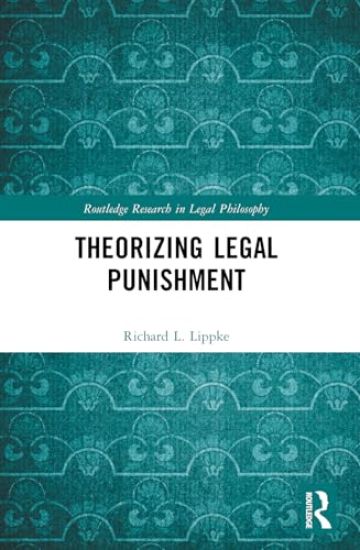
Theorizing Legal Punishment

Theorizing Legal Punishment

Richard L. Lippke

TAYLOR FRANCIS LTD
2025
nidottu
This book systematically defends an account of the institution of legal punishment that draws on both retributive and crime-prevention thinking.The work argues that legal punishment censures convicted offenders and thus morally communicates with them, any victims, and the broader community, while also serving to reduce future crime. The expressive or retributive element is assigned the lead role in this mixed account because it better captures the notion that members of society are to be held morally accountable for their failures to abide by defensible criminal prohibitions of various kinds. Despite this, it is conceded that the reduction of crime plays a vital role in justifying the institution of legal punishment and the book contains extended discussion of how and why this is so. Beyond its explication of the aims of legal punishment and their respective roles within a mixed theory, the study devotes separate chapters to sentencing, criminal procedure, and the imposition of fees and collateral legal consequences on individuals who have been convicted of crimes and fully served their sentences. In these ways, the work moves beyond discussion of the abstract aims of legal punishment to details of the institution’s internal structure and operations. The many historical deficiencies and failures of the institution are duly noted and the challenges they pose for punishment theorizing are examined.The book closes with discussion of the limited success of punishment institutions in apprehending, convicting, and punishing those who violate the law, including many who do so in serious ways. Alternatives to reliance on legal punishment institutions are briefly examined. In the end, retention of such institutions is urged although it is suggested that we ought to have modest expectations about their ultimate success. The work will be of interest to those working in the areas of Legal Philosophy and Criminology.
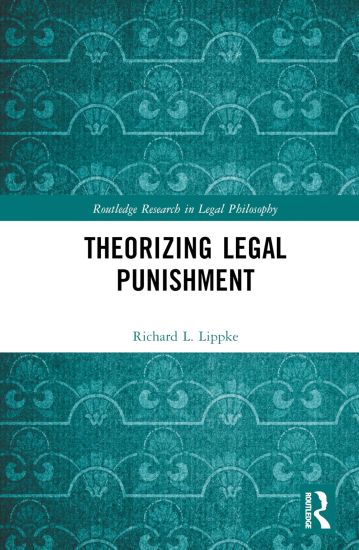
Theorizing Legal Punishment

Theorizing Legal Punishment

Richard L. Lippke

TAYLOR FRANCIS LTD
2024
sidottu
This book systematically defends an account of the institution of legal punishment that draws on both retributive and crime-prevention thinking.The work argues that legal punishment censures convicted offenders and thus morally communicates with them, any victims, and the broader community, while also serving to reduce future crime. The expressive or retributive element is assigned the lead role in this mixed account because it better captures the notion that members of society are to be held morally accountable for their failures to abide by defensible criminal prohibitions of various kinds. Despite this, it is conceded that the reduction of crime plays a vital role in justifying the institution of legal punishment and the book contains extended discussion of how and why this is so. Beyond its explication of the aims of legal punishment and their respective roles within a mixed theory, the study devotes separate chapters to sentencing, criminal procedure, and the imposition of fees and collateral legal consequences on individuals who have been convicted of crimes and fully served their sentences. In these ways, the work moves beyond discussion of the abstract aims of legal punishment to details of the institution’s internal structure and operations. The many historical deficiencies and failures of the institution are duly noted and the challenges they pose for punishment theorizing are examined.The book closes with discussion of the limited success of punishment institutions in apprehending, convicting, and punishing those who violate the law, including many who do so in serious ways. Alternatives to reliance on legal punishment institutions are briefly examined. In the end, retention of such institutions is urged although it is suggested that we ought to have modest expectations about their ultimate success. The work will be of interest to those working in the areas of Legal Philosophy and Criminology.