Kirjojen hintavertailu. Mukana 11 627 067 kirjaa ja 12 kauppaa.

Kirjahaku

Etsi kirjoja tekijän nimen, kirjan nimen tai ISBN:n perusteella.

2 kirjaa tekijältä Richard M. Berrong

In Love with a Handsome Sailor

In Love with a Handsome Sailor

Richard M. Berrong

University of Toronto Press
2003
sidottu
Writing at first anonymously and later under the pen name Pierre Loti, French author Julien Viaud (1850-1923) produced a series of fictions that sympathetically portrayed male same-sex desire and its accompanying societal conflicts. Due to the constraints of the time, Viaud had to develop various strategies for discussing his subject covertly; his success in doing so is demonstrated by the great critical and commercial success he enjoyed during his lifetime, which included his election to the French Academy at age forty-one. Richard Berrong presents a gay reading of the novels and novellas of Julien Viaud, chronologically tracing his development of a distinct homosexual identity and the strategies that he employed to discuss it in a way that would not be obvious to the general public. In so doing, Berrong asserts that Viaud's development of a homosexual identity undermined and realigned dominant constructions of masculinity, presented the need for gay community, and elaborated the role of literature for gay men. The first book-length gay reading of Viaud's corpus, this work will make an important contribution not only to the study of Viaud, but also to the study of gay and lesbian history, culture, and literature.
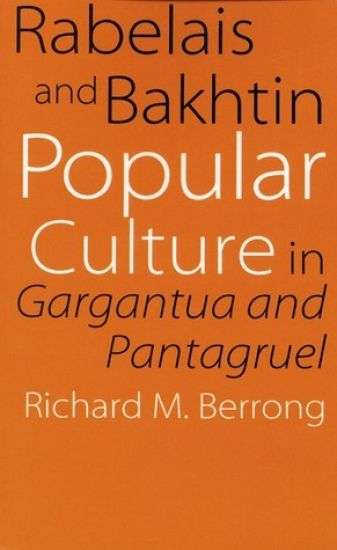
Rabelais and Bakhtin

Rabelais and Bakhtin

Richard M. Berrong

University of Nebraska Press
2006
pokkari
In Rabelais and Bakhtin, Richard M. Berrong demonstrates both the historical and textual weaknesses of the argument advanced by Mikhail Bakhtin and his influential study Rabelais and His World. The publication of Bakhtin's book in the West in the late 1960s brought both Rabelais and Bakhtin to the attention of students interested in the "New Criticism" in literature. Bakhtin agrued that the key to Rabelais's narratives was to be found in their language of popular culture, which was intended to free his readers from the ideological "prison house" of official, establishment discourse; to provide them with a nonofficial perspective from which to view—and combat—the establishment and its institutions. Since the publication of Bakhtin's study, scholars such as Peter Burke, Natalie Zemon Davis, and Carlo Ginzburg have shown that the relationship of the upper classes to popular culture changed in the first half of the sixteenth century. Previously these classes had participated fully in the culture of the people (while adhering to their own), but at that time they undertook to exclude popular culture from their lives and from their world. In his refutation of Bakhtin's thesis, Berrong demonstrates the complex and shifting role of popular culture in Rabelais's narratives. His conclusions should interest not only readers of Gargantua and Pantagruel but all students of the sixteenth century, since the use and exclusion of popular culture is an issue in the study of many of the writers, artists, and composers of the period.