Kirjojen hintavertailu. Mukana 11 244 527 kirjaa ja 12 kauppaa.

Kirjahaku

Etsi kirjoja tekijän nimen, kirjan nimen tai ISBN:n perusteella.

68 kirjaa tekijältä Richard Nelson

A Chronology and Glossary of Propaganda in the United States
The first of three volumes that will serve as a comprehensive and inclusive finding tool, this work defines propaganda in an uncertain postmodern information age. Linked to the U.S. Constitution, mass media, and business, the role propaganda plays must be understood in terms of an information-based economy. An extensive chronology of propaganda-related events, plus an A-Z guide defining hundreds of important terms (some ill-defined in context, such as backdoor contact and spin doctor), combine to meet an immediate need for an easy-to-use resource that not only credibly defines the field but stimulates new research. Americans have had a love-hate relationship with propaganda since before the nation itself existed. The thesis of this work is that propaganda is as American as apple pie. The right to persuade and communicate is enshrined in the First Amendment to the U.S. Constitution. The technologies and business aspects of mass media that shape culture around the world were perfected in America; hundreds of thousands of people find employment in various persuasion industries. Propaganda is becoming even more essential to maintaining social cohesion in a multiculturally diverse society. The three volumes in this series act as a finding tool that distinctively crossed over artificial barriers to open new approaches to understanding the phenomenon that defines our time. This work clarifies what propaganda is or is not as it knives through the confusion surrounding the imprecise terminology and lack of historical background to often associated with its study.
The Apple Family: A Pandemic Trilogy

The Apple Family: A Pandemic Trilogy

Richard Nelson

Faber Faber
2021
nidottu
These three plays were written and performed over the memorable summer of 2020. Forced into isolation as the pandemic raged and protests against racism spread after the murder of George Floyd, the Apple Family of Rhinebeck, New York, gather over Zoom to share meals and weather the storms. Together, virtually, they swap jokes, stories and their adventures with grocery shopping and dating; they reveal their depression and fears, they mourn lost friends and even watch a dance performance, as the world outside sputters out of control, amidst anger, illness, and a coming election.With an introduction and afterword by the author.
An Actor Convalescing in Devon

An Actor Convalescing in Devon

Richard Nelson

FABER FABER
2024
nidottu
He told me about some bloke who was sick and then got well - by placing a poem by William Blake in his shirt pocket . . . Heading for the West Country by train, an actor takes the scenic route from Waterloo to spend a weekend with an old friend. He recalls staying there one summer with his late partner Michael, another actor. Glad to be alive but uncertain of his future, he shares stories and his thoughts about Shakespeare, friends, his career and the trials of his own health. Richard Nelson's funny and compelling monologue opened at Hampstead Theatre, London, in March 2024.
Joshua

Joshua

Richard Nelson

Westminster/John Knox Press,U.S.
1997
nidottu
The book of Joshua has many textual problemsprimarily differences between the Hebrew and Greek texts. Much of the inconsistency stems from the varied forms of storytelling in the book, including the war narratives, folktales, sermons, and city lists. In this commentary, now available in a new casebound edition, Richard D. Nelson addresses Joshua's textual issues while offering historical, literary, and theological insights.The Old Testament Library provides fresh and authoritative treatments of important aspects of Old Testament study through commentaries and general surveys. The contributors are scholars of international standing.
Heart and Blood: Living with Deer in America
"When it comes to deer, wildness is the greatest truth. And tameness is a tender, innocent lie." So writes Richard Nelson, award-winning author of The Island Within, in this far-ranging and deeply personal look at our complex relationship with this most beautiful, but amazingly elusive, creature.Heart and Blood: Living with Deer in America begins with the author tracking a deer on a remote island off the Alaskan coast. From there he takes us on a kaleidoscopic journey, visiting such disparate territories of the deer as a hunting ranch in Texas; a state park in California; a Wisconsin forest on opening day of the hunting season; Fire Island, New York; and the suburbs of Denver--where the deer have become so numerous that they pose hazards to landscape, motorist, and pedestrian alike. Nelson examines the physiology of the deer, explaining how its unique digestive system and grazing habits have enabled it to thrive in the varied environments of the United States, whether wild, suburban, or urban. He investigates the different methods of controlling the deer's skyrocketing numbers, from the more "humane methods of relocation and sterilization, to hunting--in all its forms. Nelson also explores the role of the deer in traditional Native American life, takes us with him on a hunt, and awes us as he witnesses the birth of a fawn--an event rarely seen by humans. By the end of this journey we understand the deep reverence in which the author holds this magnificent animal. For to know the deer is to glimpse the hidden heart of wildness itself. In Heart and Blood, Richard Nelson has produced a book of outstanding insight and intelligence that brings us closer to our natural world and, in the process, closer to our own true nature
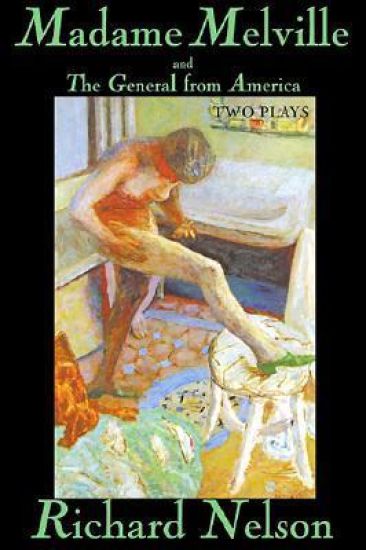
Madame Melville and the General from America
Long an associate of the Royal Shakespeare Company, American playwright Richard Nelson has been praised by critics on both sides of the Atlantic, and has been awarded the Olivier Award for his play Goodnight Children Everywhere and a Tony Award for his adaptation of James Joyce's "The Dead." Included in this volume are his latest play, Madame Melville, which received rave reviews during its London run starring Macaulay Culkin and Irene Jacob, and The General from America, which ponders the emotional conflicts that Benedict Arnold faced before deciding to hand over George Washington to the British. Madame Melville, set in Paris in 1966, before that city exploded in protest, presents the story of a fifteen-year-old American, Carl, and his beautiful teacher, Claudie Melville. The Daily Telegraph praised Madame Melville as "a play about art, music, friendship and the irrecoverable, unforgettable moment when an adolescent realizes that the world is full of wonder." The General from America provides a rich portrait of Benedict Arnold. Nelson's account of Arnold's search for love and country, and his discovery of only compromise and despair, will haunt readers and audiences.
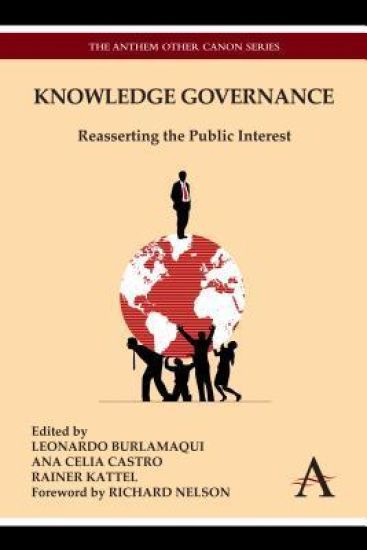
Knowledge Governance

Knowledge Governance

Richard Nelson

Anthem Press
2012
sidottu
This book argues that the current international intellectual property rights regime, led by the World Trade Organization (WTO), has evolved over the past three decades toward overemphasizing private interests and seriously hampering public interests in access to knowledge and innovation diffusion. This approach concentrates on tangible and codified knowledge creation and diffusion in research and development (R&D) that can be protected via patents and other intellectual property rules and regulations. In terms of global policy initiatives, however, it is becoming increasingly clear that the WTO in particular is mostly a conflict-resolution facility rather than a global governance body able to generate cooperation and steer international coordinated policy action. At the same time, rent extraction and profits streaming from legal hyperprotection have become pervasively important for firm strategies to compete in a globalized marketplace. “Knowledge Governance: Reasserting the Public Interest” offers a novel approach – knowledge governance – in order to move beyond the current regime.
Conversations in Tusculum

Conversations in Tusculum

Richard Nelson

Farrar Strauss Giroux-3pl
2008
pokkari
A riveting new work about power and the abuse of power in ancient Rome that has startling resonance with our age, Conversations in Tusculum reimagines the intense interaction among Brutus, Cassius, and Cicero leading up to the assassination of Julius Caesar, the leader they had once followed into battle but whom they have come to despise. Passionate in their beliefs but torn by their sense of loyalty, they struggle to continue believing in him despite their fear that his actions may pose great dangers to the nation. Conversations in Tusculum had its world premiere at the Public Theater in New York City in March 2008."
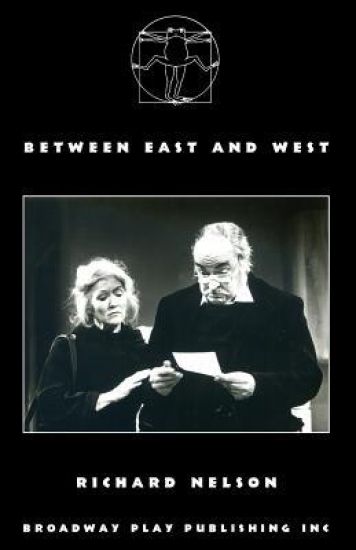
Between East And West

Between East And West

Richard Nelson

Broadway Play Publishing
1989
nidottu
BETWEEN EAST AND WEST portrays a middle-aged Czech migr couple struggling to adapt to a new country. "The title of Richard Nelson's unsettling new play is deliberately misleading. East-West politics do, however, provide the backdrop and premise of the play: It concerns the experience of a Czech couple forced for political reasons to emigrate to New York. The problems they face in exile, Nelson suggests, have as much to do with the residual gap between America and Europe as with that between East and West. But the focus is on the conflict between Gregor and Erna, the two exiles, themselves. In his careful study of their relationship, Nelson reminds us that power and freedom cannot be understood in purely political terms." Sally Laird, Times Literary Supplement "Its subject is homesickness: that love which cannot bear to speak its name because it's more private than any other emotion. The setting is a one-room flat in New York, but the real setting is the no-man's land between the home they lost and the one they'll never really find... I liked this painful, moving, compassionate play; I liked the way it stated its point obliquely, but with a hard, unsentimental edge. I liked its wise humor, and its shrewd sense of what it's like to be middle-aged, uprooted, resentful, determined, and difficult." John Peter, London Sunday Times
Franny's Way

Franny's Way

Richard Nelson

Broadway Play Publishing
2003
nidottu
Summer, 1957. The streets of Greenwich Village sizzle with the insistent rhythm of jazz. Accompanied by their grandmother, two teenage sisters from the country visit their married cousin in the city. Soon, the young women have embarked on their own private missions involving love, a forgotten child, and a lost mother. Set against the bustling backdrop of New York at mid-century, FRANNY'S WAY is a sensual, provocative ode to desire, longing, and the bittersweet collision of youth and adulthood. "Boundaries warp and melt in the dense urban heat that pervades FRANNY'S WAY, Richard Nelson's sensitively drawn portrait of love in the age of J D Salinger. The lines between childhood and adulthood blur disorientingly for the three generations of characters gathered in a cramped apartment in Greenwich Village at the height of summer in the 1950s ... Mr Nelson is again exploring a shadowy sexuality with which some theatergoers may not be entirely at ease ... FRANNY'S WAY is a wry, rueful and forgiving look at the ways people turn to one another for solace when they feel they have lost their bearings. Sex, as the interplay among the characters gently and insistently reminds you, may be a primal drive, but it doesn't always follow a straight course. Mr Nelson continues to give compassionate and insightful life to such erotic waywardness." -Ben Brantley, The New York Times "... one of the deftest achievements of Nelson's taut script is his crafting a dialogue of indirection. Hurts and jealousies roil beneath petty arguments over hogging time in the bathroom. Primal longings for affection well up in comments about the steamy jazz wafting in from a club beneath the window." -Alisa Solomon, Village Voice
Left

Left

Richard Nelson

Broadway Play Publishing
2006
nidottu
The Left is personified in Richard Nelson's idealistic and intellectual characters, whose fascinating friendships are as fraught as the political history through which they've lived. "You can't watch LEFT] without thinking about Lillian Hellman, Mary McCarthy, and Diana Trilling. Richard Nelson ... hasn't brought the famous, undignified Hellman/McCarthy/Trilling feud directly onstage, but he invokes their noisy ghosts. They resonate. It's uncanny. Imagine I'M NOT RAPPAPORT with Simon Gray's wit and Doris Lessing's brains. We first meet Marianne, a retired college president, and Eddie, who writes essays on pornography for The New York Review of Books, in the Adirondacks. They are waiting for Elinor, an editor at a Manhattan publishing house, to arrive by motorboat and explain her memoir. In her memoir, Elinor savages her oldest friend, Marianne, as typical of a whole class of I'm-all-right-Jack Upper West side intellectuals who betrayed their youthful idealism in the dreary Cold War years. Eddie, an ex-husband as well as an ex-radical, has been deleted, even from Elinor's index. From the beginning of their m nage trois, Eddie has always been the odd man out. LEFT] is as much consumed by female friendship as it is by left history. Almost immediately, we flash back fifty years to their first visit to the Adirondacks, fresh from college politics in the middle of the Spanish Civil War, looking for money to start a magazine a lot like Partisan Review. We'll go back and forth the rest of the play, until all six of them, the pure of heart and their revised editions, are in the same room, at the same time, a crowd of regrets. These people talk about Joseph Stalin and the Sierra Club, Amnesty International and Saran Wrap, South Africa and skinny-dipping. What they're really talking about is friendship in history. If the person is political, how much so, at what cost and is there any forgiveness? I felt like a spy, switching sides so often in my sympathies." -John Leonard, New York Magazine