Kirjojen hintavertailu. Mukana 12 016 292 kirjaa ja 12 kauppaa.

Kirjahaku

Etsi kirjoja tekijän nimen, kirjan nimen tai ISBN:n perusteella.

21 kirjaa tekijältä Richard Robinson

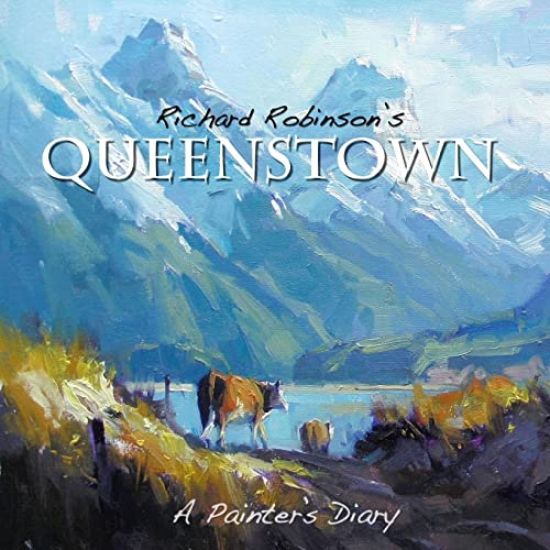
Richard Robinson's Queenstown

Richard Robinson's Queenstown

Richard Robinson

Lulu.com
2014
pokkari
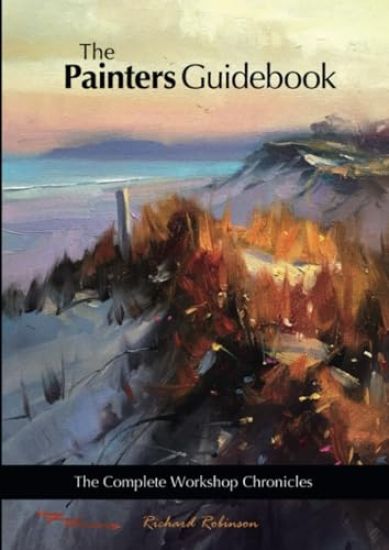
What does an artist learn from 3 months in a painter's paradise? In 2014 New Zealand artist Richard Robinson visited the Queenstown area of New Zealand for 3 months to paint some of the most spectacular scenery on the planet. It's a tough job, but someone's got to do it. This book is a painter's diary - a collection of thoughts, realisations, notes, techniques and even an epiphany or two, written to inspire and enlighten any landscape painter or art lover with a thirst for adventure and practical painting know-how. Enjoy.
International Business Policy

International Business Policy

Richard Robinson

Praeger Publishers Inc
1982
sidottu
This study develops the calculus which, if used in selecting overseas projects, structuring international enterprises, and resolving operatonal problems, would reduce the area of conflict in business and become a more viable international concept.
Business History of the World

Business History of the World

Richard Robinson

Greenwood Press
1993
sidottu
The first chronology of worldwide business history, this volume complements Robinson's earlier chronology, United States Business History, 1602-1988. It provides a basic chronology of the business world outside the United States from prehistory through the 1980s. It records representative events in the evolution of business, identifying entrepreneurs, managers, and enterprises, and also records general background events relevant to the marketplace. The volume includes indexes of names, places, and subjects.
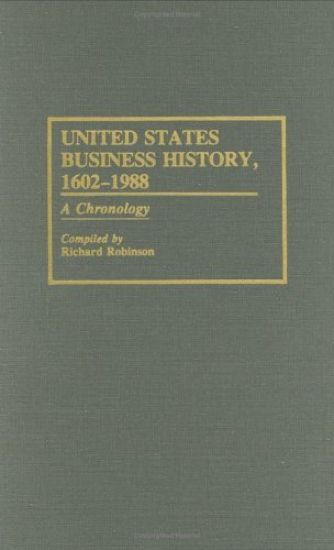
United States Business History, 1602-1988

United States Business History, 1602-1988

Richard Robinson

Greenwood Press
1990
sidottu
This unique volume provides a survey of U.S. business history in a chronological framework. Designed as a basic chronology of representative events, the work covers the years from 1602 to 1988, presenting those events that pioneered trends and those that represented what was generally happening at a particular time. Richard Robinson has included minor details and incidents that are often missed in other histories of business and has arranged the descriptive historical data in a way that allows readers to draw their own conclusions about the trends and impact of American business.Each chronological entry is divided into two sections. The first covers general events, describing the changes in lifestyles and living conditions that affected business and the marketplace. Economic conditions, government actions, educational developments, social indicators, union activities, and inventions are included here, as are certain articles and books that note the concerns of a particular time. The second section covers business events, charting the rise and fall of those enterprises engaged in producing goods or providing services. Small companies are featured alongside conglomerates, and wherever possible, the chronology focuses on the colorful individuals--the entrepreneurs, financiers, promoters, and others--who played such an important role in American business. With its chronological presentation, the book not only offers a clear picture of the development of U.S. business, but also a strong indication of how deeply it is interwoven in the fabric of society. It will be a valuable resource for courses in business history, sociology, and American history, and an important addition to both public and academic libraries.
The Province of Logic

The Province of Logic

Richard Robinson

Routledge
2019
sidottu
Originally published in 1931. This inquiry investigates and develops John Cook Wilson’s view of the province of logic. It bases the study on the posthumous collected papers Statement and Inference. The author seeks to answer questions on the nature of logic using Cook Wilson’s thought. The chapters introduce and consider topics from metaphysics to grammar and from psychology to knowledge. An early conception of logic in the sciences and presenting the work of an important twentieth century philosopher, this is an engaging work.
The Province of Logic

The Province of Logic

Richard Robinson

Routledge
2021
nidottu
Originally published in 1931. This inquiry investigates and develops John Cook Wilson’s view of the province of logic. It bases the study on the posthumous collected papers Statement and Inference. The author seeks to answer questions on the nature of logic using Cook Wilson’s thought. The chapters introduce and consider topics from metaphysics to grammar and from psychology to knowledge. An early conception of logic in the sciences and presenting the work of an important twentieth century philosopher, this is an engaging work.
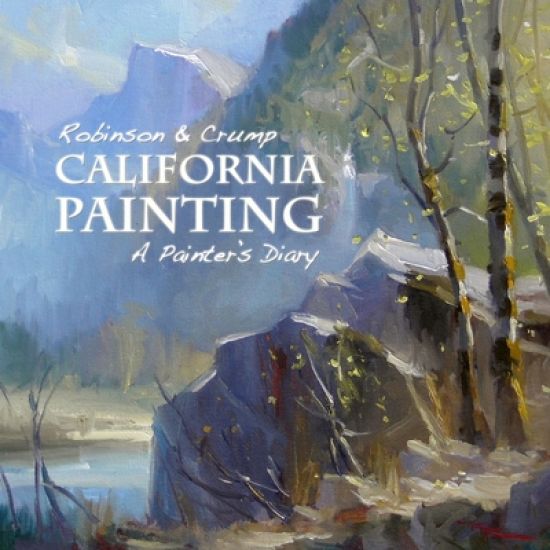
California Painting

California Painting

Richard Robinson

Lulu.com
2013
pokkari
What does an artist learn from 3 weeks in California? In April 2013 New Zealand artists Richard Robinson and John Crump visited California for 3 weeks. For 4 days they were faculty members at the Plein Air Painting Convention in Monterey. The rest of the time they were lost in the landscape. This book is a painter's diary - a collection of thoughts, realisations, notes, techniques and even an epiphany or two, written to inspire and enlighten any landscape painter or art lover with a thirst for adventure and practical painting know-how. Enjoy.
John McGahern and Modernism

John McGahern and Modernism

Richard Robinson

Bloomsbury Academic
2018
nidottu
John McGahern’s work is not easily conceived of as belatedly modernist. His memorialising, faintly archaic style implies a concern with ‘making it old’ rather than new, suggesting the symptomatic diffidence of many who wrote in the wake of modernism. Nevertheless, McGahern’s statements about the ‘presence’ of words and the hard-won impersonality of the artwork point to a covert engagement with modernist aesthetics. Offering intertextual interpretations of McGahern’s six novels, and of thematically grouped short stories, Richard Robinson reads McGahern’s fiction alongside writing by Joyce, Proust, Yeats, Beckett, Nietzsche, Lawrence and Chekhov, amongst others. Drawing out the ways in which McGahern’s fiction conceals and reveals its modernist traces, this study considers subjects such as ‘low’ modernism, the complexity of McGahern’s time-writing and his dialectical construction of the relationship between cultural tradition and modernity in Ireland. McGahern’s narratives of melancholic return are often read psycho-biographically, but they also involve a return to the remnants of literature, including that of the modernist canon. This book will be of interest not only to McGahern scholars but also to those who contemplate the compromised legacies of literary modernism in late-twentieth century and contemporary writing.
John McGahern and Modernism

John McGahern and Modernism

Richard Robinson

Bloomsbury Academic USA
2016
sidottu
John McGahern’s work is not easily conceived of as belatedly modernist. His memorialising, faintly archaic style implies a concern with ‘making it old’ rather than new, suggesting the symptomatic diffidence of many who wrote in the wake of modernism. Nevertheless, McGahern’s statements about the ‘presence’ of words and the hard-won impersonality of the artwork point to a covert engagement with modernist aesthetics. Offering intertextual interpretations of McGahern’s six novels, and of thematically grouped short stories, Richard Robinson reads McGahern’s fiction alongside writing by Joyce, Proust, Yeats, Beckett, Nietzsche, Lawrence and Chekhov, amongst others. Drawing out the ways in which McGahern’s fiction conceals and reveals its modernist traces, this study considers subjects such as ‘low’ modernism, the complexity of McGahern’s time-writing and his dialectical construction of the relationship between cultural tradition and modernity in Ireland. McGahern’s narratives of melancholic return are often read psycho-biographically, but they also involve a return to the remnants of literature, including that of the modernist canon. This book will be of interest not only to McGahern scholars but also to those who contemplate the compromised legacies of literary modernism in late-twentieth century and contemporary writing.
My Manager and Other Animals

My Manager and Other Animals

Richard Robinson

Constable
2014
nidottu
Deep down, we're just like animals. Some of us are selfish like apes. Some are chaotic like ants. . . And somehow the two clash and coalesce in 'antagonistic harmony'. A fascinating look at the evolutionary psychology, instincts and tactics of the workplace.My Manager & Other Animals examines the evolutionary psychology of work, focusing on the office, workshop, corporation or government department, and the complex and fascinating evolutionary tactics that have developed to deal with working life.37 years ago Richard Dawkins wrote The Selfish Gene and it didn't take long for the business community to latch on to the 'selfish' part and adopt it as an industry standard. After all, it fitted in with the notion that, since we are all descended from apes, we should be like them: selfish, aggressive and competitive. More recently, astounding discoveries in human and animal behaviour (particularly ants) have shown that, in all animals, cooperation and altruism is more common than we think and more useful than we could imagine. It seems we contain an inner ape and an inner ant. How confusing; they seem like opposites, because co-operation means helping others, competition means swatting them. What are we, ape or ant? This book shows that ant and ape are both important. Co-operation without leadership is random, leadership without co-operation is slavery. The result of these two colliding is the mad mad mad world of work and life, lovingly described in the book.
Understanding the Financial Industry Through Linguistics

Understanding the Financial Industry Through Linguistics

Richard Robinson

Business Expert Press
2021
pokkari
This book is a user guide to financial services and understanding how the various parts need to interact in order to support a functional marketplace, and is an essential read for both seasoned professionals as well as being accessible to those new to the industry.The author presents a new and unique approach to broad industry issues, unparalleled in the area of data, standards and financial services. This book builds on the premise that the financial industry is highly complex and fragmented and the need to understand the financial industry, so vital to business, professional and individual investors, is best solved through an applied linguistics approach. That is, to break the barriers that exist between language and data with the aim to make it easier to understand how the financial industry and regulators operate for professional individual investors in order to be better served through their enhanced understanding of financial data.At first unconventional in the cross-disciplinary pairing of applied linguistics and data in financial services, it is practical and intuitive in pursuing solutions and outcomes. While focused on financial services, the approach could be leveraged for other industries that have similar challenges.
Why the Toast Always Lands Butter Side Down

Why the Toast Always Lands Butter Side Down

Richard Robinson

Robinson Publishing
2005
nidottu
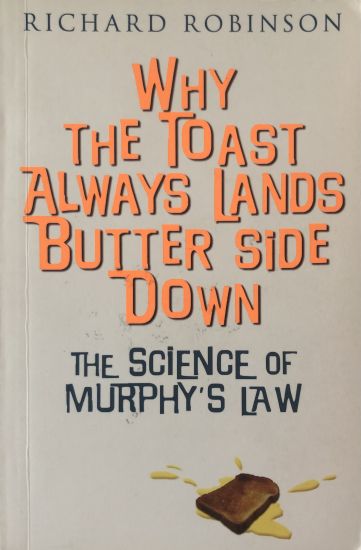
The real, scientific reasons why everything ALWAYS goes wrongThe frustrating component of life known as Murphy's (or Sod's) Law is no respecter of persons. The more you are desperate for things to go right, the more they go wrong. But, is that really the case, and, if so, is there a rational explanation?So: when you drop the toast how do you know it will land butter-side down? Why does the queue you're in always go slowest? That tune you hate - isn't it the one you can't get out of your head? However odd it seems, there is generally a scientific explanation. Much of Murphy's Law stems from the way the mind works - its physical limitations, evolutionary biases and social impressionability. In this fascinating book, popular-science presenter Richard Robinson teases out the answers, accessibly and entertainingly.
Fredegund, France

Fredegund, France

Richard Robinson

Sunny Lou Publishing
2024
pokkari
Fredegund, France is the second book of poetry written by American poet Richard Robinson. The poetry is both modern and not so modern. The theme is France, but a different kind of France than what one might visit today, or yesterday even. Itʼs a France in the mind. Or itʼs a place where France and the mind cross. In his own words, in the preface, the author says: "What can I say, France is to me like a woman, the one that got away maybe, or a vintage bottle of wine that one drank once and could never find again. She is to me what Woman is to Villiers de lʼIsle-Adam]..." As for Villiersʼ concept of Woman, L on Bloy describes it as follows: It has nothing to do with a pleading, with a dithyrambic paranymph, with such and such fawning praise for the dangerous Sex. It has to do with a renewal of earthly Paradise, after the harsh winter of six thousand years. It has to do with rediscovering that famous Garden of Voluptuousness, symbol and accomplishment of Woman, which all men search gropingly for throughout the centuries. The Resurrection of Villiers...]That is what Fredegund, France is, and as the author says, it is "very banal."Here is an excerpt from the volume, the poem Laus Perennis: And gone are the days of gestes, and tonnesOf cider, or ambrosia, or fermented meadQuaffed between daybreak and 3, and the needFor damsels in forgotten towers to get undone, The Veleda, and the hordes of blonde leudes, Lying in "wait" in the Septentrion. And I, Like a Sigismund, foreseeing myself deadAt the bottom of a well, and hearing, Above the aqueous and glaucous swell, The stagnant echoes of a laus perennis -Not for me, not for me, not for me...