Kirjojen hintavertailu. Mukana 12 016 292 kirjaa ja 12 kauppaa.

Kirjahaku

Etsi kirjoja tekijän nimen, kirjan nimen tai ISBN:n perusteella.

7 kirjaa tekijältä Richard W Harrison

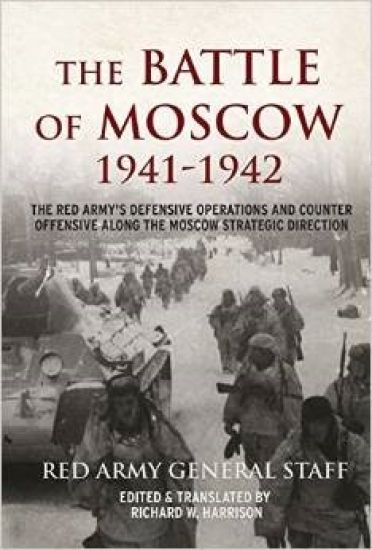
The Battle of Moscow 1941-42

The Battle of Moscow 1941-42

Richard W Harrison

Helion Company
2015
sidottu
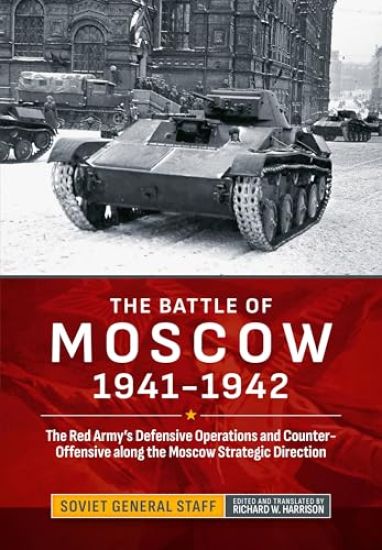
"The Battle of Moscow, 1941–1942: The Red Army’s Defensive Operations and Counteroffensive Along the Moscow Strategic Direction" is a detailed examination of one of the major turning points of World War II, as seen from the Soviet side. The Battle of Moscow marked the climax of Hitler’s “Operation Barbarossa,” which sought to destroy the Soviet Union in a single campaign and ensure German hegemony in Europe. The failure to do so condemned Germany to a prolonged war it could not win. This work orignally appeared in 1943, under the title"Razgrom Nemetskikh Voisk pod Moskvoi" (The Rout of the German Forces Around Moscow). The work was produced by the Red Army General Staff’s military-historical section, which was charged with collecting and analyzing the war’s experience and disseminating it to the army’s higher echelons. This was a collective effort, featuring many different contributors, with Marshal Boris Mikhailovich Shaposhnikov, former chief of the Red Army General Staff and then head of the General Staff Academy, serving as general editor. The book is divided into three parts, each dealing with a specific phase of the battle. The first traces the Western Front’s defensive operations along the Moscow direction during Army Group Center’s final push toward the capital in November–December, 1941. The study pays particular attention to the Red Army’s resistance to the Germans’attempts to outflank Moscow from the north. Equally important were the defensive operations to the south of Moscow, where the Germans sought to push forward their other encircling flank. The second part deals with the first phase of the Red Army’s counteroffensive, which was aimed at pushing back the German pincers and removing the immediate threat to Moscow. Here the Soviets were able to throw the Germans back and flatten both salients, particularly in the south, where they were able to make deep inroads into the enemy front to the west and northwest. The final section examines the further development of the counteroffensive until the end of January 1942. This section highlights the Soviet advance all along the front and their determined but unsuccessful attempts to cut off the Germans’Rzhev–Vyaz’ma salient. It is from this point that the front essentially stabilized, after which events shifted to the south. This new translation into English makes available to a wider readership this valuable study.
Rollback

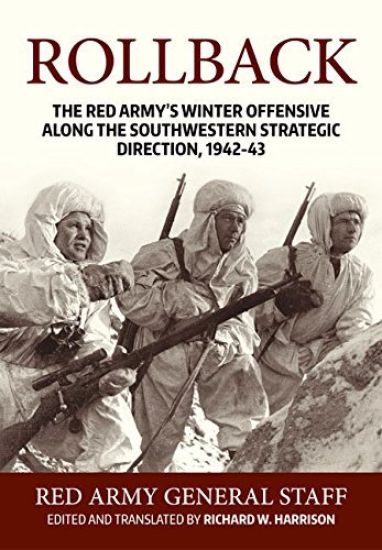
Rollback

Richard W Harrison

Helion Company
2016
sidottu
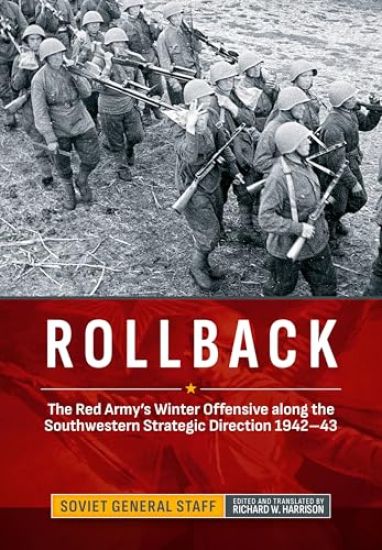
Rollback: The Red Army’s Winter Offensive along the Southwestern Strategic Direction, 1942–43 covers the period from mid-December 1942 to mid-February 1943, one of the most critical periods of the war on the Eastern Front. It was here that following the encirclement of an entire German army at Stalingrad, the Soviets sought to take advantage of the ruptured Axis front in southern Russia to finish off the Germans’ Italian and Hungarian allies and liberate the economically vital areas of eastern Ukraine. This study is drawn from a number of wartime and postwar articles, published by the General Staff’s directorate for the study of wartime experience. Also featured are documents relating to the operational-strategic conduct of the various operations, which were compiled and published after the fall of the Soviet Union. Several articles deal with the preparation for and conduct of the Southwestern Front’s Middle Don operation of December 1942. Originally intended as an ambitious offensive to cut off the German forces in the North Caucasus by driving on to Rostov, the operation was later reoriented to meet the threat of the German effort to relieve Stalingrad. The offensive not only accomplished its objective of turning back the German attack, thus dooming the Stalingrad garrison, but also destroyed the Italian army in the East as well. The Soviet Voronezh Front then struck further up the Don River, and in the Ostrogozhsk–Rossosh’operation destroyed what remained of the Italian forces in the area, as well as the Hungarian army. This enabled the Red Army to capture Khar’kov and push nearly to the Dnepr River by mid-February, before being thrown back by a skillful German counteroffensive. The territorial results of this operation set the stage for the front’s subsequent Voronezh–Kastornoe operation, which enabled the Soviets to push as far west as Kursk before exhaustion and growing German resistance brought the offensive to a halt. Further to the south, the Soviets were able to capture Voroshilovgrad and penetrate into the industrial Donets Basin. The book also contains a detailed Soviet examination of the employment of tank and mechanized corps during the campaign. The conclusions reached here had a direct bearing on the restructuring of the Red Army’s tank armies in time for the summer campaign of 1943.
The Battle of Moscow 1941-42

The Battle of Moscow 1941-42

Richard W Harrison

Helion Company
2018
nidottu
"The Battle of Moscow, 1941–1942: The Red Army’s Defensive Operations and Counteroffensive Along the Moscow Strategic Direction" is a detailed examination of one of the major turning points of World War II, as seen from the Soviet side. The Battle of Moscow marked the climax of Hitler’s “Operation Barbarossa,” which sought to destroy the Soviet Union in a single campaign and ensure German hegemony in Europe. The failure to do so condemned Germany to a prolonged war it could not win. This work originally appeared in 1943, under the title "Razgrom Nemetskikh Voisk pod Moskvoi" (The Rout of the German Forces around Moscow). The work was produced by the Red Army General Staff’s military-historical section, which was charged with collecting and analyzing the war’s experience and disseminating it to the army’s higher echelons. This was a collective effort, featuring many different contributors, with Marshal Boris Mikhailovich Shaposhnikov, former chief of the Red Army General Staff and then head of the General Staff Academy, serving as general editor. The book is divided into three parts, each dealing with a specific phase of the battle. The first traces the Western Front’s defensive operations along the Moscow direction during Army Group Center’s final push toward the capital in November–December, 1941. The study pays particular attention to the Red Army’s resistance to the Germans’ attempts to outflank Moscow from the north. Equally important were the defensive operations to the south of Moscow, where the Germans sought to push forward their other encircling flank. The second part deals with the first phase of the Red Army’s counteroffensive, which was aimed at pushing back the German pincers and removing the immediate threat to Moscow. Here the Soviets were able to throw the Germans back and flatten both salients, particularly in the south, where they were able to make deep inroads into the enemy front to the west and northwest. The final section examines the further development of the counteroffensive until the end of January 1942. This section highlights the Soviet advance all along the front and their determined but unsuccessful attempts to cut off the Germans’ Rzhev–Vyaz’ma salient. It is from this point that the front essentially stabilized, after which events shifted to the south. This new translation into English makes available to a wider readership this valuable study.
The Battle of Kursk

The Battle of Kursk

Richard W Harrison

Helion Company
2018
nidottu
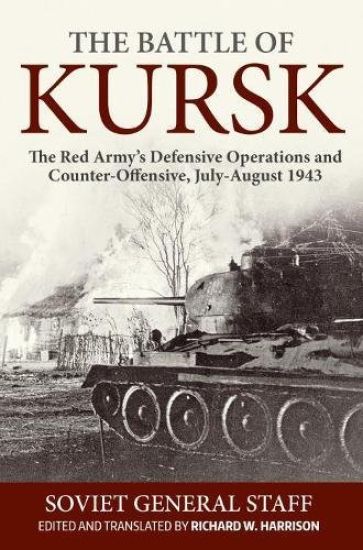
The Battle of Kursk: The Red Army’s Defensive Operations and Counter- Offensive, July-August 1943, offers a peculiarly Soviet view of one of the Second World War’s most critical events. While the Germans defeats at Moscow and Stalingrad showed that Hitler could not win the war in the East, the outcome of Kursk demonstrated beyond a doubt that he would lose it. This study was compiled by the Red Army General Staff’s military-historical directorate, which was charged with collecting and analyzing the war’s experience, and issued as an internal document in 1946-47. The study languished for more than a half-century, before being published in Russia in 2006, although heavily supplemented by commentary and other information not contained in the original. The present work omits these additions, while supplying its own commentary in places deemed necessary. The book is divided into two parts, dealing with the defensive and offensive phases of the battle, respectively. The first begins with a strategic overview of the situation along the Eastern Front by the spring and summer of 1943 and the Soviet decision to stand on the defensive. This is followed by a detailed examination of the Central Front’s efforts to counter the expected German attack out of the Orel salient, and the Voronezh Front’s attempts to do the same against the German concentrations in the Belgorod-Khar’kov area. The rest of this section is devoted to an exceedingly detailed day-by-day, tactical-operational account of the struggle, particularly along the southern face of the salient, where the Germans came closest to succeeding. The second part will be more of a revelation to the Western reader, who is likely to be more familiar with the defensive phase of the battle. Here the authors once again, in great detail, lay out the Red Army’s preparations for and conduct of a massive counteroffensive to clear the Orel salient, which soon degenerated to a grinding struggle, which while ultimately successful, cost the Soviets dearly. Likewise, the authors detail the Voronezh Front’s preparations to reduce the Belgorod salient and seize the industrial center of Khar’kov. This offensive, in conjunction with a simultaneous offensive in the Donets industrial region, pushed the German lines to the breaking point and set the stage for the follow-on advance to the Dnepr River and the eventual liberation of Ukraine.
The Soviet Army's High Commands in War and Peace, 1941-1992
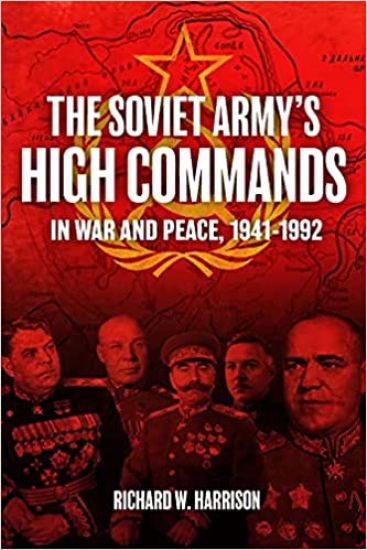
The war on the Eastern Front during 1941-45 was an immense struggle, running from the Barents Sea to the Caucasus Mountains. The vast distances involved forced the Soviet political-military leadership to resort to new organizational expedients in order to control operations along the extended front. These were the high commands of the directions, which were responsible for two or more fronts (army groups) and, along maritime axes, one or more fleets. In all, five high commands were created along the northwestern, western, southwestern, and North Caucasus strategic directions during 1941-42. However, the highly unfavourable strategic situation during the first year of the war, as well as interference in day-to-day operations by Stalin, severely limited the high commands' effectiveness. As a consequence, the high commands were abolished in mid-1942 and replaced by the more flexible system of supreme command representatives at the front. A High Command of Soviet Forces in the Far East was established in 1945 and oversaw the Red Army's highly effective campaign against Japanese forces in Manchuria. The Far Eastern High Command was briefly resurrected in 1947 as a response to the tense situation along the Korean peninsula and the ongoing civil war in China, but was abolished in 1953, soon after Stalin's death. Growing tensions with China brought about the recreation of the Far Eastern High Command in 1979, followed a few years later by the appearance of new high commands in Europe and South Asia. However, these new high commands did not long survive the collapse of the Soviet Union in 1991 and were abolished a year later. The book relies almost exclusively on Soviet and post-communist archival and other sources and is the first unclassified treatment of this subject in any country, East or West.