Kirjahaku
Etsi kirjoja tekijän nimen, kirjan nimen tai ISBN:n perusteella.
8 kirjaa tekijältä Richard W. Coan
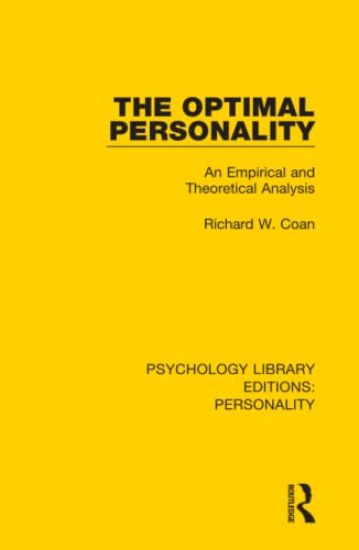
The terms mental health, maturity, personality integration, self-actualization have been used by psychologists to represent the realm of the ideal or optimal personality. Originally published in 1974, Professor Richard Coan here describes a method of analysing this domain, and examines the important theoretical implications of his findings. He developed instruments to measure various characteristics, including personal consistency, the experience of control and openness to experience, which are associated with current concepts of sound psychological functioning. A battery containing these instruments was administered to several hundred subjects and analysed. The results, reported here, are enlightening. It was found, for example, that the different characteristics viewed by psychologists as traits of the ideal person do not constitute a unitary pattern. There is no evidence of a general dimension of personality integration or mental health. A number of independent components or factors of sound functioning were isolated. Some desirable traits were discovered to be inversely related to each other, many of these relationships appearing to involve a choice between an open or spontaneous orientation and a more ordered and controlled orientation. The author’s view, fully supported by his findings, is that if people are to achieve maximal realization of their potentials, a clear requisite is the flexible utilization of various modes of experiencing and acting.
The terms mental health, maturity, personality integration, self-actualization have been used by psychologists to represent the realm of the ideal or optimal personality. Originally published in 1974, Professor Richard Coan here describes a method of analysing this domain, and examines the important theoretical implications of his findings. He developed instruments to measure various characteristics, including personal consistency, the experience of control and openness to experience, which are associated with current concepts of sound psychological functioning. A battery containing these instruments was administered to several hundred subjects and analysed. The results, reported here, are enlightening. It was found, for example, that the different characteristics viewed by psychologists as traits of the ideal person do not constitute a unitary pattern. There is no evidence of a general dimension of personality integration or mental health. A number of independent components or factors of sound functioning were isolated. Some desirable traits were discovered to be inversely related to each other, many of these relationships appearing to involve a choice between an open or spontaneous orientation and a more ordered and controlled orientation. The author’s view, fully supported by his findings, is that if people are to achieve maximal realization of their potentials, a clear requisite is the flexible utilization of various modes of experiencing and acting.


As the primary architect of early Christianity, Saint Paul exerted an influence on Western thought exceeding that of any other individual. What enabled him to do that? Both Jew and Roman citizen, he grew up in a region dominated by Greek culture and had a command of at least three languages. This novel builds on what is known of the first-century Roman Empire, the conflicting cultures, and the life and views of Paul himself. It then proceeds to create a plausible picture of the character of this man, of his inner struggles, and of the sorts of people with whom he interacted as he sought his path and went on to pursue it energetically until the end of his life.

As the primary architect of early Christianity, Saint Paul exerted an influence on Western thought exceeding that of any other individual. What enabled him to do that? Both Jew and Roman citizen, he grew up in a region dominated by Greek culture and had a command of at least three languages. This novel builds on what is known of the first-century Roman Empire, the conflicting cultures, and the life and views of Paul himself. It then proceeds to create a plausible picture of the character of this man, of his inner struggles, and of the sorts of people with whom he interacted as he sought his path and went on to pursue it energetically until the end of his life.