Kirjojen hintavertailu. Mukana 11 717 486 kirjaa ja 12 kauppaa.

Kirjahaku

Etsi kirjoja tekijän nimen, kirjan nimen tai ISBN:n perusteella.

3 kirjaa tekijältä Risto Uro

Ritual and Christian Beginnings

Ritual and Christian Beginnings

Risto Uro

Oxford University Press
2018
nidottu
The rise of early Christianity has been examined from a myriad of perspectives, but until recently ritual has been a neglected topic. Ritual and Christian Beginnings: A Socio-Cognitive Analysis argues that ritual theory is indispensable for the study of Christian beginnings. It also makes a strong case for the application of theories and insights from the Cognitive Science of Religion, a field that has established itself as a vigorous movement in Religious Studies over the past two decades. Risto Uro develops a 'socio-cognitive' approach to the study of early Christian rituals, seeking to integrate a social-level analysis with findings from the cognitive and evolutionary sciences. Ritual and Christian Beginnings provides an overview of how ritual has been approached in previous scholarship, including reasons for its neglect, and introduces the reader to the emerging fields of Ritual Studies and the Cognitive Science of Religion. In particular, it explores the ways in which cognitive theories of ritual can shed new light on issues discussed by early Christian scholars, and opens up new questions and avenues for further research. The socio-cognitive approach to ritual is applied to a number of test cases, including John the Baptist, the ritual healing practiced by Jesus and the early Christians, the social life of Pauline Christianity, and the development of early Christian baptismal practices. The analysis creates building blocks for a new account of Christian beginnings, highlighting the role of ritual innovation, cooperative signalling, and the importance of bodily actions for the generation and transmission of religious knowledge.
Ritual and Christian Beginnings

Ritual and Christian Beginnings

Risto Uro

Oxford University Press
2016
sidottu
The rise of early Christianity has been examined from a myriad of perspectives, but until recently ritual has been a neglected topic. Ritual and Christian Beginnings: A Socio-Cognitive Analysis argues that ritual theory is indispensable for the study of Christian beginnings. It also makes a strong case for the application of theories and insights from the Cognitive Science of Religion, a field that has established itself as a vigorous movement in Religious Studies over the past two decades. Risto Uro develops a 'socio-cognitive' approach to the study of early Christian rituals, seeking to integrate a social-level analysis with findings from the cognitive and evolutionary sciences. Ritual and Christian Beginnings provides an overview of how ritual has been approached in previous scholarship, including reasons for its neglect, and introduces the reader to the emerging fields of Ritual Studies and the Cognitive Science of Religion. In particular, it explores the ways in which cognitive theories of ritual can shed new light on issues discussed by early Christian scholars, and opens up new questions and avenues for further research. The socio-cognitive approach to ritual is applied to a number of test cases, including John the Baptist, the ritual healing practiced by Jesus and the early Christians, the social life of Pauline Christianity, and the development of early Christian baptismal practices. The analysis creates building blocks for a new account of Christian beginnings, highlighting the role of ritual innovation, cooperative signalling, and the importance of bodily actions for the generation and transmission of religious knowledge.
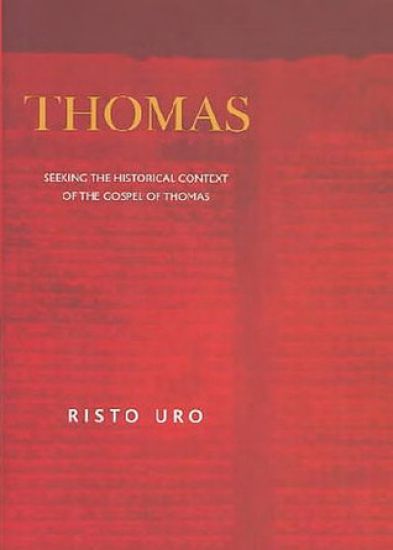
Thomas

Thomas

Risto Uro

Continuum International Publishing Group Ltd.
2003
sidottu
Many scholars believe that the Gospel of Thomas, the famous collection of Jesus' sayings found in Nag Hammadi in 1945, makes all the difference for our understanding of the origins of Christianity. The gospel has been studied closely for the new light it throws on pre-canonical traditions and for the different world of wisdom it seems to represent. Without denying the value of such approaches, the present book takes a different approach. It does not look backward to the earlier sources of the gospel nor to the historical Jesus, but seeks to locate Thomas on the map of early Christian literature and history by comparing the gospel to other related writings and traditions. These include the writings ascribed to the mysterious apostle, Judas Thomas, other documents from Nag Hammadi, Paul and Stoic teachers, and the Gospel of Matthew. No single interpretative key for the understanding of the gospel is proposed. Rather, the book opens up several new readings and historical explanations which can usefully be explored. Uro also argues that the conventional methods scholars have been using in their studies are in need of rethinking and refinement. Among many conclusions is the author's belief that Thomas is an early second-century work written by people who, like many other first- and second-century Christians, understood Jesus' message in terms of the Hellenistic belief in the divine origin of the self.