Kirjojen hintavertailu. Mukana 11 699 587 kirjaa ja 12 kauppaa.

Kirjahaku

Etsi kirjoja tekijän nimen, kirjan nimen tai ISBN:n perusteella.

14 kirjaa tekijältä Rita J. Simon

Rabbis, Lawyers, Immigrants, Thieves

Rabbis, Lawyers, Immigrants, Thieves

Rita J. Simon

Praeger Publishers Inc
1993
sidottu
Simon explores the diverse and changing roles of women over twenty-five years. Part I includes several chapters that examine the experiences and performances of women in various traditionally male-dominated professional roles: as scholars, attorneys, corrections officers, rabbis and ministers. Part II deals with immigrants and their roles as new American women. In Part III, Simon discusses the types of crimes women commit, how they are treated in the criminal justice system, women as political terrorists, and how the public regards famous women offenders. In conclusion, Simon looks at how women's changing social roles affect their personal lives and political views.
In the Golden Land

In the Golden Land

Rita J. Simon

Praeger Publishers Inc
1997
sidottu
From 1870 to 1900, over a half million Russian Jews came to the United States. Russian Jewish emigration had ceased by the 1920s due to the effects of the First World War, the Bolshevik Revolution, and the Quota Acts, but a century later, Jews from the former Soviet Union began to emigrate in large numbers. This detailed account describes the motivations of Russian and Soviet Jews for leaving their homeland and their subsequent adjustments to life in the United States. Simon, a sociologist, provides insight into who these Jewish immigrants were and are, what they accomplished, and how they have been viewed.
Abortion

Abortion

Rita J. Simon

Praeger Publishers Inc
1998
sidottu
Abortion is one of the most compelling public policy issues facing government and the public in the United States today. Most societies have enacted laws and statutes regarding abortion, and most societies have strong feelings regarding birth control and abortion. But the legal statutes and attitudes follow markedly different approaches. Simon examines how this issue is being faced in the United States, Canada, a sample of Western and Eastern European countries, Middle Eastern, African, and Latin American societies, and, among Asian countries, Japan, China, and India, along with Australia.After a brief historical introduction, Simon examines the legal statutes pertaining to abortion in the selected countries and then reviews public attitudes toward abortion based on responses to national public opinion polls. She concludes by discussing the relationships between the laws and statutes pertaining to abortion and the nations' policies vis-^D`a-vis population growth and control. Abortion is the first volume in a series that will examine major public policy issues using an explicitly comparative approach. Each will serve as a handbook for students, researchers, and scholars, containing basic empirical data and comprehensive references on the social issue or practice under examination.
Abortion

Abortion

Rita J. Simon

Praeger Publishers Inc
1998
nidottu
Abortion is one of the most compelling public policy issues facing government and the public in the United States today. Most societies have enacted laws and statutes regarding abortion, and most societies have strong feelings regarding birth control and abortion. But the legal statutes and attitudes follow markedly different approaches. Simon examines how this issue is being faced in the United States, Canada, a sample of Western and Eastern European countries, Middle Eastern, African, and Latin American societies, and, among Asian countries, Japan, China, and India, along with Australia. After a brief historical introduction, Simon examines the legal statutes pertaining to abortion in the selected countries and then reviews public attitudes toward abortion based on responses to national public opinion polls. She concludes by discussing the relationships between the laws and statutes pertaining to abortion and the nations' policies vis-^D`a-vis population growth and control. Abortion is the first volume in a series that will examine major public policy issues using an explicitly comparative approach. Each will serve as a handbook for students, researchers, and scholars, containing basic empirical data and comprehensive references on the social issue or practice under examination.
Jury and the Defense of Insanity

Jury and the Defense of Insanity

Rita J. Simon

Transaction Publishers
1998
nidottu
Thirty years after it was first published, the issues raised in The Jury and the Defense of Insanity remain pertinent. Rita James Simon examines how motivated and competent juries are, how well jurors understand and follow judges' instructions, their understand-ing of expert testimony, and the extent to which their own backgrounds and experiences influence their decisions. Simon provides a rare opportunity to observe how jurors go about the process of deliberating and reaching a verdict by following them into the jury room and recording their deliberations. This pathbreaking study of jury room behavior provides compelling evidence of the effectiveness of our trial by jury system.The Jury and the Defense of Insanity was the product of an experimental study con-ducted as part of the University of Chicago Jury Project. Over 1,000 jurors were chosen to participate, not as volunteers, but as part of their regular jury duty, in two experimental trials, one on a charge of housebreaking, the other of incest. In each the insanity de-fense was raised. Court judges instructed the jurors to consider the recorded trials they were about to hear with all the care and seriousness they would give to a real criminal prosecution, and the taped recordings of their deliberations make it clear that they did just that. These recordings, along with responses to detailed questionnaires, yielded significant data, equally applicable to civil as to criminal cases. We learn their reactions to their fellow jurors; personal evaluations of the quality and effectiveness of delibera-tions; the degree to which religion, sex, social status, education, and like factors affect participation in and influence on the course of the deliberation; and the recounting of and reliance upon personal experience in seeking to reach a verdict, among other in-sights furnished by this study.This is an exact record—not a description or recollected account—of the struggle of a jury to weigh evidence and achieve a just verdict. For lawyers whose job it is to win civil and criminal cases, for behavioral scientists who study male and female reactions in their cultural environment to the circumstances that confront them, and to all who are interested in how people behave and why, in a dramatic, socially significant situation, this is a fascinating and revealing book.
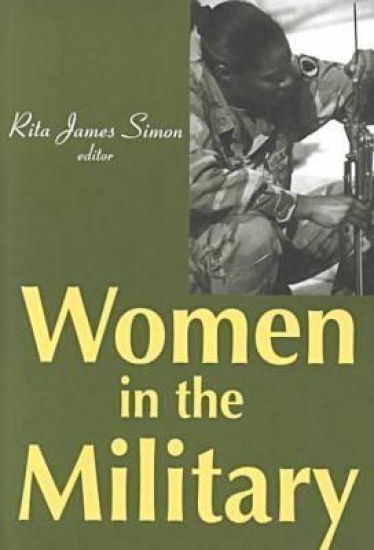
Women in the Military

Women in the Military

Rita J. Simon

Transaction Publishers
2000
nidottu
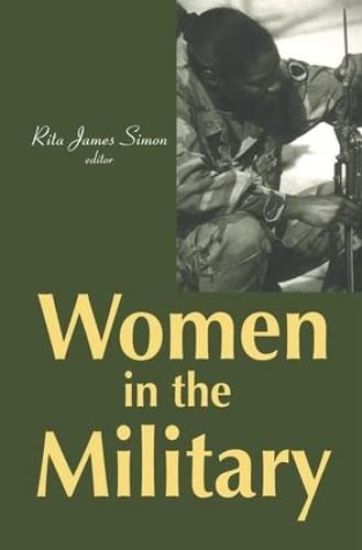
The role, status, and treatment of women is one of the major issues confronting the military today. This volume provides a range of perspectives on the magnitude of concerns, the sources of problems, how issues might best be addressed, and the future for women in the armed services. It is based on a special issue of the journal Gender Issues, supplemented with additional contributions from leading scholars.Historical and theoretical perspectives are provided by Lorry M. Fenner and Jean Bethke Elshtain. Fenner focuses on the role of women in the military since 1940, and argues for broader inclusion of women as well as other groups that have previously been restricted from full participation. Elshtain analyzes the extraordinary ability of war to draw both women and men into civic life, and observes how it calls forth and establishes a sense of particular identity for both men and women.Critical views are provided by other scholars. Laura L. Miller examines the feminist movement's insistence on full participation in combat units. Former Army chaplain Marie deYoung provides qualitative and quantitative data on military readiness and unit cohesion in mixed gender units. Leading military scholars (Mady W. Segal, David R. Segal, Jerald G. Bachman, Peter Freedman-Doan, and Patrick M. O'Malley) review national surveys comparing male and female high school seniors' responses to surveys conducted on questions about their propensity to enlist. Male-female differences are also addressed by Judith Hicks Steihm, who looks at the opinions each group has about the capabilities and performance of women. She finds differences by rank on questions as to how hard female soldiers work as compared to male soldiers and whether women are ready for combat duty.Historically, the military has provided minorities equal opportunity. Brenda L. Moore and Schulyler C. Webb examine whether or not this is still perceived to be the case in today's Navy. They focus on different perceptions by women and men, and by African American women in particular. Finally, William O'Neill examines whether the post-cold war downsized military will find women soldiers more or less important. Drawing upon social science research, historical data, and contemporary opinion surveys, Women in the Military is a cutting-edge assessment of a major gender issue in the United States. It will be valuable to researchers in women's studies, as well as those teaching courses in sociology, history, and military studies.Rita James Simon is University Professor in the School of Public Affairs and the Washington College of Law at American University. She is the editor of Gender Issues and author of The American Jury, the Insanity Defense: A Critical Assessment of Law and Policy in the Post-Hinkley Era (with David Aaronson), Adoption, Race and Identity (with Howard Alstein), In the Golden Land: A Century of Russian and Soviet Jewish Immigration, Social Science Data and Supreme Court Decisions (with Rosemary Erickson), and Abortion: Statutes, Policies, and Public Attitudes the World Over.
Immigrant Women

Immigrant Women

Rita J. Simon

Transaction Publishers
2000
nidottu
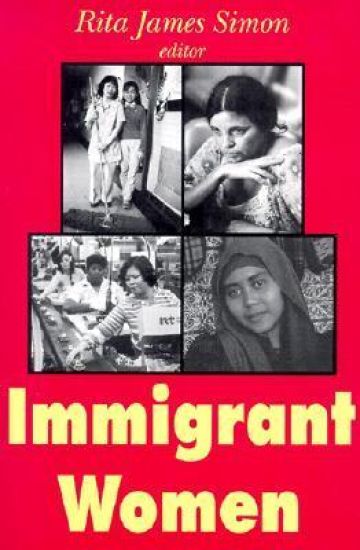
The obstacles to assimilation and treatment of immigrant women are major issues confronting the leading immigrant-receiving nations today-the United States, Canada, and Australia. This volume provides a range of perspectives on the concerns, the sources of problems, how issues might be addressed, and the future of immigrant women. It is based upon a two-part issue of the journal Gender Issues, and contains a new introduction by the editor. The first section focuses on labor force experiences of women who have immigrated to the United States and Australia from Mexico and Latin America, Eastern Europe, Korea, the Philippines, India and other parts of Asia. Nancy Foner assesses the complex and contradictory ways that migration changes women's status. Cynthia Crawford focuses on Mexican and Salvadoran women who have recently moved into janitorial work in Los Angeles. M.D.R. Evans and Tatjiana Lucik analyze labor force participation of immigrants in Australia and family strategies of women migrants from the former Yugoslavia against the experiences of woman migrants from the Mediterranean world and other parts of the Slavic world. Economist Harriet Duleep reviews what is known as the family investment model. Monica Boyd tackles the controversial issue of the leading immigrant-receiving nations' unwillingness to declare gender an explicit ground for persecution and thus for gaining -refugee status. The second section deals with social class and English language acquisition, the obstacles women have had to overcome in gaining refugee status in the United States and Canada, and a comparison of movement patterns between different commentaries in Mexico and the United States on the part of Mexican male and female immigrants. Contributors include Suzanne M. Sinke, Katharine Donato, and Nina Toren. Immigrant Women will be valuable to researchers in women's studies, population demographics, as well as those teaching courses in sociology, history, and immigration. Rita James Simon is university professor in the School of Public Affairs at the Washington College of Law at American University. She is editor of Gender Issues and author of The American Jury, The Insanity Defense: A Critical Assessment of Law and Policy in the Post-Hinckley Era (with David Aaronson), Adoption, Race, and Identity (with Howard Altstein), In the Golden Land: A Century of Russian and Soviet Jewish Immigration, Social Science Data and Supreme Court Decisions (with -Rosemary Erickson), and Abortion: Statutes, Policies, and Public Attitudes the World Over.
Sporting Equality

Sporting Equality

Rita J. Simon

Transaction Publishers
2004
nidottu
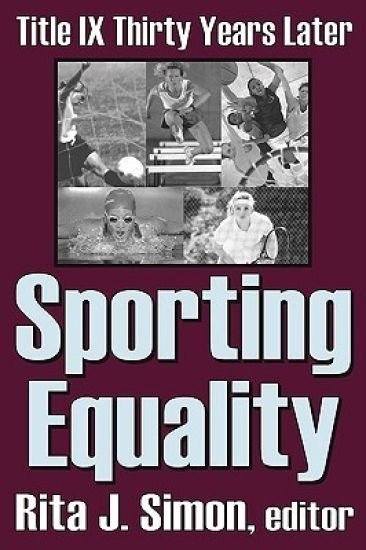
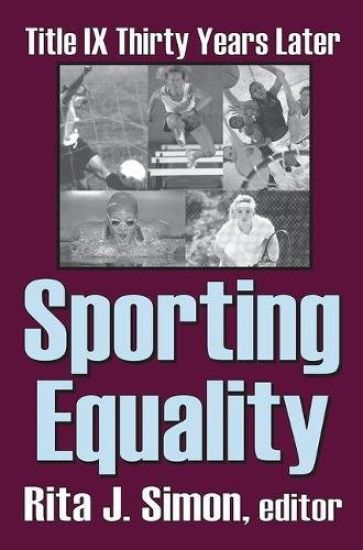
As part of its Education Amendments, the United States Congress passed Title IX in 1972 to ensure that no person should be discriminated against in any education program or activity receiving federal financial assistance. In the decades since, Title IX has had, among other effects, a marked increase on school athletic programs for women and girls at both the high school and college level. Despite this, a range of questions have been raised about the effectiveness of the federal government's enforcement, and also the impact on male athletics. The government can enact legislation, but how it works remains the domain of administrators at one end and thousands of athletes at the other. Sporting Equality reviews the impact of Title IX thirty years after its passage, and suggests future areas of contention.This new title includes the major findings and recommendations of the Secretary of Education's Commission on Opportunities in Athletics established in 2002, as well as the commission's minority report. These contributions are followed by seven chapters that analyze and assess the strength and weakness of Title IX and offer recommendations for strengthening or changing its goals and objectives. These include: Kimberly A. Yuracko, "Title IX and the Problem of Gender Equality in Athletics"; Eric C. Dudley, Jr. and George Rutherglen, "A Comment on the Report of the Commission to Review Title IX"; Barbara Murray, "How to Evaluate the Implementation of Title IX at Colleges and Universities and Attitudes and Interest of Students Regarding Athletics"; John J. Cheslock and Deborah Anderson, "Lessons From Research on Title IX and Intercollegiate Athletics"; Valerie M. Bonnette, "The Little Fusses Over Title IX."The book concludes with two controversial chapters. The first, by Leo Kocher, argues that Title IX has been detrimental to male athletics, especially gymnastics, swimming, wrestling, and track, while the second by Ellen J. Staurowsky claims that Title IX has not gone far enough in providing women athletes with the equality they deserve. This volume will be of interest to specialists in the sociology of sports, women's studies scholars, and sports educators.
Public Opinion in the United States
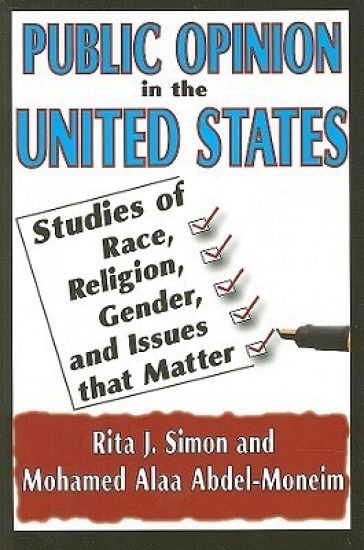
Public Opinion in the United States tracks developments in American society since World War II through the lens of public opinion. The authors assess national public opinion poll data from 1945 to 2008, targeting opinions about African Americans, Jews, Muslim Americans, gays and lesbians, immigration, abortion, and affirmative action.The authors consider whether American attitudes have developed faster than Supreme Court decisions in the areas surveyed. They assess how social change is processed by the public, how people responded to the race riots of the 1950s and 1960s, and how the war in Vietnam shaped new perspectives on issues such as race, citizenship rights, and the role of the individual. Each chapter begins by introducing the political, social, or international events that were critical in setting the stage for influencing public opinion in each decade since World War II.The volume provides a unique portrait of American society and how it has changed over the last sixty plus years. The reader will learn whether Americans are more or less prejudiced against blacks, Jews, and Muslims than they were in earlier years; whether their views on immigration, affirmative action, and abortion have changed; and when views have changed, in what direction. Do men and women, rich and poor, more and less educated, secular versus religious share the same views? And if there are differences, what directions do those differences take? Th is work describes American society in 2008 compared to the post-World War II era, and it offers stunning glimpses at the future.
Immigrant Women

Immigrant Women

Rita J. Simon

Routledge
2018
sidottu
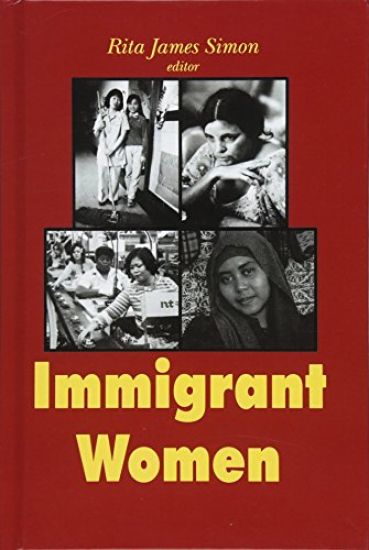
The obstacles to assimilation and treatment of immigrant women are major issues confronting the leading immigrant-receiving nations today-the United States, Canada, and Australia. This volume provides a range of perspectives on the concerns, the sources of problems, how issues might be addressed, and the future of immigrant women. It is based upon a two-part issue of the journal Gender Issues, and contains a new introduction by the editor. The first section focuses on labor force experiences of women who have immigrated to the United States and Australia from Mexico and Latin America, Eastern Europe, Korea, the Philippines, India and other parts of Asia. Nancy Foner assesses the complex and contradictory ways that migration changes women's status. Cynthia Crawford focuses on Mexican and Salvadoran women who have recently moved into janitorial work in Los Angeles. M.D.R. Evans and Tatjiana Lucik analyze labor force participation of immigrants in Australia and family strategies of women migrants from the former Yugoslavia against the experiences of woman migrants from the Mediterranean world and other parts of the Slavic world. Economist Harriet Duleep reviews what is known as the family investment model. Monica Boyd tackles the controversial issue of the leading immigrant-receiving nations' unwillingness to declare gender an explicit ground for persecution and thus for gaining -refugee status. The second section deals with social class and English language acquisition, the obstacles women have had to overcome in gaining refugee status in the United States and Canada, and a comparison of movement patterns between different commentaries in Mexico and the United States on the part of Mexican male and female immigrants. Contributors include Suzanne M. Sinke, Katharine Donato, and Nina Toren. Immigrant Women will be valuable to researchers in women's studies, population demographics, as well as those teaching courses in sociology, history, and immigration. Rita James Simon is university professor in the School of Public Affairs at the Washington College of Law at American University. She is editor of Gender Issues and author of The American Jury, The Insanity Defense: A Critical Assessment of Law and Policy in the Post-Hinckley Era (with David Aaronson), Adoption, Race, and Identity (with Howard Altstein), In the Golden Land: A Century of Russian and Soviet Jewish Immigration, Social Science Data and Supreme Court Decisions (with -Rosemary Erickson), and Abortion: Statutes, Policies, and Public Attitudes the World Over.
Jury and the Defense of Insanity

Jury and the Defense of Insanity

Rita J. Simon

Routledge
2018
sidottu
Thirty years after it was first published, the issues raised in The Jury and the Defense of Insanity remain pertinent. Rita James Simon examines how motivated and competent juries are, how well jurors understand and follow judges' instructions, their understand-ing of expert testimony, and the extent to which their own backgrounds and experiences influence their decisions. Simon provides a rare opportunity to observe how jurors go about the process of deliberating and reaching a verdict by following them into the jury room and recording their deliberations. This pathbreaking study of jury room behavior provides compelling evidence of the effectiveness of our trial by jury system.The Jury and the Defense of Insanity was the product of an experimental study con-ducted as part of the University of Chicago Jury Project. Over 1,000 jurors were chosen to participate, not as volunteers, but as part of their regular jury duty, in two experimental trials, one on a charge of housebreaking, the other of incest. In each the insanity de-fense was raised. Court judges instructed the jurors to consider the recorded trials they were about to hear with all the care and seriousness they would give to a real criminal prosecution, and the taped recordings of their deliberations make it clear that they did just that. These recordings, along with responses to detailed questionnaires, yielded significant data, equally applicable to civil as to criminal cases. We learn their reactions to their fellow jurors; personal evaluations of the quality and effectiveness of delibera-tions; the degree to which religion, sex, social status, education, and like factors affect participation in and influence on the course of the deliberation; and the recounting of and reliance upon personal experience in seeking to reach a verdict, among other in-sights furnished by this study.This is an exact record not a description or recollected account of the struggle of a jury to weigh evidence and achieve a just verdict. For lawyers whose job it is to win civil and criminal cases, for behavioral scientists who study male and female reactions in their cultural environment to the circumstances that confront them, and to all who are interested in how people behave and why, in a dramatic, socially significant situation, this is a fascinating and revealing book.
Sporting Equality

Sporting Equality

Rita J. Simon

Routledge
2017
sidottu
As part of its Education Amendments, the United States Congress passed Title IX in 1972 to ensure that no person should be discriminated against in any education program or activity receiving federal financial assistance. In the decades since, Title IX has had, among other effects, a marked increase on school athletic programs for women and girls at both the high school and college level. Despite this, a range of questions have been raised about the effectiveness of the federal government's enforcement, and also the impact on male athletics. The government can enact legislation, but how it works remains the domain of administrators at one end and thousands of athletes at the other. Sporting Equality reviews the impact of Title IX thirty years after its passage, and suggests future areas of contention.This new title includes the major findings and recommendations of the Secretary of Education's Commission on Opportunities in Athletics established in 2002, as well as the commission's minority report. These contributions are followed by seven chapters that analyze and assess the strength and weakness of Title IX and offer recommendations for strengthening or changing its goals and objectives. These include: Kimberly A. Yuracko, "Title IX and the Problem of Gender Equality in Athletics"; Eric C. Dudley, Jr. and George Rutherglen, "A Comment on the Report of the Commission to Review Title IX"; Barbara Murray, "How to Evaluate the Implementation of Title IX at Colleges and Universities and Attitudes and Interest of Students Regarding Athletics"; John J. Cheslock and Deborah Anderson, "Lessons From Research on Title IX and Intercollegiate Athletics"; Valerie M. Bonnette, "The Little Fusses Over Title IX."The book concludes with two controversial chapters. The first, by Leo Kocher, argues that Title IX has been detrimental to male athletics, especially gymnastics, swimming, wrestling, and track, while the second by Ellen J. Staurowsky claims that Title IX has not gone far enough in providing women athletes with the equality they deserve. This volume will be of interest to specialists in the sociology of sports, women's studies scholars, and sports educators.
Women in the Military

Women in the Military

Rita J. Simon

Routledge
2018
sidottu
The role, status, and treatment of women is one of the major issues confronting the military today. This volume provides a range of perspectives on the magnitude of concerns, the sources of problems, how issues might best be addressed, and the future for women in the armed services. It is based on a special issue of the journal Gender Issues, supplemented with additional contributions from leading scholars.Historical and theoretical perspectives are provided by Lorry M. Fenner and Jean Bethke Elshtain. Fenner focuses on the role of women in the military since 1940, and argues for broader inclusion of women as well as other groups that have previously been restricted from full participation. Elshtain analyzes the extraordinary ability of war to draw both women and men into civic life, and observes how it calls forth and establishes a sense of particular identity for both men and women.Critical views are provided by other scholars. Laura L. Miller examines the feminist movement's insistence on full participation in combat units. Former Army chaplain Marie deYoung provides qualitative and quantitative data on military readiness and unit cohesion in mixed gender units. Leading military scholars (Mady W. Segal, David R. Segal, Jerald G. Bachman, Peter Freedman-Doan, and Patrick M. O'Malley) review national surveys comparing male and female high school seniors' responses to surveys conducted on questions about their propensity to enlist. Male-female differences are also addressed by Judith Hicks Steihm, who looks at the opinions each group has about the capabilities and performance of women. She finds differences by rank on questions as to how hard female soldiers work as compared to male soldiers and whether women are ready for combat duty.Historically, the military has provided minorities equal opportunity. Brenda L. Moore and Schulyler C. Webb examine whether or not this is still perceived to be the case in today's Navy. They focus on different perceptions by women and men, and by African American women in particular. Finally, William O'Neill examines whether the post-cold war downsized military will find women soldiers more or less important. Drawing upon social science research, historical data, and contemporary opinion surveys, Women in the Military is a cutting-edge assessment of a major gender issue in the United States. It will be valuable to researchers in women's studies, as well as those teaching courses in sociology, history, and military studies.Rita James Simon is University Professor in the School of Public Affairs and the Washington College of Law at American University. She is the editor of Gender Issues and author of The American Jury, the Insanity Defense: A Critical Assessment of Law and Policy in the Post-Hinkley Era (with David Aaronson), Adoption, Race and Identity (with Howard Alstein), In the Golden Land: A Century of Russian and Soviet Jewish Immigration, Social Science Data and Supreme Court Decisions (with Rosemary Erickson), and Abortion: Statutes, Policies, and Public Attitudes the World Over.
Public Opinion in the United States

Public Opinion in the United States

Rita J. Simon

AldineTransaction
2010
sidottu
Public Opinion in the United States tracks developments in American society since World War II through the lens of public opinion. The authors assess national public opinion poll data from 1945 to 2008, targeting opinions about African Americans, Jews, Muslim Americans, gays and lesbians, immigration, abortion, and affirmative action.The authors consider whether American attitudes have developed faster than Supreme Court decisions in the areas surveyed. They assess how social change is processed by the public, how people responded to the race riots of the 1950s and 1960s, and how the war in Vietnam shaped new perspectives on issues such as race, citizenship rights, and the role of the individual. Each chapter begins by introducing the political, social, or international events that were critical in setting the stage for influencing public opinion in each decade since World War II.The volume provides a unique portrait of American society and how it has changed over the last sixty plus years. The reader will learn whether Americans are more or less prejudiced against blacks, Jews, and Muslims than they were in earlier years; whether their views on immigration, affirmative action, and abortion have changed; and when views have changed, in what direction. Do men and women, rich and poor, more and less educated, secular versus religious share the same views? And if there are differences, what directions do those differences take? Th is work describes American society in 2008 compared to the post-World War II era, and it offers stunning glimpses at the future.