Kirjojen hintavertailu. Mukana 12 002 614 kirjaa ja 12 kauppaa.

Kirjahaku

Etsi kirjoja tekijän nimen, kirjan nimen tai ISBN:n perusteella.

6 kirjaa tekijältä Roald Hoffmann

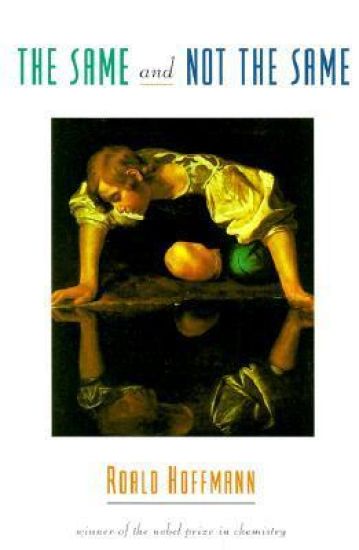
The Same and Not the Same

The Same and Not the Same

Roald Hoffmann

Columbia University Press
1995
sidottu
Positioned at the crossroads of the physical and biological sciences, chemistry deals with neither the infinitely small, nor the infinitely large, nor directly with life. So it is sometimes thought of as dull, the way things in the middle often are. But this middle ground is precisely where human beings exist. As Hoffmann shows in his inspired prose, the world observed at its molecular level is complex and agitated, as are the emotions of the supposedly dispassionate scientists who explore it. In The Same and Not the Same the vital tensions of chemistry are revealed; with down-to-earth explanations, Hoffmann uncovers the polarities that power, rend, and reform the world of molecules. When we wash an apple before eating it, we are thinking not merely of the dirt that may still be on it but of the pesticides used in agricultural production. When we take medication, we expect relief for our pain but also fear side effects. The Same and Not the Same shows this ambivalence to be only one of a number of dualities pervading the world of molecules. The theme of identity, reflected in the title of the book, is central to the story. Other dualities, from stasis and dynamics, to creation and discovery to the rich complexity of revealing and concealing, are lucidly delineated for nonscientist and scientist alike. The Same and Not the Same also offers a rare and compelling personal statement of the social responsibility of scientists. Unabashedly confronting some of the major ethical controversies in chemistry today, the book strives for balance in facing the pressing ecological and environmental concerns of our time.
The Same and Not the Same

The Same and Not the Same

Roald Hoffmann

Columbia University Press
1997
pokkari
Positioned at the crossroads of the physical and biological sciences, chemistry deals with neither the infinitely small, nor the infinitely large, nor directly with life. So it is sometimes thought of as dull, the way things in the middle often are. But this middle ground is precisely where human beings exist. As Hoffmann shows in his inspired prose, the world observed at its molecular level is complex and agitated, as are the emotions of the supposedly dispassionate scientists who explore it. In The Same and Not the Same the vital tensions of chemistry are revealed; with down-to-earth explanations, Hoffmann uncovers the polarities that power, rend, and reform the world of molecules. When we wash an apple before eating it, we are thinking not merely of the dirt that may still be on it but of the pesticides used in agricultural production. When we take medication, we expect relief for our pain but also fear side effects. The Same and Not the Same shows this ambivalence to be only one of a number of dualities pervading the world of molecules. The theme of identity, reflected in the title of the book, is central to the story. Other dualities, from stasis and dynamics, to creation and discovery to the rich complexity of revealing and concealing, are lucidly delineated for nonscientist and scientist alike. The Same and Not the Same also offers a rare and compelling personal statement of the social responsibility of scientists. Unabashedly confronting some of the major ethical controversies in chemistry today, the book strives for balance in facing the pressing ecological and environmental concerns of our time.

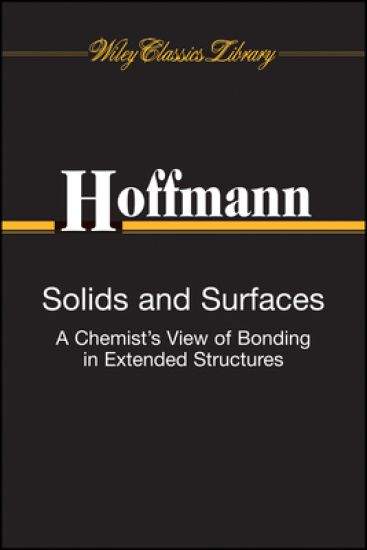
Solids and Surfaces

Solids and Surfaces

Roald Hoffmann

John Wiley Sons Inc
1989
sidottu
This unique book shows how chemistry and physics come together in the solid state and on surfaces. Using a lively, graphic, descriptive approach, it teaches chemists the language that is necessary to understand the electronic structure of extended systems. And, at the same time, it demonstrates how a chemical, frontier-orbital, approach to solid state and surface bonding and reactivity may be constructed. The book begins with the language of crystal orbitals, band structures and densities of states. The tools for moving back from the highly delocalized orbitals of the solid are then built up in a transparent manner; they include decompositions of the densities of states and crystal orbital overlap populations. Using these tools, the book shapes a meeting ground between detailed quantum mechanical calculations and a chemical frontier orbital perspec- tive. Applications include a general picture of chemisorption, bond-breaking and making in the solid state, bonding in metals, the electronic structure of selected conducting and supercon- ducting structures, dissociation, migration and coupling on surfaces and the forces controlling deformation of extended systems.
Solids and Surfaces

Solids and Surfaces

Roald Hoffmann

Wiley-Blackwell
2021
nidottu
This unique book shows how chemistry and physics come together in the solid state and on surfaces. Using a lively, graphic, descriptive approach, it teaches chemists the language that is necessary to understand the electronic structure of extended systems. And, at the same time, it demonstrates how a chemical, frontier-orbital, approach to solid state and surface bonding and reactivity may be constructed. The book begins with the language of crystal orbitals, band structures and densities of states. The tools for moving back from the highly delocalized orbitals of the solid are then built up in a transparent manner; they include decompositions of the densities of states and crystal orbital overlap populations. Using these tools, the book shapes a meeting ground between detailed quantum mechanical calculations and a chemical frontier orbital perspec- tive. Applications include a general picture of chemisorption, bond-breaking and making in the solid state, bonding in metals, the electronic structure of selected conducting and supercon- ducting structures, dissociation, migration and coupling on surfaces and the forces controlling deformation of extended systems.
Chemical Sciences in the 20th Century

Chemical Sciences in the 20th Century

Roald Hoffmann

Wiley-VCH Verlag GmbH
2001
sidottu
Chemistry in the last century was characterized by spectacular growth and advances, stimulated by revolutionary theories and experimental breakthroughs. Yet, despite this rapid development, the history of this scientific discipline has achieved only recently the status necessary to understand the effects of chemistry on the scientific and technological culture of the modern world. This book addresses the bridging of boundaries between chemistry and the other "classical" disciplines of science, physics and biology as well as the connections of chemistry to mathematics and technology. Chemical research is represented as an interconnected patchwork of scientific specialties, and this is shown by a mixture of case studies and broader overviews on the history of organic chemistry, theoretical chemistry, nuclear- and cosmochemistry, solid state chemistry, and biotechnology. All of these fields were at the center of the development of twentieth century chemistry, and the authors cover crucial topics such as the emergence of new subdisciplines and research fields, the science-technology relationship, and national styles of scientific work. This monograph represents a unique treasure trove for general historians and historians of science, while also appealing to those interested in the theoretical background and development of modern chemistry.