Kirjojen hintavertailu. Mukana 11 627 362 kirjaa ja 12 kauppaa.

Kirjahaku

Etsi kirjoja tekijän nimen, kirjan nimen tai ISBN:n perusteella.

6 kirjaa tekijältä Rob Dekkers

(R)Evolution

(R)Evolution

Rob Dekkers

Springer-Verlag New York Inc.
2005
sidottu
(R)Evolution studies the adaptation of industrial organisations to the dynamics of the environment by drawing an analogy with evolutionary biology, by extensively studying literature in management science, and by case studies. These investigations have lead to the insight that companies might evolve slower than generally expected; they doubt the effect of reorganizations, as commonly practiced in industry. Additionally, this work proposes the model for the Innovation Impact Point, the model for the Dynamic Adaptation Capability, the model for Collaboration.
(R)Evolution

(R)Evolution

Rob Dekkers

Springer-Verlag New York Inc.
2010
nidottu
(R)Evolution studies the adaptation of industrial organisations to the dynamics of the environment by drawing an analogy with evolutionary biology, by extensively studying literature in management science, and by case studies. These investigations have lead to the insight that companies might evolve slower than generally expected; they doubt the effect of reorganizations, as commonly practiced in industry. Additionally, this work proposes the model for the Innovation Impact Point, the model for the Dynamic Adaptation Capability, the model for Collaboration.
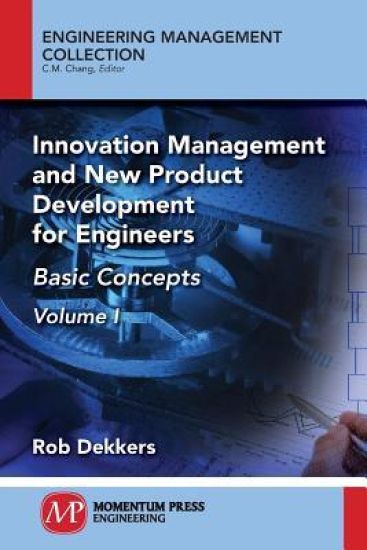
Innovation Management and New Product Development for Engineers, Volume I
Whereas innovation has become part of daily language, in practice, realizing new product and new service development is a complex and daunting task for engineers, design engineering managers, managers, and those involved in other functions in organizations. Most books on innovation management approach this topic from a managerial or economic perspective; this text takes the actual design and engineering processes as starting point. To this purpose, it relates product design and engineering processes and their management to sources of innovation, collaboration with suppliers, and knowledge providers (for example, inventors and universities), and users.The managerial aspects get ample attention as well as the socioeconomic aspects in the context of product design and engineering. For this wide range of topics, the book provides both theoretical underpinning and practical guidance. Readers and students will benefit from this book by not only understanding the key mechanisms for innovation but also by the practical guidance it offers. The author uses diagrams, models, methods, and steps to guide readers to a better understanding of innovation projects. This practical approach and the link to theory make the book valuable to practitioners as well as engineering students.
Innovation Management and New Product Development for Engineers, Volume II
Whereas innovation has become part of daily language, in practice, realizing new product and new service development is a complex and daunting task for engineers, design engineering managers, managers, and those involved in other functions in organizations. Most books on innovation management approach this topic from a managerial or economic perspective; this text takes the actual design and engineering processes as starting point. To this purpose, it relates product design and engineering processes and their management to sources of innovation, collaboration with suppliers, and knowledge providers (for example, inventors and universities), and users.The managerial aspects get ample attention as well as the socioeconomic aspects in the context of product design and engineering. For this wide range of topics, the book provides both theoretical underpinning and practical guidance. Readers and students will benefit from this book by not only understanding the key mechanisms for innovation but also by the practical guidance it offers. The author uses diagrams, models, methods, and steps to guide readers to a better understanding of innovation projects. This practical approach and the link to theory make the book valuable to practitioners as well as engineering students.

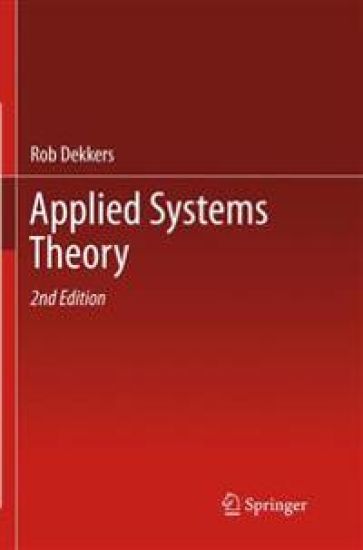
Applied Systems Theory

Applied Systems Theory

Rob Dekkers

Springer International Publishing AG
2017
sidottu
Offering an up-to-date account of systems theories and its applications, this book provides a different way of resolving problems and addressing challenges in a swift and practical way, without losing overview and grip on the details. From this perspective, it offers a different way of thinking in order to incorporate different perspectives and to consider multiple aspects of any given problem. Drawing examples from a wide range of disciplines, it also presents worked cases to illustrate the principles. The multidisciplinary perspective and the formal approach to modelling of systems and processes of ‘Applied Systems Theory’ makes it suitable for managers, engineers, students, researchers, academics and professionals from a wide range of disciplines; they can use this ‘toolbox’ for describing, analysing and designing biological, engineering and organisational systems as well as getting a better understanding of societal problems. This revised, updated and expanded second edition includes coverage of abductive reasoning, the relevance of systems theories for research methods and a new chapter about problem analysis and solving based on systems theories.
Applied Systems Theory

Applied Systems Theory

Rob Dekkers

Springer International Publishing AG
2018
nidottu
Offering an up-to-date account of systems theories and its applications, this book provides a different way of resolving problems and addressing challenges in a swift and practical way, without losing overview and grip on the details. From this perspective, it offers a different way of thinking in order to incorporate different perspectives and to consider multiple aspects of any given problem. Drawing examples from a wide range of disciplines, it also presents worked cases to illustrate the principles. The multidisciplinary perspective and the formal approach to modelling of systems and processes of ‘Applied Systems Theory’ makes it suitable for managers, engineers, students, researchers, academics and professionals from a wide range of disciplines; they can use this ‘toolbox’ for describing, analysing and designing biological, engineering and organisational systems as well as getting a better understanding of societal problems. This revised, updated and expanded second edition includes coverage of abductive reasoning, the relevance of systems theories for research methods and a new chapter about problem analysis and solving based on systems theories.