Kirjojen hintavertailu. Mukana 11 238 394 kirjaa ja 12 kauppaa.

Kirjahaku

Etsi kirjoja tekijän nimen, kirjan nimen tai ISBN:n perusteella.

12 kirjaa tekijältä Rob Reider

Effective Operations and Controls for the Small Privately Held Business
Effective Operations and Controls for the Small Privately Held Business "Rob Reider is the ultimate 'on-target' consultant to the small business. Whether you are just starting out or have been in a small business for years, this book is a must-read. It is concise, clear, organized and addresses the management, financial, and personnel issues that confront and often destroy small business--eighty percent of all the businesses in America." --Tom Torgerson, CPA, President, Torgerson AssociatesManagement and Financial Consultants "Dr. Reider's emphasis on first understanding the small business environment and then identifying and integrating individual business goals addresses a critical entry point for new business owners. His detailed advice around realistic issues emphasizes a solutions-based orientation that provides even the novice with keys to successful business practices." --Linda Lippitt, PhD, Director, Learning Legacies "Rob Reider is an experienced consultant, seminar facilitator, and author who has written an important book for small business owners and managers. The topics included are relevant to privately owned business managers who consider their organizations to be 'small businesses' regardless of their actual sales volume. This is a book that should be on the bookshelf of every businessperson with responsibility for the management of a small privately owned business." --Peter B. Heyler, PBH Executive Services "(This book) is an excellent resource not just for the small business owner, but also for colleges and universities. Any higher education institution that has a business program entrepreneurial component will find this book invaluable." --Steve C. Martinez, PhD, Director, New Mexico Highlands University, Santa Fe and Espanola Centers
Operational Review Workbook

Operational Review Workbook

Rob Reider

John Wiley Sons Inc
2002
nidottu
Practical, proven tools for conducting successful operational reviews An operational review evaluates management’s conformity with plans and resource allocations, organizational structure, operating procedures, processes, and controls. In today’s volatile marketplace, organizations must do everything possible to ensure their operations are running most economically and effectively to maximize desired results. In such a competitive environment, operational reviews have become increasingly important. The Operational Review Workbook not only gives readers a better understanding of the concepts behind operational reviews but also enables them to conduct reviews with more confidence and authority. A companion to Rob Reider’s Operational Review: Maximum Results at Efficient Costs, Third Edition, the Workbook explains the benefits of a review and offers step-by-step guidance through its various stages. In addition to the author’s incisive analysis, this practical guide: *Includes case studies, checklists, forms, and exercises *Reinforces the fundamental principles necessary to perform an operational review *Presents in a step-by-step manner how an operational review should be performed *Shows how to judge a review’s results and make recommendations to management *Demonstrates how to use tools and techniques such as financial statement analysis, verification of data accuracy, determination of compliance with laws and regulations, development and understanding of ratio change and trend analysis, use of systems and layout flowcharts, effective interviewing techniques, and preparation and use of survey forms, questionnaires, and checklists *Integrates operational review concepts with other analytical processes such as benchmarking strategies and activity-based costing principles The Operational Review Workbook delivers all the tools needed to successfully conduct an operational review of the organization, department, or activity. CEOs, operations management and staff, internal and external consultants and auditors, CFOs and controllers, and other organizational stakeholders will find Reider’s incomparable guide an invaluable addition to their professional libraries.
Benchmarking Strategies

Benchmarking Strategies

Rob Reider

John Wiley Sons Inc
2000
sidottu
Like top-notch athletes, corporations need to stay in fighting shape to compete. And assessing the fitness-both functionally and financially-of every corporate operation and activity is the role played by the benchmarking process. Not simply a detailed company physical that isolates operational weaknesses and fiscal bloat, when effectively implemented, benchmarking also represents the cure-a set of best practice guidelines for maximizing performance, guiding the company toward corporate health, while cleaning up operating inefficiencies and financial waste. Written by a leading benchmarking authority, Benchmarking Strategies is a state-of-the-art how-to manual for transforming your organization into a lean, optimally performing endurance runner-no matter what sort of shape your company is in now. In a practical, user-friendly format, Reider helps you identify just what sort of businesses your company is in (and not in), develop a set of benchmarks and basic business principles as part of a corporate strategic plan, identify areas or functions that need improvement, implement best practices in a companywide program of continuous improvement, and develop performance measures to chart genuine gains as a learning organization. A best practice is defined not simply as an operational change that is cost effective, but one that moves the company toward fulfilling the expectations of its stakeholders (from boards of directors, CEOs, and frontline employees to vendors and customers). The book then offers a practical vision of achievable excellence in which every activity affects every other and every employee and department is a shaper of corporate destiny. In clear, practical language, Benchmarking Strategies de-cants the often unwieldy theory behind corporate improvement into expert advice on: * Benchmarking principles, techniques, and implementation * Identifying your company's basic operational principles * Benchmarks for organizational growth-including cost reductions, price and sales volume increases, and new distribution channels * Strategies for gaining competitive advantage-not just meeting your competition but surpassing them * How effective benchmarking encompasses both internal and external needs Offering the insight, wisdom, and hard-nosed realism of a seasoned coach, Benchmarking Strategies is the essential manual to making excellence an ongoing reality in every corner of your firm and to transforming a good organization into a world-class competitor. Find out how operationally and financially fit your company really is . . .and the secret to transforming it into a tough competitor if it isn't. Both the diagnosis and the cure for an out-of-shape organization, benchmarking is one of the most effective regimens available for transforming any company into an optimally functioning, world-class performer. Used in a program of continuous improvement, benchmarking is a process that allows a company to measure the efficiency and effectiveness of each of its activities and operations and put in place a set of best practices designed to move the company toward improved performance and profits. And Benchmarking Strategies shows you exactly how. Written by one of its leading experts, Benchmarking Strategies is a practical manual to benchmarking principles, techniques, and implementation, outlining just how to set up benchmarking criteria, monitor overall progress-while fulfilling the expectations of the company's various stakeholders. Inside, you'll find expert guidance on: * Developing benchmarks and basic business principles for your company as part of a detailed corporate strategic plan. * Identifying internal operational areas or functions to benchmark and establishing best practice target triggers for building internal excellence in Using external benchmarks to compare your company to competitors, industry, and best-in-class functions to become the best you can be.
Improving the Economy, Efficiency, and Effectiveness of Not-for-Profits
MISSION ACCOMPLISHED As not-for-profits must increasingly achieve greater results with less resources, they are continually seeking ways to use such scarce resources with more economy, with greater efficiency of processes and people within their organizations, and with increased effectiveness of results in order to further their missions. Whether used alone or together with other tools such as benchmarking, activity-based management, and flexible budgeting, the operational review is the tool best used to perform an evaluation of these crucial three e’s–economy, efficiency, and effectiveness. This book shows not-for-profit managers why conducting an operational review can be beneficial, explains the tools and personnel needed to conduct the review, and shows in detail how to conduct a review of operations in each area. It includes case study materials for a social service agency, a museum operation, an arts organization, a community service agency, and a college business office. Here is accessible, comprehensive coverage of: *How to approach an operational review, judge its results, and make recommendations to management *How to position your not-for-profit organization more effectively in the competitive world of funding, personnel, resources, and service results *How to identify and implement best practices within funding and operational constraints in all areas of the not-for-profit’s operations in an organized program of continuing improvements . . . and much more, including extensive exhibits, forms, working tools, checklists, and examples for conducting an operational review throughout all functions of a not-for-profit organization. Executive directors, outside auditors, CPAs, manage-ment consultants, boards, fund-raising executives, and all others involved in the not-for-profit’s operations will learn to get the most for their mission from this indispensable book.
Expanding Customer Service as a Profit Center: Striving for Excellence and Competitive Advantage
Striving for excellence in customer service is critical to gain a competitive advantage. It is the keystone for business growth and prosperity as it builds repetitive sales to existing customers and referrals for new customers. If customer service is looked at as a major business component and all customers are treated with excellence prior to the sale, during the sale, and after the sale, customer service will become a profit center that builds sales dollars to the top line and real profits to the bottom line. Customer service is not as simple as offering a smiling "good morning" greeting and a "have a nice day" parting, but an integrated system that manifests itself in all activities of the business to wield an overall customer service organizational mentality. Every time a customer comes in "contact with the company there is what we call a "touch point" and each touch point must be a Wow! Moment" for the customer. It is the build-up of these wow moments that develops into a superior customer service experience. No longer does the company sell whatever the customer is willing to buy or the company wants to sell, but realigns its customer service efforts to sell those products that the customer really needs. This book is geared to those interested in delivering customer service as a profit center concept that enables the organization to grow in the desired directions - doing the right thing the right way in spite of organizational roadblocks.
The Search for Best Practices

The Search for Best Practices

Rob Reider

Business Expert Press
2014
nidottu
The book is geared to those interested in doing the right thing the right way, often in the face of organizational roadblocks. The book is a 'how to' book to assist management and operations personnel to analyze their operations in a program of continuous improvements. It proposes an on-going search for best practices so that each entity operates most economically, efficiently, and effectively--consistent with why the entity is in existence in the first place. Best practice techniques assist the company in identifying its critical problem areas and treating the cause and not the symptom. With sensible business principles as the hallmark for the company's quest for best practices, the company can be clear as to the direction for movement and avoid merely improving poor practices or matching competitors less than desirable practices. Clear business principles that make sense to all levels of the organization allow the company to identify and develop the proper best practices. In this manner, everyone in the organization is moving in the same desired direction--and singing from the same songbook. The viruses that corrupt a business organization can be widespread and quite contagious. Nouveau quick fixes may be okay in the short term, but over the long haul the company needs to know what they are doing. If the company doesn't, some other company will. The main audience for this book is anyone currently or desirous of working in business--including management/supervision/employees and anyone interested in the world of business and how businesses operate. As many businesses are struggling to be competitive, or merely to survive, this book becomes a primer or 'how to' for identifying and maintaining excellence in their operations using best practices in developing a learning organization. The book can be used by individuals, groups or departments--management and operations personnel--in business as a learning, coaching, and mentoring tool in their quest to make their operations the best possible. Another audience is undergraduate and graduate business programs where the book could be used as a course text or supplemental readings for an existing course. Courses could include any course related to business operations, management courses, or its own specific course.
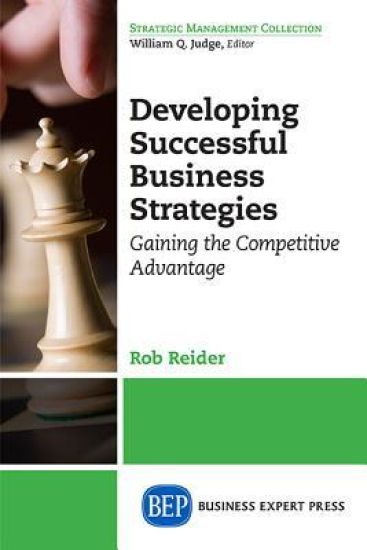
Developing Successful Business Strategies

Developing Successful Business Strategies

Rob Reider

Business Expert Press
2014
nidottu
This book presents effective planning business strategies and related budgeting concepts and those activities necessary for the successful growth of the organization. The planning process is shown to be an integral function of developing management strategies for future growth and the gaining of competitive advantage in these fast moving times. Budgeting is presented as a logical outgrowth and an essential part of the planning process rather than an independent internal activity. The book emphasizes the principal factors that should be considered in planning and budgeting for the company, what management and operations personnel must know to better understand effective planning for the business, and what can be done to enhance the overall strategic and financial planning for the organization. The intent of the book is to introduce and explain the relationship between effective planning methods (long-term and short-term) and the budgeting and control processes. The program concentrates on practical approaches to organizational planning and integration with budgeting as well as enhancing familiarity with related concepts and methodology. The book is designed for those who desire to increase their knowledge and practical use of planning and budgeting techniques as a means of achieving improved organizational effectiveness. In addition, the book intends to show the interaction and interdependence of the strategic planning (long and short term), detail planning, budgeting and monitoring processes and to demonstrate how planning is an essential first step in the preparation of an effective budget for the organization.
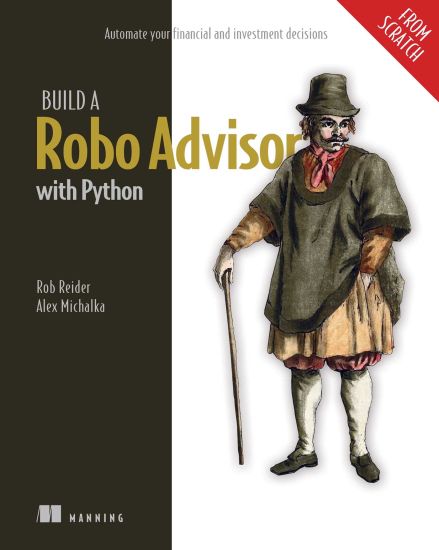
Build a Robo Advisor with Python (From Scratch)
Take control of your wealth management by building your own reliable, effective, and automated financial advisor tool. In Build a Robo Advisor with Python (From Scratch) you'll learn how to: Measure returns and estimate the benefits of robo advisors Use Monte Carlo simulations to build and test financial planning tools Construct diversified, efficient portfolios using optimization and other advanced methods Implement and evaluate rebalancing methods to track a target portfolio over time Decrease taxes through tax-loss harvesting and optimized withdrawal sequencing Use reinforcement learning to find the optimal investment path up to, and after, retirement Every day automated digital advisors, also called robo advisors, make financial decisions worth millions of dollars. Build a Robo Advisor with Python (From Scratch): Automate your financial and investment decisions teaches you how to construct a Python-based financial advisor of your very own You'll develop a flexible tool that's capable of managing a real investing strategy--all with popular free Python libraries. About the technology Automated "robo advisors" are commonplace in financial services, thanks to their ability to give high-quality investment advice at a fraction of the cost of human advisors. Your own robo advisor will be a real asset for your financial planning, whether you're saving for retirement, creating a diversified portfolio, or trying to ensure your tax efficiency. About the book In Build a Robo Advisor with Python (From Scratch), you'll design and develop a working financial advisor that can manage a real investing strategy. You'll add new features to your advisor chapter-by-chapter, including determining the optimal weight of cryptocurrency in your portfolio, rebalancing to keep your investments on target while minimizing taxes, and using reinforcement learning to find a "glide path" that can maximize how long your money will last in retirement. Best of all, the skills you learn in reinforcement learning, convex optimization, and Monte Carlo methods can be applied to numerous lucrative fields beyond the domain of finance. About the reader The book is accessible to anyone with a basic knowledge of Python and finance--no special skills required. About the author Rob Reider has been a quantitative hedge fund portfolio manager for over 15 years. He holds a PhD in Finance from The Wharton School and is an Adjunct Professor at NYU, where he teaches a graduate course in the Math-Finance department called "Time Series Analysis and Statistical Arbitrage." He has built asset allocation models, financial planning tools, and optimal tax strategies for a robo advisor. Rob has given numerous lectures that combine Python with finance, as well as developing an online course entitled "Time Series Analysis in Python." As a hedge fund manager, Rob has been involved in all aspects of the investment process, from discovering new trading strategies to backtesting, executing, and managing the risk. Alex Michalka has worked in finance and technology since 2006. He began his career developing weather derivative pricing models at Weatherbill, spent six years conducting research on quantitative equity portfolio construction at AQR Capital Management, and currently leads the investments research group at Wealthfront. He holds a BA in applied mathematics from UC Berkeley and a PhD in operations research from Columbia University.
Operational Review

Operational Review

Rob Reider

JOHN WILEY AND SONS LTD
2002
sidottu
Maximize operating results at minimum cost, using the most efficient methods The effectiveness of even the most efficient departments or organizations inevitably decays over time. Far from a simple critique, an operational review identifies what current practices have lost their usefulness and what new best practices can be implemented to ensure a function achieves its goals. Rob Reider’s Operational Review: Maximum Results at Efficient Costs, Third Edition examines reviews from every angle, showing each organization how to choose and implement the right review for them. At its heart, an operational review appraises management’s conformity with desired plans and allocation of resources. Reider’s easy-to-use guide will help readers: *Understand fundamental review principles *Understand the purpose and mechanics of conducting a review *Identify the relationship and differences between operational reviews and other procedures, such as benchmarking, activity-based costing, and reengineering, and how these procedures can be used together to identify best practices in a program for continuous improvement *Increase the skills and abilities needed to conduct a review *Increase awareness of review opportunities *Improve capability to perform reviews The third edition of this proven, popular study will guide your organization through the review process from start to finish, so that the review can be performed most economically and efficiently to maximize review results.