Kirjojen hintavertailu. Mukana 12 390 323 kirjaa ja 12 kauppaa.

Kirjahaku

Etsi kirjoja tekijän nimen, kirjan nimen tai ISBN:n perusteella.

2 kirjaa tekijältä Robert A. M. Gregson

n-Dimensional Nonlinear Psychophysics

n-Dimensional Nonlinear Psychophysics

Robert A. M. Gregson

Routledge
2021
sidottu
Originally published in 1992, this work compliments and extends the theory and results of nonlinear psychophysics – an original approach created by the author. It breaks with the traditional mathematics used in the experimental psychology of sensation and draws on what is popularly known as chaos theory and its extension into neural networks. Topical and innovative in its approach, it integrates a diversity of topics previously treated separately into one framework. The properties of the mathematics used are illustrated in the context of substantive problems in psychophysics; thus, it builds strong new bridges between the dynamics of mass action in psychophysical processes and the broader phenomena of sensation. No other treatments of the topic take quite this approach; the use of systems theory, rather than traditional equations of psychophysics dating from the mid-nineteenth century, offers a striking contrast in both theory construction and data analysis.
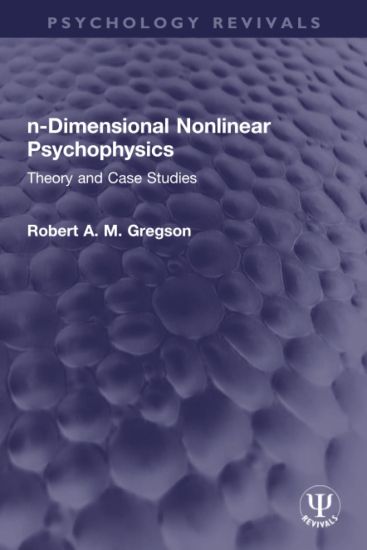
n-Dimensional Nonlinear Psychophysics

n-Dimensional Nonlinear Psychophysics

Robert A. M. Gregson

TAYLOR FRANCIS LTD
2023
nidottu
Originally published in 1992, this work compliments and extends the theory and results of nonlinear psychophysics – an original approach created by the author. It breaks with the traditional mathematics used in the experimental psychology of sensation and draws on what is popularly known as chaos theory and its extension into neural networks. Topical and innovative in its approach, it integrates a diversity of topics previously treated separately into one framework. The properties of the mathematics used are illustrated in the context of substantive problems in psychophysics; thus, it builds strong new bridges between the dynamics of mass action in psychophysical processes and the broader phenomena of sensation. No other treatments of the topic take quite this approach; the use of systems theory, rather than traditional equations of psychophysics dating from the mid-nineteenth century, offers a striking contrast in both theory construction and data analysis.