Kirjojen hintavertailu. Mukana 12 390 323 kirjaa ja 12 kauppaa.

Kirjahaku

Etsi kirjoja tekijän nimen, kirjan nimen tai ISBN:n perusteella.

8 kirjaa tekijältä Robert A. Scott

Miracle Cures

Miracle Cures

Robert A. Scott

University of California Press
2010
sidottu
Iconic images of medieval pilgrims, such as Chaucer's making their laborious way to Canterbury, conjure a distant time when faith was the only refuge of the ill and infirm, and thousands traveled great distances to pray for healing. Why, then, in an age of advanced biotechnology and medicine, do millions still go on pilgrimages? Why do journeys to important religious shrines--such as Lourdes, Compostela, Fatima, and Medjugorje--constitute a major industry? In Miracle Cures, Robert A. Scott explores these provocative questions and finds that pilgrimage continues to offer answers for many. Its benefits can range from a demonstrable improvement in health to complete recovery. Using research in biomedical and behavioral science, Scott examines accounts of miracle cures at medieval, early modern, and contemporary shrines. He inquires into the power of relics, apparitions, and the transformative nature of sacred journeying and shines new light on the roles belief, hope, and emotion can play in healing.
The Gothic Enterprise

The Gothic Enterprise

Robert A. Scott

University of California Press
2011
pokkari
The great Gothic cathedrals of Europe are among the most astonishing achievements of Western culture. Evoking feelings of awe and humility, they make us want to understand what inspired the people who had the audacity to build them. This engrossing book surveys an era that has fired the historical imagination for centuries. In it Robert A. Scott explores why medieval people built Gothic cathedrals, how they built them, what conception of the divine lay behind their creation, and how religious and secular leaders used cathedrals for social and political purposes. As a traveler's companion or a rich source of knowledge for the armchair enthusiast, "The Gothic Enterprise" helps us understand how ordinary people managed such tremendous feats of physical and creative energy at a time when technology was rudimentary, famine and disease were rampant, the climate was often harsh, and communal life was unstable and incessantly violent. While most books about Gothic cathedrals focus on a particular building or on the cathedrals of a specific region, "The Gothic Enterprise" considers the idea of the cathedral as a humanly created space. Scott discusses why an impoverished people would commit so many social and personal resources to building something so physically stupendous and what this says about their ideas of the sacred, especially the vital role they ascribed to the divine as a protector against the dangers of everyday life. Scott's narrative offers a wealth of fascinating details concerning daily life during medieval times. The author describes the difficulties master-builders faced in scheduling construction that wouldn't be completed during their own lifetimes, how they managed without adequate numeric systems or paper on which to make detailed drawings, and how climate, natural disasters, wars, variations in the hours of daylight throughout the year, and the celebration of holy days affected the pace and timing of work. Scott also explains such things as the role of relics, the quarrying and transporting of stone, and the incessant conflict cathedral-building projects caused within their communities. Finally, by drawing comparisons between Gothic cathedrals and other monumental building projects, such as Stonehenge, Scott expands our understanding of the human impulses that shape our landscape.
Miracle Cures

Miracle Cures

Robert A. Scott

University of California Press
2011
pokkari
Iconic images of medieval pilgrims, such as Chaucer's making their laborious way to Canterbury, conjure a distant time when faith was the only refuge of the ill and infirm, and thousands traveled great distances to pray for healing. Why, then, in an age of advanced biotechnology and medicine, do millions still go on pilgrimages? Why do journeys to important religious shrines - such as Lourdes, Compostela, Fatima, and Medjugorje - constitute a major industry? In "Miracle Cures", Robert A. Scott explores these provocative questions and finds that pilgrimage continues to offer answers for many. Its benefits can range from a demonstrable improvement in health to complete recovery. Using research in biomedical and behavioral science, Scott examines accounts of miracle cures at medieval, early modern, and contemporary shrines. He inquires into the power of relics, apparitions, and the transformative nature of sacred journeying and shines new light on the roles belief, hope, and emotion can play in healing.
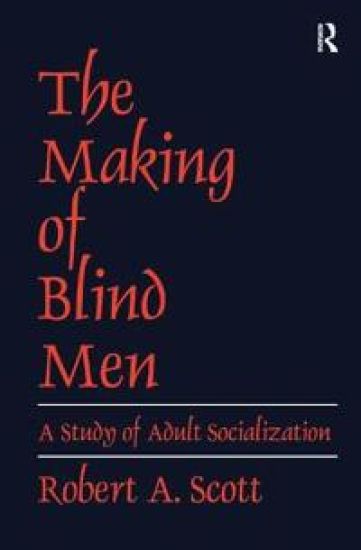
The Making of Blind Men

The Making of Blind Men

Robert A. Scott

Transaction Publishers
1981
nidottu
The disability of blindness is a learned social role. The various attitudes and patterns of behavior that characterize people who are blind are not inherent in their condition but, rather, are acquired through ordinary processes of social learning.The Making of Blind Men is intended as a systematic and integrated overview of the blindness problem in America. Dr. Scott chronicles which aspects of this problem are being dealt with by organizations for the blind and the effectiveness of this intervention system. He details the potential consequences of blind people becoming clients of blindness agencies by pointing out that many of the attitudes, behavior patterns, and qualities of character that have been assumed to be given to blind people by their condition are, in fact, products of socialization.As the self-concepts of blind men are generated by the same processes of socialization that shape us all, Dr. Scott puts forth the challenge of reforming the organized intervention system by critically evaluating the validity of blindness workers' assumptions about blindness and the blind. It is felt that an enlightened work force can then render the socialization process of the blind into a rational and deliberate force for positive change.
Encyclopedia of Inorganic Chemistry, 5 Volume Set
This 5-Volume-Set reflects the activity of the Editorial Board of the Encyclopedia of Inorganic Chemistry (EIC) to add new topics and broaden the scope of the Encyclopedia. The first volume gives a survey on the physical methods used to characterize inorganic compounds and materials, the second volume added the hot area of inorganic nanomaterials, the third focused on computational methods used in inorganic, and especially in bioinorganic chemistry, the fourth volume added the dimension of radiochemistry and especially the fate of radionuclides in the environment and the fifth volume concentrated on inorganic chemistry as a basic science for the technological development of new fuel cells and batteries. The 5-Volume-Set consists of the following volumes: Applications of Physical Methods to Inorganic and Bioinorganic ChemistryNanomaterials: Inorganic and Bioinorganic PerspectivesComputational Inorganic and Bioinorganic ChemistryRadionuclides in the EnvironmentEnergy Production and Storage : Inorganic Chemical Strategies for a Warming World These EIC Books are not available as o-Books and e-Books. However, the complete content of these EIC Books is an integral part of EIC online for further details visit the Encyclopedia of Inorganic Chemistry on Wiley Online Library: http://onlinelibrary.wiley.com/ref/eic
The Making of Blind Men

The Making of Blind Men

Robert A. Scott

Routledge
2017
sidottu
The disability of blindness is a learned social role. The various attitudes and patterns of behavior that characterize people who are blind are not inherent in their condition but, rather, are acquired through ordinary processes of social learning.The Making of Blind Men is intended as a systematic and integrated overview of the blindness problem in America. Dr. Scott chronicles which aspects of this problem are being dealt with by organizations for the blind and the effectiveness of this intervention system. He details the potential consequences of blind people becoming clients of blindness agencies by pointing out that many of the attitudes, behavior patterns, and qualities of character that have been assumed to be given to blind people by their condition are, in fact, products of socialization.As the self-concepts of blind men are generated by the same processes of socialization that shape us all, Dr. Scott puts forth the challenge of reforming the organized intervention system by critically evaluating the validity of blindness workers' assumptions about blindness and the blind. It is felt that an enlightened work force can then render the socialization process of the blind into a rational and deliberate force for positive change.
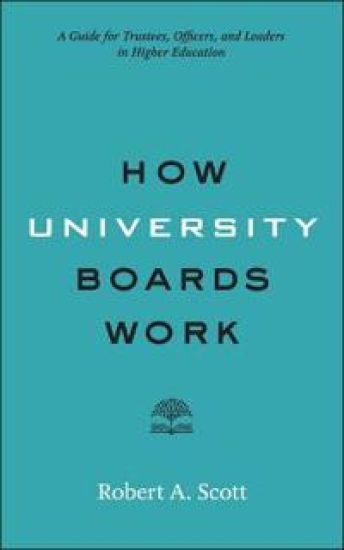
How University Boards Work

How University Boards Work

Robert A. Scott

Johns Hopkins University Press
2018
pokkari
An expert guide designed to help university trustees become effective leaders.Honorable Mention for Eric Hoffer Award (Business Category) by The Hoffer ProjectWe expect college and university trustees to hire the president, advise senior staff, manage investments and financial decisions, and oversee major strategic initiatives. Unfortunately, they sometimes come into this powerful role with little or no understanding of what they are meant to do or how their institutions work.How University Boards Work, by Robert A. Scott, is designed to help trustees understand how to fulfill their responsibilities. Written by a widely respected leader in American higher education and former university president, How University Boards Work is the product of personal experience and considerable research. This concise, straightforward guide includes:• an explanation of the difference between governance and management• tips on how best to prepare for board decisions and discussions• examples of positive and negative board behavior• guidance about board professional development• advice on managing transitions between chief executivesHow University Boards Work will prove an invaluable resource for those responsible for governing colleges and universities, whether privately financed or state funded. It will also be an illuminating read for board secretaries, campus executives and administrators, faculty leaders, alumni volunteers, and public officials, as well as anybody seeking to understand institutional governance in the light of past and current trends in higher education.
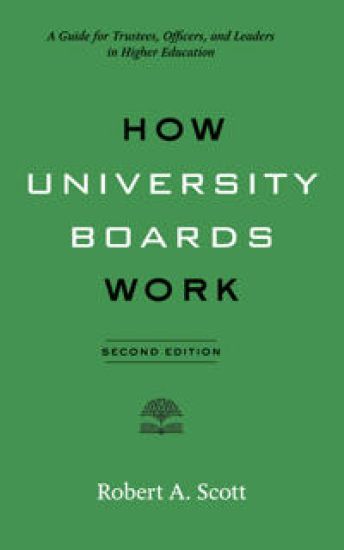
How University Boards Work

How University Boards Work

Robert A. Scott

Johns Hopkins University Press
2026
pokkari
A completely updated guide to helping university trustees become effective stewards of their institutions. Boards of trustees hold immense responsibility in guiding the future of colleges and universities. They hire and fire presidents, approve and monitor strategy, oversee finances, and safeguard institutional missions and autonomy. Yet many trustees enter this role with limited understanding of the distinct culture, structure, and values of the academic institutions they are selected to govern. In this second edition of How University Boards Work, former university president Robert A. Scott offers a practical and candid guide for navigating the complexities of academic board service. Originally published in 2018 and widely adopted in board development programs, this updated edition incorporates insights gleaned from years of training sessions, executive coaching, and a radically altered higher education landscape. Elements unique to this edition include: • A new preface addressing the contemporary pressures affecting higher education governance, including political interference, enrollment challenges, changing public attitudes, tuition pricing, overall costs and ROI, and post-pandemic adaptations. • Expanded guidance on key topics such as consent agendas, indicators of institutional vitality and vulnerability, risk assessment, and succession planning. • Updated index entries and terminology reflecting evolving governance concerns such as cybersecurity and free speech. With illustrative examples of effective and problematic board behavior and actionable suggestions for trustee development, How University Boards Work remains the definitive primer for trustees of both public and private institutions.