Kirjojen hintavertailu. Mukana 11 244 527 kirjaa ja 12 kauppaa.

Kirjahaku

Etsi kirjoja tekijän nimen, kirjan nimen tai ISBN:n perusteella.

14 kirjaa tekijältä Robert B. Brandom

Pragmatism and Idealism

Pragmatism and Idealism

Robert B. Brandom

Oxford University Press
2022
nidottu
In this short book, based upon his Spinoza Lectures at the University of Amsterdam, Robert B. Brandom offers a pragmatist approach to representation and reality, drawing on Richard Rorty and Hegel. During the last decade of his life, Rorty emphasized the anti-authoritarian credentials of his pragmatism. He came to see pragmatism as the fighting faith of a second phase of the Enlightenment. The first stage, as Rorty construed it, concerned our emancipation from nonhuman authority in practical matters: issues of what we ought to do and how things ought to be. The envisaged second stage addresses rather our emancipation from nonhuman authority in theoretical matters. Brandom shows how pragmatism moves beyond the traditional model of reality as authoritative over our cognitive representations of it in language and thought, to a new conception of how discursive practices help us cope with the vicissitudes of life. Hegel anticipates the challenge to the very idea of objective reality as providing norms for thought which Rorty believed required us to enact a second phase of the Enlightenment. Unlike Rorty, Hegel presents a detailed, constructive, anti-authoritarian, non-fetishistic, social pragmatist account of the representational dimension of conceptual content. At its heart is an account of the social dimension of discursive normativity in terms of reciprocal recognition, and an account of the historical dimension of discursive normativity in terms of a distinctive new conception of reason: the recollective rationality that turns a past into a tradition. His idealism thereby offers a concrete pragmatist alternative to Rorty's global semantic and epistemological anti-representationalism.
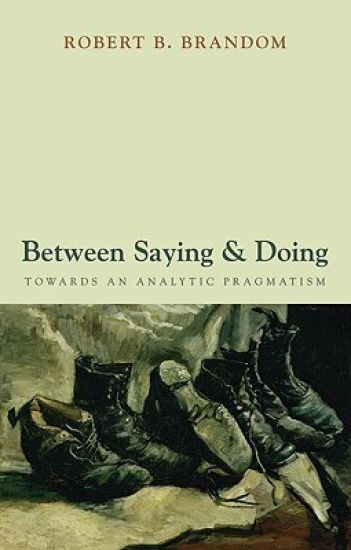
Between Saying and Doing

Between Saying and Doing

Robert B. Brandom

Oxford University Press
2008
sidottu
Between Saying and Doing aims to reconcile pragmatism (in both its classical American and its Wittgensteinian forms) with analytic philosophy. It investigates the relations between the meaning of linguistic expressions and their use. Giving due weight both to what one has to do in order to count as saying various things and to what one needs to say in order to specify those doings, makes it possible to shed new light on the relations between semantics (the theory of the meanings of utterances and the contents of thoughts) and pragmatics (the theory of the functional relations among meaningful or contentful items). Among the vocabularies whose interrelated use and meaning are considered are: logical, indexical, modal, normative, and intentional vocabulary. As the argument proceeds, new ways of thinking about the classic analytic core programs of empiricism, naturalism, and functionalism are offered, as well as novel insights about the ideas of artificial intelligence, the nature of logic, and intentional relations between subjects and objects.
Between Saying and Doing

Between Saying and Doing

Robert B. Brandom

Oxford University Press
2010
nidottu
Between Saying and Doing aims to reconcile pragmatism (in both its classical American and its Wittgensteinian forms) with analytic philosophy. It investigates the relations between the meaning of linguistic expressions and their use. Giving due weight both to what one has to do in order to count as saying various things and to what one needs to say in order to specify those doings, makes it possible to shed new light on the relations between semantics (the theory of the meanings of utterances and the contents of thoughts) and pragmatics (the theory of the functional relations among meaningful or contentful items). Among the vocabularies whose interrelated use and meaning are considered are: logical, indexical, modal, normative, and intentional vocabulary. As the argument proceeds, new ways of thinking about the classic analytic core programs of empiricism, naturalism, and functionalism are offered, as well as novel insights about the ideas of artificial intelligence, the nature of logic, and intentional relations between subjects and objects.
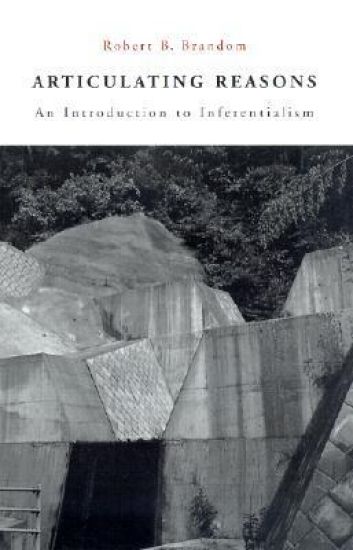
Articulating Reasons

Articulating Reasons

Robert B. Brandom

Harvard University Press
2001
nidottu
Robert B. Brandom is one of the most original philosophers of our day, whose book Making It Explicit covered and extended a vast range of topics in metaphysics, epistemology, and philosophy of language--the very core of analytic philosophy. This new work provides an approachable introduction to the complex system that Making It Explicit mapped out. A tour of the earlier book's large ideas and relevant details, Articulating Reasons offers an easy entry into two of the main themes of Brandom's work: the idea that the semantic content of a sentence is determined by the norms governing inferences to and from it, and the idea that the distinctive function of logical vocabulary is to let us make our tacit inferential commitments explicit.Brandom's work, making the move from representationalism to inferentialism, constitutes a near-Copernican shift in the philosophy of language--and the most important single development in the field in recent decades. Articulating Reasons puts this accomplishment within reach of nonphilosophers who want to understand the state of the foundations of semantics.
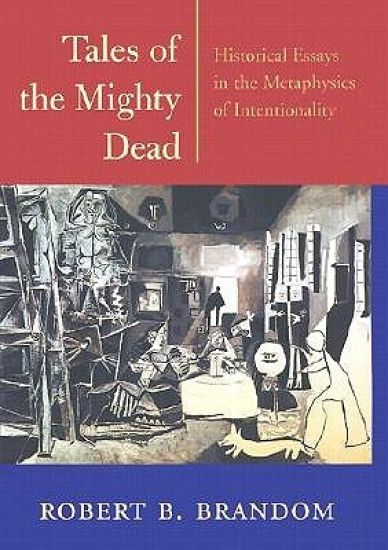
Tales of the Mighty Dead

Tales of the Mighty Dead

Robert B. Brandom

Harvard University Press
2002
sidottu
A work in the history of systematic philosophy that is itself animated by a systematic philosophic aspiration, this book by one of the most prominent American philosophers working today provides an entirely new way of looking at the development of Western philosophy from Descartes to the present.Brandom begins by setting out a historical context and outlining a methodological rationale for his enterprise. Then, in chapters on Spinoza, Leibniz, Hegel, Frege, Heidegger, and Sellars, he pursues the most fundamental philosophical issues concerning intentionality, and therefore mindedness itself, revealing an otherwise invisible set of overlapping themes and explanatory strategies. Variously functionalist, inferentialist, holist, normative, and social pragmatist in character, the explanations of intentionality offered by these philosophers, taken together, form a distinctive tradition. The fresh perspective afforded by this tradition enriches our understanding of the philosophical topics being addressed, provides a new conceptual vantage point for viewing our philosophical ancestors, and highlights central features of the sort of rationality that consists in discerning a philosophical tradition--and it does so by elaborating a novel, concrete instance of just such an enterprise.
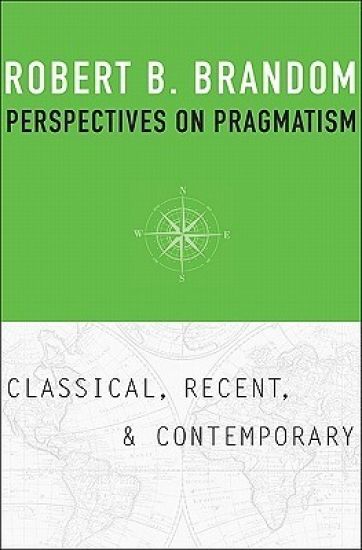
Perspectives on Pragmatism

Perspectives on Pragmatism

Robert B. Brandom

Harvard University Press
2011
sidottu
Pragmatism has been reinvented in every generation since its beginnings in the late nineteenth century. This book, by one of today’s most distinguished contemporary heirs of pragmatist philosophy, rereads cardinal figures in that tradition, distilling from their insights a way forward from where we are now.Perspectives on Pragmatism opens with a new accounting of what is living and what is dead in the first three generations of classical American pragmatists, represented by Charles Sanders Peirce, William James, and John Dewey. Post-Deweyan pragmatism at midcentury is discussed in the work of Wilfrid Sellars, one of its most brilliant and original practitioners. Sellars’ legacy in turn is traced through the thought of his admirer, Richard Rorty, who further developed James’s and Dewey’s ideas within the professional discipline of philosophy and once more succeeded, as they had, in showing the more general importance of those ideas not only for intellectuals outside philosophy but for the wider public sphere.The book closes with a clear description of the author’s own analytic pragmatism, which combines all these ideas with those of Ludwig Wittgenstein, and synthesizes that broad pragmatism with its dominant philosophical rival, analytic philosophy, which focuses on language and logic. The result is a treatise that allows us to see American philosophy in its full scope, both its origins and its promise for tomorrow.
From Empiricism to Expressivism

From Empiricism to Expressivism

Robert B. Brandom

Harvard University Press
2015
sidottu
The American philosopher Wilfrid Sellars ranks as one of the leading twentieth-century critics of empiricism—a philosophical approach to knowledge that seeks to ground it in human sense experience. Sellars stood in the forefront of a recoil within analytic philosophy from the foundationalist assumptions of contemporary empiricists. From Empiricism to Expressivism is a far-reaching reinterpretation of Sellars from one of the philosopher’s most brilliant intellectual heirs.Unifying and extending Sellars’s most important ideas, Robert Brandom constructs a theory of pragmatic expressivism which, in contrast to empiricism, understands meaning and knowledge in terms of the role expressions play in social practices. The key lies in Sellars’s radical reworking of Kant’s idea of the categories: the idea that the expressive job characteristic of many of the most important philosophical concepts is not to describe or explain the empirical world but rather to make explicit essential features of the conceptual framework that makes description and explanation possible.Brandom reconciles otherwise disparate elements of Sellars’s system, revealing a greater level of coherence and consistency in the philosopher’s arguments against empiricism than has usually been acknowledged. From Empiricism to Expressivism clarifies what Sellars had in mind when he talked about moving analytic philosophy from its Humean to its Kantian phase, and why such a move might be of crucial importance today.
Making It Explicit

Making It Explicit

Robert B. Brandom

Harvard University Press
1998
nidottu
What would something unlike us--a chimpanzee, say, or a computer--have to be able to do to qualify as a possible knower, like us? To answer this question at the very heart of our sense of ourselves, philosophers have long focused on intentionality and have looked to language as a key to this condition. Making It Explicit is an investigation into the nature of language--the social practices that distinguish us as rational, logical creatures--that revises the very terms of this inquiry. Where accounts of the relation between language and mind have traditionally rested on the concept of representation, this book sets out an alternate approach based on inference, and on a conception of certain kinds of implicit assessment that become explicit in language. Making It Explicit is the first attempt to work out in detail a theory that renders linguistic meaning in terms of use--in short, to explain how semantic content can be conferred on expressions and attitudes that are suitably caught up in social practices.At the center of this enterprise is a notion of discursive commitment. Being able to talk--and so in the fullest sense being able to think--is a matter of mastering the practices that govern such commitments, being able to keep track of one's own commitments and those of others. Assessing the pragmatic significance of speech acts is a matter of explaining the explicit in terms of the implicit. As he traces the inferential structure of the social practices within which things can be made conceptually explicit, the author defines the distinctively expressive role of logical vocabulary. This expressive account of language, mind, and logic is, finally, an account of who we are.
Reason in Philosophy

Reason in Philosophy

Robert B. Brandom

The Belknap Press
2013
nidottu
Transcendentalism never came to an end in America. It just went underground for a stretch, but is back in full force in Robert Brandom’s new book. Brandom takes up Kant and Hegel and explores their contemporary significance as if little time had expired since intellectuals gathered around Emerson in Concord to discuss reason and idealism, selves, freedom, and community. Brandom’s discussion belongs to a venerable tradition that distinguishes us as rational animals, and philosophy by its concern to understand, articulate, and explain the notion of reason that is thereby cast in that crucial demarcating role.An emphasis on our capacity to reason, rather than merely to represent, has been growing in philosophy over the last thirty years, and Robert Brandom has been at the center of this development. Reason in Philosophy is the first book that gives a succinct overview of his understanding of the role of reason as the structure at once of our minds and our meanings—what constitutes us as free, responsible agents. The job of philosophy is to introduce concepts and develop expressive tools for expanding our self-consciousness as sapients: explicit awareness of our discursive activity of thinking and acting, in the sciences, politics, and the arts. This is a paradigmatic work of contemporary philosophy.
A Spirit of Trust

A Spirit of Trust

Robert B. Brandom

The Belknap Press
2019
sidottu
Forty years in the making, this long-awaited reinterpretation of Hegel’s The Phenomenology of Spirit is a landmark contribution to philosophy by one of the world’s best-known and most influential philosophers.In this much-anticipated work, Robert Brandom presents a completely new retelling of the romantic rationalist adventure of ideas that is Hegel’s classic The Phenomenology of Spirit. Connecting analytic, continental, and historical traditions, Brandom shows how dominant modes of thought in contemporary philosophy are challenged by Hegel.A Spirit of Trust is about the massive historical shift in the life of humankind that constitutes the advent of modernity. In his Critiques, Kant talks about the distinction between what things are in themselves and how they appear to us; Hegel sees Kant’s distinction as making explicit what separates the ancient and modern worlds. In the ancient world, normative statuses—judgments of what ought to be—were taken to state objective facts. In the modern world, these judgments are taken to be determined by attitudes—subjective stances. Hegel supports a view combining both of those approaches, which Brandom calls “objective idealism”: there is an objective reality, but we cannot make sense of it without first making sense of how we think about it.According to Hegel’s approach, we become agents only when taken as such by other agents. This means that normative statuses such as commitment, responsibility, and authority are instituted by social practices of reciprocal recognition. Brandom argues that when our self-conscious recognitive attitudes take the radical form of magnanimity and trust that Hegel describes, we can overcome a troubled modernity and enter a new age of spirit.