
Kirjahaku
Etsi kirjoja tekijän nimen, kirjan nimen tai ISBN:n perusteella.
17 kirjaa tekijältä Robert Blake

Illuminates 250 years of constitutional history by discussing the relations between the Prime Minister, the Crown, the Cabinet and both Houses of Parliament.

There was no more appropriate person to write this book. Robert Blake was the doyen of Tory historians being most famous for his unsurpassed biography of Disraeli (to be reissued in Faber Finds). His history of the Conservative Party was first published in 1970. It then went as far as Churchill. A subsequent edition took it up to Thatcher and the final edition, the one being reissued by Faber Finds, to Major. For the span it covers, it remains the definitive one-volume history.'His consummate insight into the whole of the political scene, and his power to communicate the enjoyment of it, makes this exciting reading for anyone remotely interested in British political and social history, or even in the English character.' Sunday Times'This book is full of insights and enriched throughout by sparkling commentary' Evening Standard'An up-to-date history of the Party was wanted. Mr Blake supplies it with lucidity, scholarship and serene worldliness' Guardian

First published in 1966, Robert Blake's biography of Disraeli is one of the supreme political biographies of the last hundred years.An outsider, a nationalist, a European, a Romantic and a Tory - Disraeli's story is an extraordinary one. Born in 1804, the grandson of an immigrant Italian Jew, he became leader of the Conservative Party and was twice Prime Minister. Famous for the 1867 Reform Act, his purchasing of the Suez Canal and his diplomatic triumphs at the Congress of Berlin, he was also the creator of the political novel and, in Sybil, wrote the major 'Condition of England' work of fiction.'An outstandingly successful biography . . . Disraeli has never been brought so vividly to life.' Sir Philip Magnus, Daily Telegraph'A huge, scholarly and remarkably readable work which makes us revise vast tracts of our assumptions about nineteenth-century politics.' Sir Michael Howard, Sunday Times'A book that people will still be reading in fifty years' time and long after.' Times Literary Supplement

In his preface Robert Blake writes, 'The title of this book is taken from a remark attributed to Asquith after he had attended Bonar Law's funeral in Westminster Abbey. ''It is fitting,'' he is reputed to have said, ''that we should have buried the Unknown Prime Minister by the side of the Unknown Soldier.'' I have used this phrase, not because I consider that Asquith's remark was either just or true, but because, however unfairly, it has come to be the verdict of most people today. Even in his own lifetime Bonar Law's origins, career, character, and the reasons for his success acquired something of an aura of mystery which the passage of time has done nothing to remove. It is my hope that this book may dispel that erroneous impression.'It does. Neither flamboyant nor possessed of the statesmanship of Lloyd George or Winston Churchill, Bonar Law nevertheless was a remarkably successful politician, especially a party politician. Before his brief Premiership in 1922-23, he had been the Leader of the Conservative Party for eleven years from 1911 and in that time had played a vital part in almost every political issue. During the 1914-18 war his role was crucial. It was his decision which brought about the first coalition of 1915 and the exclusion of Winston Churchill from the Admiralty. He was largely responsible for the withdrawal from the Dardanelles and the overthrow of Asquith in 1916. It was his support that allowed Lloyd George to become Prime Minister and it was the withdrawal of that support that led to the end of the Coalition Government in 1922. The fact that the Conservative Party survived the chaotic war years, unlike the Liberal Party, and survived with an outlook sufficiently enlightened to cope not inadequately with the problems of the post-war era, was the achievement of Bonar Law more than any other single person. By nature melancholy, this disposition was aggravated by personal tragedy: first his wife died and then his two elder sons were killed in 1917. For all that he remained someone who inspired affection in such otherwise diverse characters as Lloyd George, F. E. Smith (Lord Birkenhead), John Maynard Keynes, Edward Carson and Lord Beaverbrook.

Between the disintegration of the Liberal Party in 1915 and the election of Harold Wilson's Labour in 1964, Britain weathered a turbulent half-century including two world wars and many profound socio-political changes. What did not survive this tumult was Britain's sea-based Empire, as the great land-based USA and USSR now assumed dominance. With customary wit, scholarship and wisdom Robert Blake guides the reader through Britain's slow decline from the world's premier power to a nation with no military commitments East of Suez: still important, wishing to see itself as 'a cut above the rest', but now effectively no better than third-ranking. '[T]he most successful sections [are] the four brilliant chapters on the Second World War... But it is not only for these that The Decline of Power should be read. It is a fair-minded book... fluently, even racily written...' Peter Pulzer, London Review of Books

'Lively and entertaining... [Disraeli's Grand Tour] concentrates on one colourful episode, or sequence of episodes, in the young Disraeli's life: the tour through the Mediterranean and Near East which he undertook with the man who was intended to become his brother-in-law. On the way they were joined by raffish Wykhamist James Clay, a friend of Disraeli's brother, and also by Tita Falcieri, who had formerly been a servant to Byron. Indeed... much of the tour might almost be considered a Byronic pilgrimage of a kind... Lord Blake suggests that [Disraeli's] travels in the provinces of the Ottoman Empire inclined him, when in office many years later, to take a more favourable attitude to Turkish power than was common among Englishmen of his time. However, the author is more interested in tracing the effects of the visit to the Holy Land on Disraeli's view of his own position as a Jew converted to Christianity and an aspirant man-of-letters and politician.' Dan Jacobson, London Review of Books
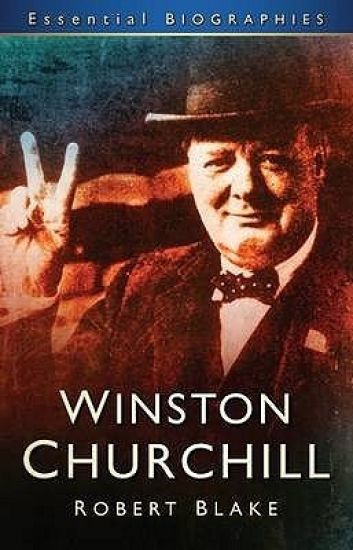
Winston Churchill is probably still the best-known Prime Minster of Great Britain. Born at Blenheim Palace, he joined the army after Harrow, but in 1899 resigned his commission to report on the Boer War. Elected to Parliament in 1900, he served in both Conservative and Liberal governments, and became Chancellor of the Exechequer under Baldwin, A period in the political wilderness was ended by the declaration of the Second World War and his appointment to the Admiralty; after Chamberlain's resignation in 1940 he led a coalition government. He worked closely with Roosevelt and to a lesser degree with Stalin throughout the war. He lost the election of 1945 but became Prime Minister again from 1951 to 1955. His last years saw a return to writing, including his memoirs of the Second World War.

First published in 1977, A History of Rhodesia is a history of the origins and course of modern European occupation of ‘Southern Rhodesia’, ‘Rhodesia’ as it has been termed since the old ‘Northern Rhodesia’ became independent under the name Zambia in 1963. Robert Blake describes the years of the Monomotapa; the Portuguese occupation in the sixteenth and seventeenth centuries; the Ndebele kingdom of the nineteenth century; the advent of Cecil Rhodes and the establishment of the Chartered Company which ruled Rhodesia until 1922; the period Southern Rhodesia enjoyed a self-governing colony from 1923 to 1951; the years of the Central African Federation from 1953 to its dissolution in 1963; and finally the dramatic course of events which led to Ian Smith’s government making a unilateral declaration of independence in 1965. The years since UDI are covered by a long epilogue that takes the story forward to the early months of 1977.Rhodesian history is a strange and intriguing compound of romance, idealism, courage, arrogance, avarice and accident. Rhodesia’s story is not only that of economic, political, ideological and external forces which have shaped it—it is also that of the individuals who made—or failed to make decisions: Rhodes, Lobengula, Jameson, Lord Malvern, Roy Welensky, Garfield Todd, Joshua Nkomo, Ian Smith.Written with access to many collections of papers not normally available to historians, Robert Blake’s book is a major contribution to the history of colonial and post-colonial Africa.

First published in 1977, A History of Rhodesia is a history of the origins and course of modern European occupation of ‘Southern Rhodesia’, ‘Rhodesia’ as it has been termed since the old ‘Northern Rhodesia’ became independent under the name Zambia in 1963. Robert Blake describes the years of the Monomotapa; the Portuguese occupation in the sixteenth and seventeenth centuries; the Ndebele kingdom of the nineteenth century; the advent of Cecil Rhodes and the establishment of the Chartered Company which ruled Rhodesia until 1922; the period Southern Rhodesia enjoyed a self-governing colony from 1923 to 1951; the years of the Central African Federation from 1953 to its dissolution in 1963; and finally the dramatic course of events which led to Ian Smith’s government making a unilateral declaration of independence in 1965. The years since UDI are covered by a long epilogue that takes the story forward to the early months of 1977. Rhodesian history is a strange and intriguing compound of romance, idealism, courage, arrogance, avarice and accident. Rhodesia’s story is not only that of economic, political, ideological and external forces which have shaped it—it is also that of the individuals who made—or failed to make decisions: Rhodes, Lobengula, Jameson, Lord Malvern, Roy Welensky, Garfield Todd, Joshua Nkomo, Ian Smith. Written with access to many collections of papers not normally available to historians, Robert Blake’s book is a major contribution to the history of colonial and post-colonial Africa.

The Nuns Of Minsk, A Tale Of Russian Atrocities In Poland
Robert Blake
KESSINGER PUBLISHING, LLC
2010
pokkari


The Nuns Of Minsk, A Tale Of Russian Atrocities In Poland
Robert Blake
KESSINGER PUBLISHING, LLC
2010
sidottu

Unrepentant Tory: The Life and Times of Andrew Bonar Law, 1858-1923, Prime Minister of the United Kingdom
Robert Blake
Literary Licensing, LLC
2011
nidottu