Kirjojen hintavertailu. Mukana 11 342 296 kirjaa ja 12 kauppaa.

Kirjahaku

Etsi kirjoja tekijän nimen, kirjan nimen tai ISBN:n perusteella.

11 kirjaa tekijältä Robert C. Allen

Enclosure and the Yeoman

Enclosure and the Yeoman

Robert C. Allen

Clarendon Press
1992
sidottu
This book traces the shift from medieval to modern institutions in English agriculture. It explores their importance for productivity growth, income distribution, and the contribution of agriculture to British economic development. Robert C. Allen's pioneering study shows that, contrary to the assumption of many historians, small-scale farmers in the open-field system were responsible for a considerable proportion of the productivity growth achieved between the middle ages and the nineteenth century. The process of enclosure and the replacement of these yeomen by large-scale tenant farming relying on wage labour had relatively little impact on the agricultural contribution to economic development during the industrial revolution. Enclosures and large farms enriched landowners without benefiting consumers, workers, or farmers. Thoroughly grounded in the archival sources, and underpinned by rigorous economic analysis, Enclosure and the Yeoman is a scholarly and challenging reassessment of the history of English agriculture. It will be indispensable reading for all historians concerned with the making of modern Britain.
The Industrial Revolution

The Industrial Revolution

Robert C. Allen

Oxford University Press
2017
nidottu
The 'Industrial Revolution' was a pivotal point in British history that occurred between the mid-eighteenth and mid-nineteenth centuries and led to far reaching transformations of society. With the advent of revolutionary manufacturing technology productivity boomed. Machines were used to spin and weave cloth, steam engines were used to provide reliable power, and industry was fed by the construction of the first railways, a great network of arteries feeding the factories. Cities grew as people shifted from agriculture to industry and commerce. Hand in hand with the growth of cities came rising levels of pollution and disease. Many people lost their jobs to the new machinery, whilst working conditions in the factories were grim and pay was low. As the middle classes prospered, social unrest ran through the working classes, and the exploitation of workers led to the growth of trade unions and protest movements. In this Very Short Introduction, Robert C. Allen analyzes the key features of the Industrial Revolution in Britain, and the spread of industrialization to other countries. He considers the factors that combined to enable industrialization at this time, including Britain's position as a global commercial empire, and discusses the changes in technology and business organization, and their impact on different social classes and groups. Introducing the 'winners' and the 'losers' of the Industrial Revolution, he looks at how the changes were reflected in evolving government policies, and what contribution these made to the economic transformation. ABOUT THE SERIES: The Very Short Introductions series from Oxford University Press contains hundreds of titles in almost every subject area. These pocket-sized books are the perfect way to get ahead in a new subject quickly. Our expert authors combine facts, analysis, perspective, new ideas, and enthusiasm to make interesting and challenging topics highly readable.
Global Economic History

Global Economic History

Robert C. Allen

Oxford University Press
2026
nidottu
Very Short Introductions: Brilliant, Sharp, Inspiring Why are some countries rich, and some poor? Does this status persist throughout time, and if so, why? How can a country escape poverty? In this Very Short Introduction, Robert C. Allen explores the interplay of geography, globalization, technological change, economic policy, and institutions, to show how they have determined the wealth and poverty of nations around the world. Using historical examples to analyse the factors that have influenced growth, he exposes what has caused the unequal world we live in today, focusing on recent changes in equality and world economic disruption. ABOUT THE SERIES: The Very Short Introductions series from Oxford University Press contains hundreds of titles in almost every subject area. These pocket-sized books are the perfect way to get ahead in a new subject quickly. Our expert authors combine facts, analysis, perspective, new ideas, and enthusiasm to make interesting and challenging topics highly readable.
Global Economic History

Global Economic History

Robert C. Allen

Oxford University Press
2011
nidottu
Why are some countries rich and others poor? In 1500, the income differences were small, but they have grown dramatically since Columbus reached America. Since then, the interplay between geography, globalization, technological change, and economic policy has determined the wealth and poverty of nations. The industrial revolution was Britain's path breaking response to the challenge of globalization. Western Europe and North America joined Britain to form a club of rich nations by pursuing four polices-creating a national market by abolishing internal tariffs and investing in transportation, erecting an external tariff to protect their fledgling industries from British competition, banks to stabilize the currency and mobilize domestic savings for investment, and mass education to prepare people for industrial work. Together these countries pioneered new technologies that have made them ever richer. Before the Industrial Revolution, most of the world's manufacturing was done in Asia, but industries from Casablanca to Canton were destroyed by western competition in the nineteenth century, and Asia was transformed into 'underdeveloped countries' specializing in agriculture. The spread of economic development has been slow since modern technology was invented to fit the needs of rich countries and is ill adapted to the economic and geographical conditions of poor countries. A few countries - Japan, Soviet Russia, South Korea, Taiwan, and perhaps China - have, nonetheless, caught up with the West through creative responses to the technological challenge and with Big Push industrialization that has achieved rapid growth through investment coordination. Whether other countries can emulate the success of East Asia is a challenge for the future. ABOUT THE SERIES: The Very Short Introductions series from Oxford University Press contains hundreds of titles in almost every subject area. These pocket-sized books are the perfect way to get ahead in a new subject quickly. Our expert authors combine facts, analysis, perspective, new ideas, and enthusiasm to make interesting and challenging topics highly readable.
To Be Continued...

To Be Continued...

Robert C. Allen

Routledge
1994
sidottu
To Be Continued... explores the world's most popular form of television drama; the soap opera. From Denver to Delhi, Moscow to Manchester, audiences eagerly await the next episode of As the World Turns, The Rich Also Weep or Eastenders. But the popularity of soap operas in Britain and the US pales in comparison to the role that they play in media cultures in other parts of the world.To Be Continued... investigates both the cultural specificity of television soap operas and their reception in other cultures, covering soap production and soap watching in the U.S., Asia, Europe, Australia and Latin America. The contributors consider the nature of soap as a media text, the history of the serial narrative as a form, and the role of the soap opera in the development of feminist media criticism.To Be Continued... presents the first scholarly examination of soap opera as global media phenomenon.
To Be Continued...

To Be Continued...

Robert C. Allen

Routledge
1994
nidottu
To Be Continued... explores the world's most popular form of television drama; the soap opera. From Denver to Delhi, Moscow to Manchester, audiences eagerly await the next episode of As the World Turns, The Rich Also Weep or Eastenders. But the popularity of soap operas in Britain and the US pales in comparison to the role that they play in media cultures in other parts of the world.To Be Continued... investigates both the cultural specificity of television soap operas and their reception in other cultures, covering soap production and soap watching in the U.S., Asia, Europe, Australia and Latin America. The contributors consider the nature of soap as a media text, the history of the serial narrative as a form, and the role of the soap opera in the development of feminist media criticism.To Be Continued... presents the first scholarly examination of soap opera as global media phenomenon.
The British Industrial Revolution in Global Perspective

The British Industrial Revolution in Global Perspective

Robert C. Allen

Cambridge University Press
2009
pokkari
Why did the industrial revolution take place in eighteenth-century Britain and not elsewhere in Europe or Asia? In this convincing new account Robert Allen argues that the British industrial revolution was a successful response to the global economy of the seventeenth and eighteenth centuries. He shows that in Britain wages were high and capital and energy cheap in comparison to other countries in Europe and Asia. As a result, the breakthrough technologies of the industrial revolution - the steam engine, the cotton mill, and the substitution of coal for wood in metal production - were uniquely profitable to invent and use in Britain. The high wage economy of pre-industrial Britain also fostered industrial development since more people could afford schooling and apprenticeships. It was only when British engineers made these new technologies more cost-effective during the nineteenth century that the industrial revolution would spread around the world.
The British Industrial Revolution in Global Perspective

The British Industrial Revolution in Global Perspective

Robert C. Allen

Cambridge University Press
2009
sidottu
Why did the industrial revolution take place in eighteenth-century Britain and not elsewhere in Europe or Asia? In this convincing new account Robert Allen argues that the British industrial revolution was a successful response to the global economy of the seventeenth and eighteenth centuries. He shows that in Britain wages were high and capital and energy cheap in comparison to other countries in Europe and Asia. As a result, the breakthrough technologies of the industrial revolution - the steam engine, the cotton mill, and the substitution of coal for wood in metal production - were uniquely profitable to invent and use in Britain. The high wage economy of pre-industrial Britain also fostered industrial development since more people could afford schooling and apprenticeships. It was only when British engineers made these new technologies more cost-effective during the nineteenth century that the industrial revolution would spread around the world.
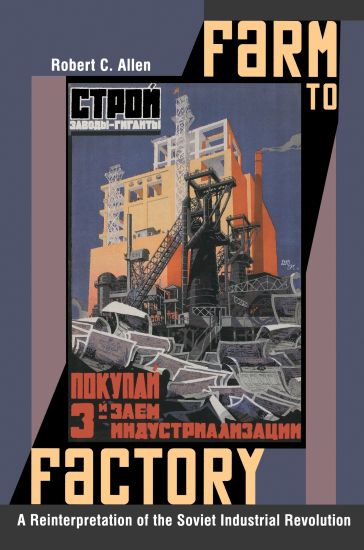
Farm to Factory

Farm to Factory

Robert C. Allen

Princeton University Press
2009
pokkari
To say that history's greatest economic experiment--Soviet communism--was also its greatest economic failure is to say what many consider obvious. Here, in a startling reinterpretation, Robert Allen argues that the USSR was one of the most successful developing economies of the twentieth century. He reaches this provocative conclusion by recalculating national consumption and using economic, demographic, and computer simulation models to address the "what if" questions central to Soviet history. Moreover, by comparing Soviet performance not only with advanced but with less developed countries, he provides a meaningful context for its evaluation. Although the Russian economy began to develop in the late nineteenth century based on wheat exports, modern economic growth proved elusive. But growth was rapid from 1928 to the 1970s--due to successful Five Year Plans. Notwithstanding the horrors of Stalinism, the building of heavy industry accelerated growth during the 1930s and raised living standards, especially for the many peasants who moved to cities. A sudden drop in fertility due to the education of women and their employment outside the home also facilitated growth. While highlighting the previously underemphasized achievements of Soviet planning, Farm to Factory also shows, through methodical analysis set in fluid prose, that Stalin's worst excesses--such as the bloody collectivization of agriculture--did little to spur growth. Economic development stagnated after 1970, as vital resources were diverted to the military and as a Soviet leadership lacking in original thought pursued wasteful investments.
Fading Ads of Detroit

Fading Ads of Detroit

Robert C. Allen

History Press
2018
nidottu
Detroit Free Press journalist Robert Allen sifts through these advertising fossils, exposing the gripping stories connected to the Motor City's historic rises, falls and eccentricities.Across Detroit, fleeting symbols of the past hide in plain sight, behind weeds and under veneers of paint. Demolishing a vacant building among empty storefronts on the west side uncovered the telltale gold and green of a Vernors Ginger Ale sign, preserved almost as vibrantly as the artist intended. In faded red, white and blue, Mac-O-Lac Paint makes an expired pitch to passersby on Gratiot near Eastern Market. On the east side, Mohawk Rock and Rye still declares itself the World's Finest Carhartt, Stroh's and Faygo appear in odd, deserted places.
Fading Ads of Detroit

Fading Ads of Detroit

Robert C. Allen

History Press Library Editions
2018
sidottu
Across Detroit, fleeting symbols of the past hide in plain sight, behind weeds and under veneers of paint. Demolishing a vacant building among empty storefronts on the west side uncovered the telltale gold and green of a Vernors Ginger Ale sign, preserved almost as vibrantly as the artist intended. In faded red, white and blue, Mac-O-Lac Paint makes an expired pitch to passersby on Gratiot near Eastern Market. On the east side, Mohawk Rock and Rye still declares itself the "World's Finest " Carhartt, Stroh's and Faygo appear in odd, deserted places. Detroit Free Press journalist Robert Allen sifts through these advertising fossils, exposing the gripping stories connected to the Motor City's historic rises, falls and eccentricities.