
Kirjojen hintavertailu. Mukana 11 699 587 kirjaa ja 12 kauppaa.

Kirjahaku

Etsi kirjoja tekijän nimen, kirjan nimen tai ISBN:n perusteella.

3 kirjaa tekijältä Robert Cryer

The Development of International Humanitarian Law by the International Criminal Tribunals
In response to some of the most protracted and brutal conflicts of the last twenty years, the United Nations has created several ad hoc criminal tribunals tasked with bringing the perpetrators of war crimes, crimes against humanity, and crimes of genocide to justice. This book analyses the jurisprudence of these ad hoc tribunals, comprising the International Criminal Tribunal for the Former Yugoslavia, the International Criminal Tribunal for Rwanda, and the Special Court for Sierra Leone. Their decisions have been the subject of considerable discussion with regard to their approach and contributions to international criminal law. However, their contributions to international humanitarian law, through its interpretation and application, have been largely overlooked. This is unfortunate given that the ad hoc tribunals, through the prism of international criminal law, have taken the view that to determine whether conduct amounts to a war crime requires a detailed analysis of international humanitarian law. The Development of International Humanitarian Law by the International Criminal Tribunals critically evaluates the jurisprudence of the ad hoc tribunals towards international humanitarian law and identifies how this jurisprudence has in turn influenced the progressive development of the law. It discusses the pronouncements of the ad hoc tribunals on both treaty and customary norms of international humanitarian law, maintaining particular focus on the interpretation of those norms to further understand the detail of the law invoked. Equally, the book critiques instances in which the ad hoc tribunals have declined to deal with some of the important international humanitarian law issues that have arisen before them.
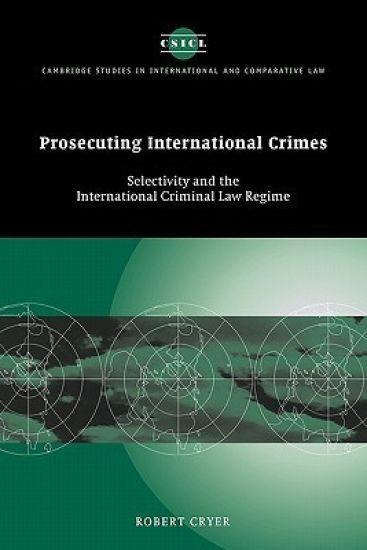
Prosecuting International Crimes

Prosecuting International Crimes

Robert Cryer

Cambridge University Press
2011
pokkari
This 2005 book discusses the legitimacy of the international criminal law regime. It explains the development of the system of international criminal law enforcement in historical context, from antiquity through the Nuremberg and Tokyo Trials, to modern-day prosecutions of atrocities in the former Yugoslavia, Rwanda and Sierra Leone. The modern regime of prosecution of international crimes is evaluated with regard to international relations theory. The book then subjects that regime to critique on the basis of legitimacy and the rule of law, in particular selective enforcement, not only in relation to who is prosecuted, but also the definitions of crimes and principles of liability used when people are prosecuted. It concludes that although selective enforcement is not as powerful as a critique of international criminal law as it was previously, the creation of the International Criminal Court may also have narrowed the substantive rules of international criminal law.
Prosecuting International Crimes

Prosecuting International Crimes

Robert Cryer

Cambridge University Press
2005
sidottu
This 2005 book discusses the legitimacy of the international criminal law regime. It explains the development of the system of international criminal law enforcement in historical context, from antiquity through the Nuremberg and Tokyo Trials, to modern-day prosecutions of atrocities in the former Yugoslavia, Rwanda and Sierra Leone. The modern regime of prosecution of international crimes is evaluated with regard to international relations theory. The book then subjects that regime to critique on the basis of legitimacy and the rule of law, in particular selective enforcement, not only in relation to who is prosecuted, but also the definitions of crimes and principles of liability used when people are prosecuted. It concludes that although selective enforcement is not as powerful as a critique of international criminal law as it was previously, the creation of the International Criminal Court may also have narrowed the substantive rules of international criminal law.