Kirjojen hintavertailu. Mukana 12 390 323 kirjaa ja 12 kauppaa.

Kirjahaku

Etsi kirjoja tekijän nimen, kirjan nimen tai ISBN:n perusteella.

4 kirjaa tekijältä Robert D. Levine

Syntactic Analysis

Syntactic Analysis

Robert D. Levine

Cambridge University Press
2017
sidottu
In syntactic analysis, as in linguistics generally, the skills required to first identify, and then make sense of, complex patterns in linguistic data involve a certain specific kind of reasoning, where various alternatives are entertained and modified in light of progressively broader empirical coverage. Rather than focus on transmitting the details of complex theoretical superstructures, this textbook takes a practical, analytical approach, starting from a small set of powerful analytic tools, applied first to simple phenomena and then to the passive, complement and raising/control constructions. The analytic tools are then applied to unbounded dependencies, via detailed argumentation. What emerges is that syntactic structure, and intricate networks of dependencies linking different parts of those structures, are straightforward projections of lexical valence, in tandem with very general rules regulating the sharing of feature values. Featuring integrated exercises and problems throughout each chapter, this book equips students with the analytical tools for recognizing and assessing linguistic patterns.

Syntactic Analysis

Syntactic Analysis

Robert D. Levine

Cambridge University Press
2017
pokkari
In syntactic analysis, as in linguistics generally, the skills required to first identify, and then make sense of, complex patterns in linguistic data involve a certain specific kind of reasoning, where various alternatives are entertained and modified in light of progressively broader empirical coverage. Rather than focus on transmitting the details of complex theoretical superstructures, this textbook takes a practical, analytical approach, starting from a small set of powerful analytic tools, applied first to simple phenomena and then to the passive, complement and raising/control constructions. The analytic tools are then applied to unbounded dependencies, via detailed argumentation. What emerges is that syntactic structure, and intricate networks of dependencies linking different parts of those structures, are straightforward projections of lexical valence, in tandem with very general rules regulating the sharing of feature values. Featuring integrated exercises and problems throughout each chapter, this book equips students with the analytical tools for recognizing and assessing linguistic patterns.

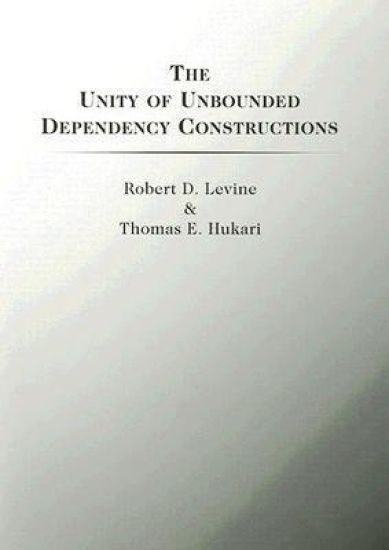
The Unity of Unbounded Dependency Constructions

The Unity of Unbounded Dependency Constructions

Robert D. Levine; Thomas E. Hukari

Centre for the Study of Language Information
2006
sidottu
How do languages transmit information about the properties of phrases over large structural distances? This is the difficult question raised by the phenomenon of extraction, and while extraction has driven the development of syntactic theory for decades, there is still no consensus on what form the connectivity mechanism should take. A number of recent theoretical approaches share the view that extraction is not a unitary phenomenon, but this monograph offers data that radically undercuts this view. The grammar of extraction connectivity, the authors conclude, is relatively simple, homogenous in construction type, and uniform in the position of the extractee.
The Unity of Unbounded Dependency Constructions

The Unity of Unbounded Dependency Constructions

Robert D. Levine; Thomas E. Hukari

Centre for the Study of Language Information
2006
nidottu
How do languages transmit information about the properties of phrases over large structural distances? This is the difficult question raised by the phenomenon of extraction, and while extraction has driven the development of syntactic theory for decades, there is still no consensus on what form the connectivity mechanism should take. A number of recent theoretical approaches share the view that extraction is not a unitary phenomenon, but this monograph offers data that radically undercuts this view. The grammar of extraction connectivity, the authors conclude, is relatively simple, homogenous in construction type, and uniform in the position of the extractee.