
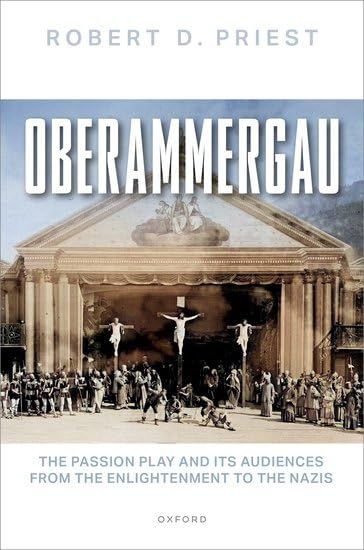
The passion play at Oberammergau in Bavaria is one of the oldest theatrical spectacles in the world, with a history of regular performance that dates back to 1634. By the dawn of the twentieth century, each season drew hundreds of thousands of spectators from Europe, North America, and beyond. Thomas Cook's first package tourists rubbed shoulders with luminaries ranging from Henry Ford to Rabindranath Tagore and Sylvia Pankhurst to Franz Liszt. This book provides a new account of Oberammergau's surprising rise from local curiosity to global celebrity that weaves its development into the course of European and transnational history. Beginning in 1770, when the play's survival was threatened by a government ban, the book traces Oberammergau's story across the next century and a half, ending with the Nazi government's sponsorship of the tercentenary season in 1934. Combining close analysis of the community's archives and an analysis of the kaleidoscopic cultural and intellectual resonances of the play in Europe and North America, the book shows how the passion play's success hinged on the way its performers channelled the turbulence of modern European history and the shifting fascinations of their international audiences during the long nineteenth century. Not simply a religious relic serving devout spectators a dose of Catholic kitsch, the Oberammergau passion evolved in close connection with shifts in European culture. As the village transformed into an international destination, a diverse and growing crowd of artists, writers, actors, journalists, politicians, musicians, tourists, and pilgrims from across Europe and America took their experiences at Oberammergau back home to intervene in pressing debates of the time. Admirers used Oberammergau to think about unity in a divided Germany, the role of theatre in society, and the waning of religious belief; critics saw an example of commercialisation, cultural decline, and prejudice. This book shows that to explain the extraordinary prominence of Oberammergau in nineteenth- and twentieth-century European and American culture, we need to understand the vast array of meanings that viewers drew from the play's content and survival, and recognise that these extended far beyond the religious.
