
Kirjahaku
Etsi kirjoja tekijän nimen, kirjan nimen tai ISBN:n perusteella.
13 kirjaa tekijältä Robert Hart


It is 1962 and Will Johnstone is sent back to his twelve-year-old body. What's more, he is about to escape his abusive father ... by committing suicide. Will recoils from the act, resuming his troubled but jarringly changed life. Helped by unexpected allies, he sets out to rescue himself. Through his friendship with Col, the son of an East German defector, Will is swept into events at the edge of a different Cold War - events that threaten to rip apart his life - and heart. A timeslip novel set in Europe during an alternative Cold War.

Eighteen-year-old Collette's peaceful life in France is shattered when the Nazi panzers steamroll across her country. In England, she feels compelled to help the nation she loves and joins the Women's Auxilliary Air Force, training as a radar operator. There, her French accent is noticed and she is recruited into the Special Operations Executive to spy in France. Smothering her fear and self-doubt, Colette undergoes intensive training as a radio operator. One moonlit night, she is infiltrated into France to work with the R sistance. Nazi tracking vans are out, using her transmissions to locate her. Her messages must be short and she moves fast after each one. It's a game of cat and mouse which Colette must win ... every time.
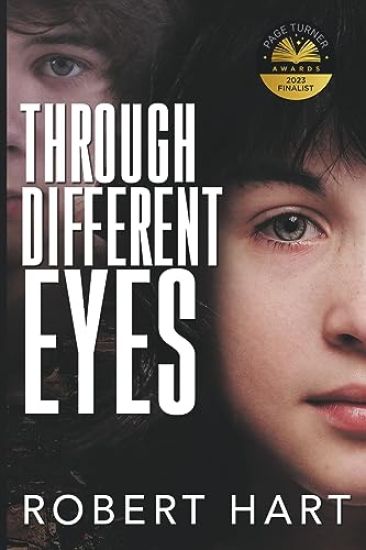
As the Cold War rages, twelve-year-old Colette (Col) Schmidt, flees Leipzig with her mother after they discover her secret policeman father is a Nazi war criminal. Settled in England by MI6, the lies Col must tell to hide her true origins weigh down her budding friendships. She makes inadvertent slips that expose her origins to her friends, but these reinforce and deepen their relationships. After MI6 use the pair as bait to lure out communist agents, they ship Colette and her mother to Australia. There, she is forced to use her linguistic skills to spy on the migrant communities. The risk of exposure causes the lies to proliferate and her internal conflict intensifies. Masking her truth in necessary lies, she finds support from a school friend, a Russian migr and a first World War Scottish soldier. But the lies she must tell and their cargo of guilt take her to the brink of a breakdown. Can Colette find a way past the lies - without bringing the communist assassins to her door? Finalist in the 2023 PageTurner Awards
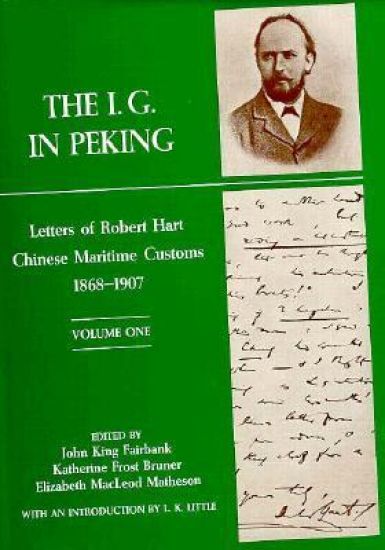
Robert Hart’s forty-five-year administration of China’s customs service was a unique achievement. In these letters Hart speaks to us directly from a time long past in China, but a time that may seem only yesterday to a Western reader. The result is a primary source for the history of modern China and the era of foreign privilege there. Bearing sole responsibility for the Chinese Maritime Customs as its Inspector General, Hart built up an international staff of thousands, facilitated foreign trade, gave the late-Ch’ing court its principal new revenues, and fostered China’s modernity in administration, schools, naval development, postal service, and many other lines. Behind the scenes Hart was also a diplomat who settled the Sino–French war, changed Macao’s status, got boundaries delimited with Burma and India, and mitigated the disasters of imperialism. His career at Peking, coinciding with that of the Empress Dowager Tz’u-hsi, represented the constructive side of the unequal treaty system and Victorian Britain’s informal empire in East Asia. The publication of the great I. G.’s weekly or fortnightly letters to his confidant and London commissioner, James Duncan Campbell, gives us an intimate, inside view of Hart’s problems and methods. He appraises his employers in China’s foreign office, the Tsungli Yamen, and comments pithily on the complex flow of events and personalities. He quotes the Confucian Classic but, even more, the Latin poets. His personal life is revealed—standing long hours at his writing desk, finding solace in the violin, keeping his own counsel, constantly isolated by his responsibilities. Having no confidant in Peking, he explains himself to his loyal agent in London. The Hart–Campbell letters, after five years’ editing and annotation and with an informed introduction by Hart’s final successor as foreign I. G., L. K. Little, thus take their place as one of the great historical treasures that bring a vanished era back to life.


Thomas and Naomi Archer live on the River Dart in Devon, in the shelter of the Hoodown Woods-their life and love overshadowed by a dreadful family tragedy. One spring day, their granddaughter, Willow, runs in from the garden. "Grandpa, come see what I've found " What they discover in the woods transforms all their lives forever.

What happens when a boy starts asking questions? It's New Year's day, 1956, and as the low winter sun penetrates the dark corners of Eric Street, it sets fire to a boy's curiosity. "Until this day I'd lived unaware. I didn't live my life - it lived me. But I did know I was different from other kids. There was something secret about me and my family. That morning I became curious. That day I started asking questions." Charming, funny and sad, this novel is based on a true story. Tommy Angel is an orphan growing up with his grandparents, Rebecca and Daniel, in the East End of London in the Fifties. Tommy tries to make sense of the world around him but his questions arouse shameful memories, stir the family ghosts and open a box of dark family secrets. Gradually he uncovers the truth about his lost sisters, his real father and mother. The author, a distinguished educator, born in 1945, grew up in an extended Jewish family in the East End of London. This debut novel is based on his childhood.

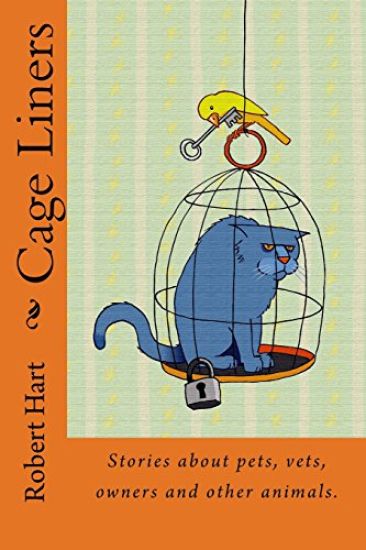
Cage Liners: Vignettes about pets, vets, owners and other animals.
Robert Hart
Createspace Independent Publishing Platform
2014
nidottu
Cage Liners are light-hearted stories based on personal experience during the author's fifty years as a veterinarian. Most illustrate the relationships and behavior of pet owners, pets, receptionists, veterinary nurses and veterinarians, when they meet, and sometimes clash, over clinical cases. Veterinarians often line their hospital pet-cages with newspaper, or place newspaper under a blanket, because it is easily discarded when soiled. This suggested an eco-title for these stories which, if necessary, can be recycled in pet cages after reading. In the early chapters, as a city-boy student dealing with farm animals, he was humiliated on his first farm visit, perplexed by his feelings during farm surgery, embarrassed trying to shear a ewe, astonished by his mentor when testing a bull, and scared out of his boots by a charging pig. So, he expected small animal practice to be a breeze-duh-he learned rapidly that although veterinarians treat patients, they must deal with owners and staff. The highlights of his internship included helping a prostitute by curing her dog's skin problem and her offer to barter services; having a client strip in the office (before fainting); puzzling over the logic of 'wanting a dog spayed if she's pregnant, but not to spay her otherwise as the owner wants her to have puppies, ' adopting an injured pug who bonded with his fianc (after a rocky start), and being humbled by his own pride of knowledge. He learned that the success of treatment is often because the client trusts his veterinarian, in the words of Houdini, 'It's not the trick. It's the magician.' You will meet Aunt Josephine, his help-mate in telling some stories-a conscience figure who haunted his years of practice. Always ready to dispense wisdom at a moment's notice, she needs no excuse to dispense caustic advice. An author's ploy, she is a composite of several people compressed into one character for dramatic effect (and to save space). As the stories illustrate, to be in the presence of someone unashamedly self-righteous shows how remarkably open minded we are. It is much like hiring the incompetent to make one's self appear brilliant, or looking for pictures of ugly people to make one's self feel fabulous In many stories, time and place have been deliberately mingled, using later situations to trigger memories of early experiences, occasionally confusing pet and owner names-once even a mute client with a mute cat. Delight in the company of the Reverend Irish gentleman whose dog is "Drinking the plurality of gallons, so she is," who later adopted an abandoned case and helped the author counsel a young man whose dog ate his stash of pot. And there are tragedies that reinforce humility. A week from "Manic Monday" to "Frantic Friday" illustrates a variety of situations. As Thomas Magnum, P.I. once said-"Sometimes it helps to look for the obvious. Every case, no matter how simple, can lead you down a blind alley or two." By learning from a young teenager that cats can indeed talk, the author met her mother, Helen. They have now shared thirty-four years together. Finally, animal names may have been changed to protect them from embarrassment.

Forest gardening is a way of working with Nature which is not only productive and requires minimal maintenance, but creates great environmental benefits. As Herbert Girardet says in his Foreword, "Robert Hart was a rare person . . . For decades he waged a battle for life, patiently writing books and articles and quietly planting trees on his small farm in Shropshire. Robert created a magnificent forest garden which had a profound influence on the way people cultivated their land. It was a garden dedicated to human needs for fruit, nuts, vegetables and plant medicines. But it was at the same time a celebration of the myriad interactions of life, based on profound observations, both intuitive and scientific, of how different life forms interact in order to stimulate and support one another."