Kirjojen hintavertailu. Mukana 11 244 527 kirjaa ja 12 kauppaa.

Kirjahaku

Etsi kirjoja tekijän nimen, kirjan nimen tai ISBN:n perusteella.

12 kirjaa tekijältä Robert J. Conley

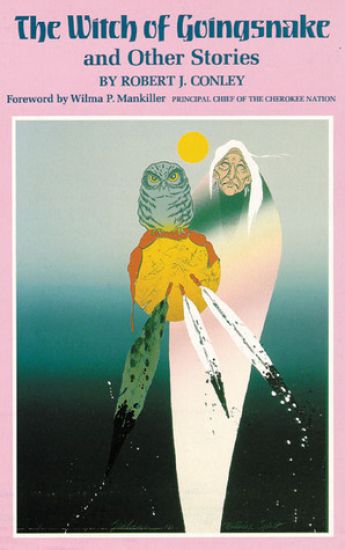
The Witch of Goingsnake

The Witch of Goingsnake

Robert J. Conley

University of Oklahoma Press
1991
nidottu
Based on Cherokee history, oral storytelling, and personal experience, these stories, taken as a whole, reflect the depth of Cherokee historical experience and the range of contemporary Cherokee life. Several stories, including the one from which the collection takes its name, deal with the spiritual world. In the title story a man and his family are devastated by the evil powers of a tsigli, a witch. In other stories ""medicine"" is used to more constructive ends. Some of the stories feature human-animal transformations, the ability to become invisible, and the power to manipulate events. In the context of the Cherokee world such stories are not fantasies. They are stories about reality - the reality known to Cherokees.The collection also includes tales of Cherokee ""outlaws,"" one of the most intriguing aspects of Cherokee history to Cherokees and non-Cherokees alike. Set in the days of Indian Territory, before Oklahoma statehood, these stories provide a taste of the wild West, seasoned with Cherokee cultural experience.Still other stories describe modern-day Cherokees confronting the past and the present and continually struggling to find a place in the white people's world while maintaining a Cherokee belief system and way of life. Some Cherokees confront ignorant whites, others confront ignorant Cherokees, and still others simply make their own way, dealing with each other, with outsiders, with their environment, and with their spirituality in uniquely personal, albeit Cherokee, ways.Clearly, these stories differ from stories that grow out of a European tradition, for behind them lie completely different cultural referents; different notions about interpreting events, time, and language; and a different view of the purpose and art of storytelling. Their author speaks with a clear Cherokee Indian voice to show how these cultural characteristics have survived centuries of abrupt change and to give readers an understanding of the fullness and humanity of the Cherokees as a people.As Wilma P. Mankiller, Principal Chief of the Cherokee Nation, says in her foreword to the stories: ""Much has been written about the Cherokee people. Not enough has been written by the Cherokee people. The subtle nuances of language, the memories of tribal life, and the strong sense of the past and its integration with the present are lost even to the most gifted non-Cherokee writer. There is a movement among contemporary Cherokee writers to produce more indigenous literature. Robert Conley is a leader of that movement.""
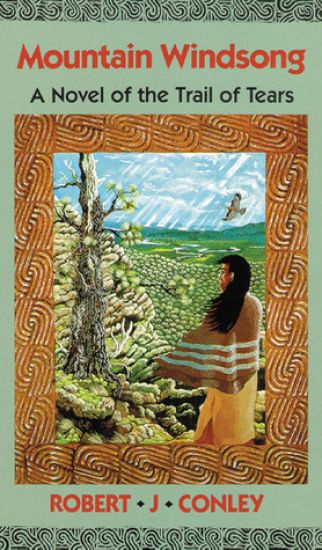
Mountain Windsong

Mountain Windsong

Robert J. Conley

University of Oklahoma Press
1995
nidottu
Set against the tragic events of the Cherokees' removal from their traditional lands in North Carolina to Indian Territory between 1835-1838, Mountain Windsong is a love story that brings to life the suffering and endurance of the Cherokee people. It is the moving tale of Waguli (Whippoorwill"") and Oconeechee, a young Cherokee man and woman separated by the Trail of Tears. Just as they are about to be married, Waguli is captured be federal soldiers and, along with thousands of other Cherokees, taken west, on foot and then by steamboat, to what is now eastern Oklahoma. Though many die along the way, Waguli survives, drowning his shame and sorrow in alcohol. Oconeechee, among the few Cherokees who remain behind, hidden in the mountains, embarks on a courageous search for Waguli.Robert J. Conley makes use of song, legend, and historical documents to weave the rich texture of the story, which is told through several, sometimes contradictory, voices. The traditional narrative of the Trail of Tears is told to a young contemporary Cherokee boy by his grandfather, presented in bits and pieces as they go about their everyday chores in rural North Carolina. The telling is neiter bitter nor hostile; it is sympathetic by unsentimental. An ironic third point of view, detached and often adversarial, is provided by the historical documents interspersed through the novel, from the text of the removal treaty to Ralph Waldo Emerson's letter to the president of the United States in protest of the removal. In this layering of contradictory elements, Conley implies questions about the relationships between history and legend, storytelling and myth-making.Inspired by the lyrics of Don Grooms's song ""Whippoorwill,"" which open many chapters in the text, Conley has written a novel both meticulously accurate and deeply moving.
The Peace Chief

The Peace Chief

Robert J. Conley

University of Oklahoma Press
2001
nidottu
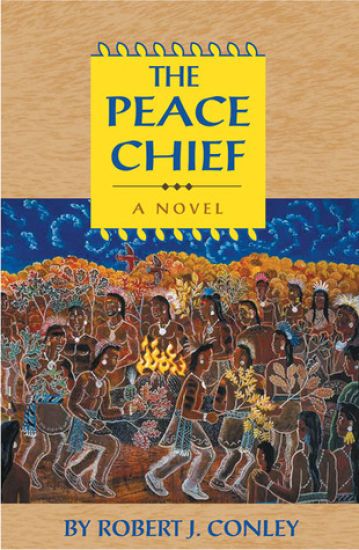
In The Peace Chief, one young Cherokee must be reborn to lead his people through the difficult early days of sixteenth-century European expansion into America. Conley tells the story of Young Puppy, a member of the Long Hair Clan who mistakenly kills his best friend, Asquani. To avoid being killed--the usual remedy for restoring balance between the two clans--Young Puppy flees to the sanctuary of Kituwah, where, after a year in exile, his offense will be forgiven. Spiritually reborn as Comes Back to Life, he becomes the ceremonial leader of his people: the Peace Chief.
War Woman

War Woman

Robert J. Conley

University of Oklahoma Press
2001
nidottu
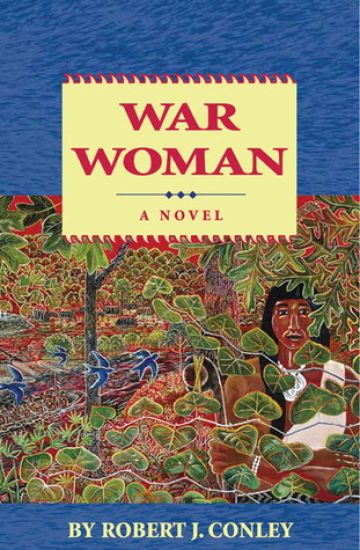
Few writers portray Native American life and history as richly, authentically, and insightfully as Robert J. Conley. Conley represents an important voice of the Cherokee past. The novels in his Real People series combine powerful characters, gripping plots, and vivid descriptions of tradition and mythology to preserve Cherokee culture and history. War Woman spans the late 1500s to mid-1600s.War Woman, a brave, headstrong, clever Cherokee, is believed by many in her town to be a witch. Having heard stories about the Spanish, and believing there is great profit to be made by trading with them, she leads a small band of youths on the treacherous road to La Florida. This journey, blessed with success and marred by terrible tragedy, marks the beginning of War Woman's own personal journey as she leads her people by example and by guidance through terrifying times.
Cherokee Dragon

Cherokee Dragon

Robert J. Conley

University of Oklahoma Press
2001
nidottu
Few writers portray Native American life and history as richly, authentically, and insightfully as Robert J. Conley. Conley represents an important voice of the Cherokee past. The novels in his Real People series combine powerful characters, gripping plots, and vivid descriptions of tradition and mythology to preserve Cherokee culture and history.In Cherokee Dragon, the tenth novel in the series, Robert Conley explores the life if Dragging Canoe, the last great war chief of the united Cherokee tribe. In the late eighteenth century, as the English settlers begin steadily encroaching upon the Cherokee lands, the Nation divided among several towns and many chiefs?unites in a series of battles. But the united front is not one that lasts: Dragging Canoe's belief that they must fight the settlers to preserve their lands and their culture is far from universal.
Cherokee Medicine Man

Cherokee Medicine Man

Robert J. Conley

University of Oklahoma Press
2007
nidottu
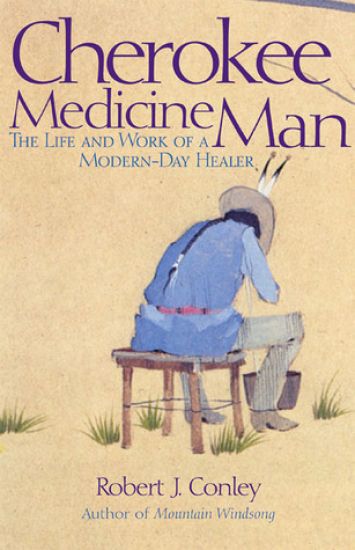
A modern medicine man portrayed through the words of the people he has helpedRobert J. Conley did not set out to chronicle the life of Cherokee medicine man John Little Bear. Instead, the medicine man came to him. Little Bear asked Conley to write down his story, to reveal to the world ""what Indian medicine is really about."" For Little Bear, as for the Cherokee ancestors who brought their traditions over the Trail of Tears to Indian Territory, the medicine is about helping people. Visitors from neighboring states and Mexico come to him, each one seeking help for a different kind of problem. Each seeker's story is presented here exactly as it was told to Conley.Little Bear has cured problems involving health, relationships, and money by uncovering the source of the problem rather than simply treating the symptoms. Whereas mainstream medicine and counseling have failed his patients, Little Bear's healing practices have proven beneficial time and again.
Cherokee Thoughts

Cherokee Thoughts

Robert J. Conley

University of Oklahoma Press
2008
nidottu
Gaming and chiefing. Imposters and freedmen. Distinguished novelist Robert J. Conley examines some of the most interesting facets of the Cherokee world. In 26 essays laced with humor, understatement, even open sarcasm, this popular writer takes on politics, culture, his people's history, and what it means to be Cherokee.Readers who think they know Conley will find an abundance of surprises in these pages. He reveals historical information not widely known or written about, such as Cherokee Confederate general Stand Watie's involvement in the infamous Reconstruction treaty forced upon his people in 1866, and he explains his admiration for such characters as Ned Christie and Henry Starr, whom some might consider criminals. From legendary figures Dragging Canoe and Nancy Ward to popular icons like Will Rogers to contemporary ""Cherokee Wannabes"" - people seeking ancestral roots whether actual or fanciful - Conley traces the dogged persistence of the Cherokee people in the face of relentless incursions upon their land and culture.""Cherokees are used to controversy,"" observes Conley; ""in fact, they enjoy it."" As provocative as it is entertaining, Cherokee Thoughts will intrigue tribal members and anyone with an interest in the Cherokee people.
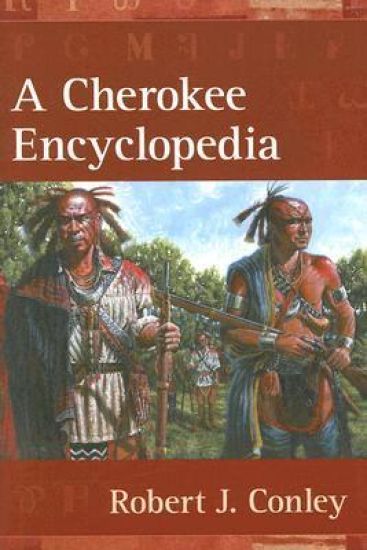
A Cherokee Encyclopedia

A Cherokee Encyclopedia

Robert J. Conley

University of New Mexico Press
2007
sidottu
A quick reference guide for many of the people, places, and things connected to the United Keetoowah Band of Cherokees, as well as for the other officially recognized Cherokee groups, the Cherokee Nation and the Eastern Band of Cherokees.
Some Empirical Evidence on the Non-Normality of Cost Variances on Defense Contracts
This study tested the hypothesis that defense cost variances reported on the Cost Performance Report are normally distributed. The DOD requires that all defense cost variances which breech a pre-specified threshold be investigated. The present variance investigation model has been criticized because it can prompt frivolous investigations. In theory, statistical models could reduce the number of frivolous investigations, but they are not used because they require too much information about the cost variance, including its distributional form. Often such models assume a normal distribution, but researchers have shown that the models do not work properly if the assumption is fallacious. Two prior studies have investigated the normality of cost variances with mixed results, and neither investigated defense cost variances. Here, fifty series of cost variances from two defense contracts were extracted from Cost Performance Reports and evaluated using four popular tests of normality (Bowman-Shenton, Shapiro-Wilks, Kolmogorov-Smirnov, and Chi-square). The results show that the vast majority of the series of cost variances were not normally distributed. These results were insensitive to the normality test used and to the effects of inflation. The statistical variance investigation models may still be used, but normality should not be assumed. This work has been selected by scholars as being culturally important, and is part of the knowledge base of civilization as we know it. This work was reproduced from the original artifact, and remains as true to the original work as possible. Therefore, you will see the original copyright references, library stamps (as most of these works have been housed in our most important libraries around the world), and other notations in the work. This work is in the public domain in the United States of America, and possibly other nations. Within the United States, you may freely copy and distribute this work, as no entity (individual or corporate) has a copyright on the body of the work. As a reproduction of a historical artifact, this work may contain missing or blurred pages, poor pictures, errant marks, etc. Scholars believe, and we concur, that this work is important enough to be preserved, reproduced, and made generally available to the public. We appreciate your support of the preservation process, and thank you for being an important part of keeping this knowledge alive and relevant.
Go-Ahead Rider

Go-Ahead Rider

Robert J. Conley

M. Evans Co Inc
2014
pokkari
When recent Harvard graduate George Tanner returns home to Tahlequah in the Cherokee nation, he finds the town bustling and accommodations scarce. The council is in session and everyone is in town. Captain Go-Ahead Rider, the district sheriff, offers Tanner immediate employment as a deputy. Rider senses trouble as some key issues come up for vote before the Council. The big issue—and the most controversial one—is whether the railroad should be allowed to come into town. Mix Hail, the swing vote on the issue, suddenly disappears, and Tanner finds himself smack in the middle of big-money politics and his own nation’s concerns. As the two lawmen sort through a pile of blackmail, revenge, and bootlegging, they uncover a nasty plot by some of the town’s leading citizens. Tanner learns how to be a lawman, while at the same time experiencing the joy of being home, in his own land, with his own people, speaking his own language.
Quitting Time

Quitting Time

Robert J. Conley

M. Evans Co Inc
2014
pokkari
For many years Oliver Colfax worked as a hired killer. But after he developed a friendship with one of his targets, Colfax lost heart in that line of work and quit. A few odd jobs keep body and soul together, but until Colfax decides what to do with the rest of his life, he’s content sitting in his St. Louis hotel room and drinking fine whiskey. When a rancher from Colorado asks him to deal with some cattle rustlers, Colfax declines, thinking it is just one more case of a big landowner wanting it all. But when Colfax learns that a production of Titus Andronicus is playing in nearby Pullman, Colorado, he has a change of heart. He has always longed to see someone play Titus. Dealing with the cattle rustlers proves to be a routine job, but investigating the tragedy that hits the touring Shakespearean drama troupe turns out to be a tough assignment. It may be the hardest case he’s ever taken on, one that is certain to change his life forever.
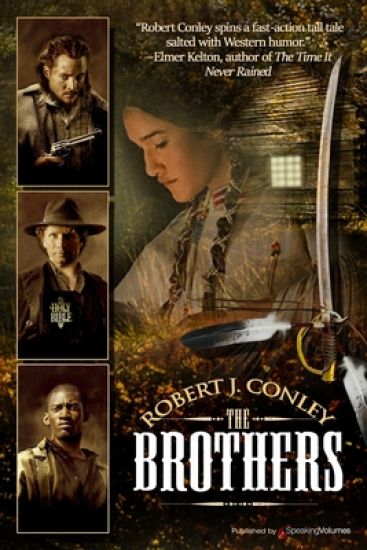
The Brothers

The Brothers

Robert J. Conley

Speaking Volumes
2019
nidottu
"Robert Conley spins a fast-action tall tale salted with Western humor."-Elmer Kelton, author of The Time It Never RainedHalf Cherokee and Civil War veteran Captain Skylar Garret returns to the home of Phillip Garret his white father, seeking an inheritance that he believes to have belonged to his late mother. Intertwined now into the lives of his three half brothers-one a vocal atheist, one an aspiring minister, and the other a black slave boy who Phillip Garret doesn't claim-Skylar finds himself in more than a quarrel for money, but also in the middle of a love triangle with his own father, and ultimately on trial for patricide. Will Skylar Garret be the next hanging from Judge Parker's court? PRAISE FOR ROBERT J. CONLEY "Conley speaks with a clear Cherokee Indian voice to show how his tribe's cultural characteristics have survived centuries of abrupt change."-The Cherokee Advocate "...his prose and analyses, effortlessly blending indigenous and local knowledge with the larger Western cultural canon, have undeniable charm and enduring value."-Publishers Weekly " Robert Conley is] in the ranks of N. Scott Momaday, Louise Erdrich, James Welch or W. P. Kinsella as interpreters of the many facets of the Native American experience."-Fort Worth Star-Telegram "No one weaves a tribal story quite like Robert Conley. Conley's books are entertaining, colorful, and chock-full of tribal history and culture."-Wilma R Mankiller, former Principal Chief of the Cherokee Nation "Robert Conley is one of the most underrated and overlooked writers of our time, as well as the most skilled."-Don Coldsmith, author of Moon of Madness