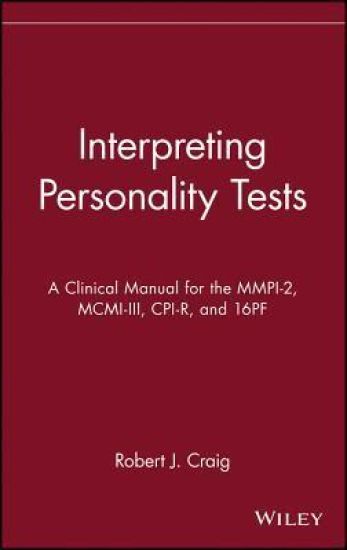
Personality assessment is a major component of many mental health practices, as well as a required course in most graduate programs in psychology. Interpreting Personality Tests is a clear, succinct guide that offers practicing clinical psychologists and graduate students precise interpretive guidelines for the four main personality inventories–MMPI-2, MCMI-III, CPI-R, and 16PF. This accessible book provides step-by-step procedures for clinical personality interpretation, helping mental health professionals determine the psychological health of their clients, ascertain maladjustment and problem behaviors, and ultimately reach a diagnosis. The book is divided into four chapters devoted to each of the key personality tests:*Minnesota Multiphasic Personality Inventory-2(MMPI-2) Chapter One includes the history and development of the original MMPI, along with original MMPI norms, MMPI-2 norms, and transformed scores. There is a full interpretation of the MMPI-2 validity scales, including the Lie Scale, F Scale, Backside F Scale, K Scale, True Response Inconsistency Scale, Variable Response Inconsistency Scale, Dissimulation Index, Superlative Self-Assessment Scale, Infrequency-Psychopathology Scale, Weiner’s Subtle and Obvious Items, and Mean Profile Elevation. Also covered is interpretation of MMPI-2 Code Types for One-Point and Two-Point Codes.*Millon Clinical Multiaxial Inventory-III (MCMI-III) Chapter Two explores the background and history of this test, including information on test development and Base Rate scores. It explains how to interpret the MCMI-III scales, including Disclosure (Scale X), Desirability (Scale Y), and Debasement (Scale Z). There are also full interpretations for One-Point and Two-Point Codes, which includes information on Millon’s current thinking about subtypes of personality disorders.*California Psychological Inventory-Revised (CPI-R) Chapter Three provides a general overview of the test and its philosophical basis. It explains how to achieve correct interpretation of the test by inspecting patterns of elevations on different classes of scales, which are subdivided into one of four classes: Class I, to assess interpersonal adequacy; Class II, to assess interpersonal controls, values, and beliefs; Class III, to assess intellectual achievement and academic ability; and Class IV, to assess measures of personal styles. There is also information on scale interaction interpretations.*Sixteen Personality Factors (16PF) Beginning with the test’s background and history, Chapter Four outlines all steps in the interpretive process of the 16PF basic scales, including Impression Management, Acquiescence, and Infrequency. Also covered is configural interpretation, with a detailed list of configurations presented as hypotheses for further consideration and verification. Clear and concise, Interpreting Personality Tests is an invaluable resource for everyone in the assessment field. The only concise guide to address each of the four most frequently used personality tests. Personality assessment is a crucial part of the mental health process. Interpreting Personality Tests is the ultimate guide for psychologists, counselors, and students who want to learn how to interpret the four key personality inventories. Offering hundreds of interpretive data profiles, this volume is a valuable source of information for these major objective personality tests: *Minnesota Multiphasic Personality Inventory-2 (MMPI-2)*Millon Clinical Multiaxial Inventory-III (MCMI-III)*California Psychological Inventory-Revised (CPI-R)*Sixteen Personality Factors (16PF) For definitive, precise guidance on clinical personality interpretation, Interpreting Personality Tests is the reference the assessment field has been waiting for.