Kirjojen hintavertailu. Mukana 11 244 527 kirjaa ja 12 kauppaa.

Kirjahaku

Etsi kirjoja tekijän nimen, kirjan nimen tai ISBN:n perusteella.

4 kirjaa tekijältä Robert J. Rabel

Robert E. Sherwood and the Classical Tradition
This volume explores the reception of the classical past in the works of twentieth-century American dramatist Robert E. Sherwood and his use of the ancient world to critique key events and trends in American history. It explores his comedies and the influence of both Greek Old and New Comedy, as well as his mediation of his experiences in World War I through Livy’s account of the war with Carthage. During the 1930s, Sherwood used the Peloponnesian War as a template for bringing to the attention of an unaware public the danger of an impending war between the forces of democracy and the totalitarianism represented by Nazi Germany, and post-war he raised awareness of the dangers of nuclear war through the lens of the Greek gods. As well as looking at his use of the classical past in his work, since Sherwood wrote drama deeply concerned with the major social and political events of his day, his plays open windows onto the major social and political challenges facing the United States and the world from the outbreak of World War I until the beginning of the nuclear age. This volume will be of interest to anyone working on the Classical Tradition and Classical Reception, as well as to students of twentieth-century American literature, drama, history, and politics.
Robert E. Sherwood and the Classical Tradition

Robert E. Sherwood and the Classical Tradition

Robert J. Rabel

TAYLOR FRANCIS LTD
2023
nidottu
This volume explores the reception of the classical past in the works of twentieth-century American dramatist Robert E. Sherwood and his use of the ancient world to critique key events and trends in American history. It explores his comedies and the influence of both Greek Old and New Comedy, as well as his mediation of his experiences in World War I through Livy’s account of the war with Carthage. During the 1930s, Sherwood used the Peloponnesian War as a template for bringing to the attention of an unaware public the danger of an impending war between the forces of democracy and the totalitarianism represented by Nazi Germany, and post-war he raised awareness of the dangers of nuclear war through the lens of the Greek gods. As well as looking at his use of the classical past in his work, since Sherwood wrote drama deeply concerned with the major social and political events of his day, his plays open windows onto the major social and political challenges facing the United States and the world from the outbreak of World War I until the beginning of the nuclear age. This volume will be of interest to anyone working on the Classical Tradition and Classical Reception, as well as to students of twentieth-century American literature, drama, history, and politics.
Plot and Point of View in the Iliad

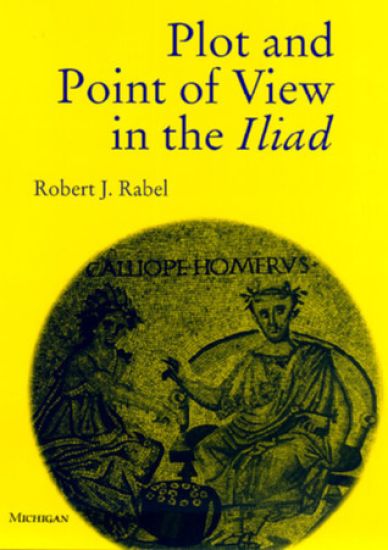
Plot and Point of View in the Iliad

Robert J. Rabel

The University of Michigan Press
1997
sidottu
Plot and Point of View in the Iliad argues that Homer, the poet of the Iliad, may be fully distinguished from the narrator of Homeric poetry, who is the Muse, and also from the heroes and heroines who live within the world of the story. The Iliad is a poem with a particularly rich and complex structure of perspectives, and as point of view as an element of storytelling has garnered tremendous interest in this century, critical attention has taken up this question in relation to Homer's poem. Robert Rabel argues that in different ways, both the Muse-narrator and the poet manipulate point of view in order to discover and define the meaning of the Iliad, placing various ways of thinking in competing and complementary relationships with one another. In the process, the Muse-narrator produces a sophisticated and compelling analysis of the tragic limitations of life in accordance with the heroic ethic. In the end, the poet provides a demonstration of the extent to which reality can only be grasped and apprehended in epic poetry through images that are constructed from various individual perspectives. This volume will be of interest to students of comparative and classical literature, philosophers, and readers of Homeric epic. All Greek passages are translated, and discussions of technical language are kept to a minimum.
Maxwell Anderson and the Classical Tradition

Maxwell Anderson and the Classical Tradition

Robert J. Rabel

TAYLOR FRANCIS LTD
2025
sidottu
This book sheds new light on the dramatic works of the American playwright, poet, and lyricist Maxwell Anderson, assessing the pervasive influence of Greek and Roman antiquity on his plays that dominated Broadway in the first half of the twentieth century.Anderson is an important, though often forgotten, figure in the history of American drama and the Classical Tradition. The book highlights Anderson’s remarkably creative use of classical antiquity, while also illustrating how he served as a first-hand witness and reactor to some of the main social and political events of his time. It explores Anderson’s major theatrical works and adaptations of ancient Greek drama and poetry, including Winterset, The Winged Victory, the never-published Ulysses Africanus, and Bad Seed, as well as his later minor works. Anderson found in tragedians such as Aeschylus, Sophocles, and Euripides ideal models for the dramatic portrayal of human emotion amidst the social and political backdrop of the United States from the interwar period to the nuclear age, which this book seeks to explore at length for the first time.This volume is of interest to students and scholars of Classical Reception and the Classical Tradition, as well as those working on twentieth century American literature, drama, history, and politics.