Kirjojen hintavertailu. Mukana 12 281 494 kirjaa ja 12 kauppaa.

Kirjahaku

Etsi kirjoja tekijän nimen, kirjan nimen tai ISBN:n perusteella.

3 kirjaa tekijältä Robert L. Cooper

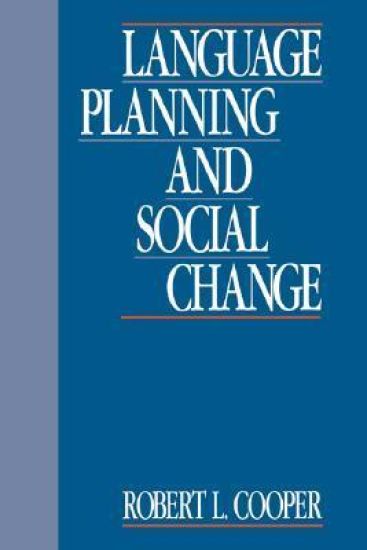
Language Planning and Social Change

Language Planning and Social Change

Robert L. Cooper

Cambridge University Press
1990
sidottu
This book describes the ways in which politicians, church leaders, generals, leaders of national movements and others try to influence our use of language. Professor Cooper argues that language planning is never attempted for its own sake. Rather it is carried out for the attainment of nonlinguistic ends such as national integration, political control, economic development, the pacification of minority groups, and mass mobilization. Many examples are discussed, including the revival of Hebrew as a spoken language, feminist campaigns to eliminate sexist bias in language, adult literacy campaigns, the plain language movement, efforts to distinguish American from British spelling, the American bilingual education movement, the creation of writing systems for unwritten languages, and campaigns to rid languages of foreign terms. Language Planning and Social Change is the first book to define the field of language planning and relate it to other aspects of social planning and to social change. The book is accessible and presupposes no special background in linguistics, sociology or political science. It will appeal to applied linguists and to those sociologists, economists and political scientists with an interest in language.
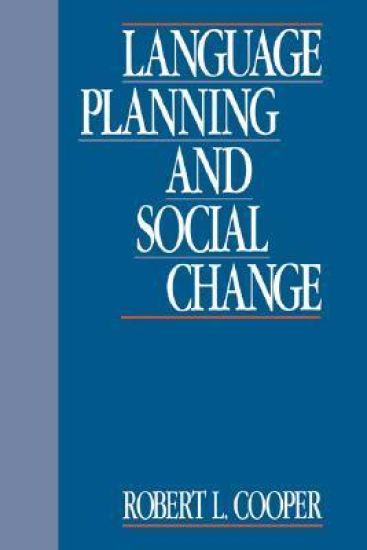
Language Planning and Social Change

Language Planning and Social Change

Robert L. Cooper

Cambridge University Press
1990
pokkari
This book describes the ways in which politicians, church leaders, generals, leaders of national movements and others try to influence our use of language. Professor Cooper argues that language planning is never attempted for its own sake. Rather it is carried out for the attainment of nonlinguistic ends such as national integration, political control, economic development, the pacification of minority groups, and mass mobilization. Many examples are discussed, including the revival of Hebrew as a spoken language, feminist campaigns to eliminate sexist bias in language, adult literacy campaigns, the plain language movement, efforts to distinguish American from British spelling, the American bilingual education movement, the creation of writing systems for unwritten languages, and campaigns to rid languages of foreign terms. Language Planning and Social Change is the first book to define the field of language planning and relate it to other aspects of social planning and to social change. The book is accessible and presupposes no special background in linguistics, sociology or political science. It will appeal to applied linguists and to those sociologists, economists and political scientists with an interest in language.

The Languages of Jerusalem

The Languages of Jerusalem

Bernard Spolsky; Robert L. Cooper

Clarendon Press
1991
sidottu
The Old City of Jerusalem, small and densely populated, is a complex microcosm of Israeli society. It is a multilingual community characterized by unequal power relations between the speakers of the two official languages of Israel - Arabs and Jews. The authors begin with a sociolinguistic sketch of the Old City in the present day. They then provide a historical background to their field study, discussing Jewish multilingualism from the period of the Second Temple until modern times, the sociolinguistics of Jerusalem one hundred years ago, and the recent revival and spread of Hebrew. They go on to develop a model of the rules of language choice which arises from their analysis of language use in street signs, and which they then apply to language use in the market place. In the final chapters they examine language learning and language spread in their social context. The authors demonstrate that, because of the close association between language use and social structure, the study of language use in a multilingual society is at the same time both a powerful and a delicate method of studying the dynamics of group interactions.