Kirjojen hintavertailu. Mukana 11 699 587 kirjaa ja 12 kauppaa.

Kirjahaku

Etsi kirjoja tekijän nimen, kirjan nimen tai ISBN:n perusteella.

4 kirjaa tekijältä Robert L. Devaney

A First Course In Chaotic Dynamical Systems
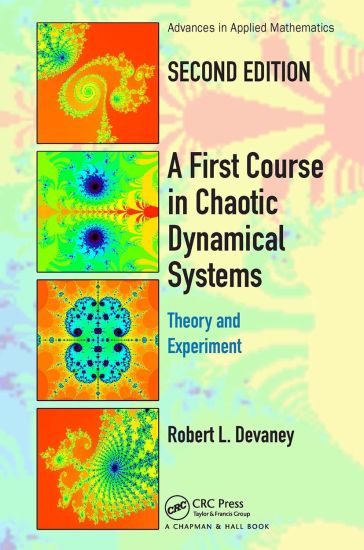
A First Course in Chaotic Dynamical Systems: Theory and Experiment, Second EditionThe long-anticipated revision of this well-liked textbook offers many new additions. In the twenty-five years since the original version of this book was published, much has happened in dynamical systems. Mandelbrot and Julia sets were barely ten years old when the first edition appeared, and most of the research involving these objects then centered around iterations of quadratic functions. This research has expanded to include all sorts of different types of functions, including higher-degree polynomials, rational maps, exponential and trigonometric functions, and many others. Several new sections in this edition are devoted to these topics.The area of dynamical systems covered in A First Course in Chaotic Dynamical Systems: Theory and Experiment, Second Edition is quite accessible to students and also offers a wide variety of interesting open questions for students at the undergraduate level to pursue. The only prerequisite for students is a one-year calculus course (no differential equations required); students will easily be exposed to many interesting areas of current research. This course can also serve as a bridge between the low-level, often non-rigorous calculus courses, and the more demanding higher-level mathematics courses.Features More extensive coverage of fractals, including objects like the Sierpinski carpet and othersthat appear as Julia sets in the later sections on complex dynamics, as well as an actualchaos "game." More detailed coverage of complex dynamical systems like the quadratic familyand the exponential maps. New sections on other complex dynamical systems like rational maps. A number of new and expanded computer experiments for students to perform. About the AuthorRobert L. Devaney is currently professor of mathematics at Boston University. He received his PhD from the University of California at Berkeley under the direction of Stephen Smale. He taught at Northwestern University and Tufts University before coming to Boston University in 1980. His main area of research is dynamical systems, primarily complex analytic dynamics, but also including more general ideas about chaotic dynamical systems. Lately, he has become intrigued with the incredibly rich topological aspects of dynamics, including such things as indecomposable continua, Sierpinski curves, and Cantor bouquets.

An Introduction To Chaotic Dynamical Systems

An Introduction To Chaotic Dynamical Systems

Robert L. Devaney

TAYLOR FRANCIS LTD
2024
nidottu
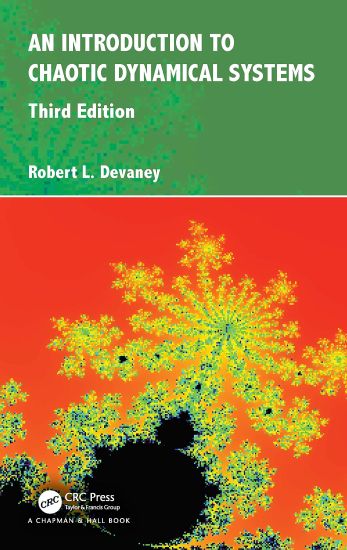
There is an explosion of interest in dynamical systems in the mathematical community as well as in many areas of science. The results have been truly exciting: systems which once seemed completely intractable from an analytic point of view can now be understood in a geometric or qualitative sense rather easily. Scientists and engineers realize the power and the beauty of the geometric and qualitative techniques. These techniques apply to a number of important nonlinear problems ranging from physics and chemistry to ecology and economics.Computer graphics have allowed us to view the dynamical behavior geometrically. The appearance of incredibly beautiful and intricate objects such as the Mandelbrot set, the Julia set, and other fractals have really piqued interest in the field.This is text is aimed primarily at advanced undergraduate and beginning graduate students. Throughout, the author emphasizes the mathematical aspects of the theory of discrete dynamical systems, not the many and diverse applications of this theory.The field of dynamical systems and especially the study of chaotic systems has been hailed as one of the important breakthroughs in science in the past century and its importance continues to expand. There is no question that the field is becoming more and more important in a variety of scientific disciplines.New to this edition:•Greatly expanded coverage complex dynamics now in Chapter 2•The third chapter is now devoted to higher dimensional dynamical systems.•Chapters 2 and 3 are independent of one another.•New exercises have been added throughout.
An Introduction To Chaotic Dynamical Systems

An Introduction To Chaotic Dynamical Systems

Robert L. Devaney

TAYLOR FRANCIS LTD
2021
sidottu
There is an explosion of interest in dynamical systems in the mathematical community as well as in many areas of science. The results have been truly exciting: systems which once seemed completely intractable from an analytic point of view can now be understood in a geometric or qualitative sense rather easily. Scientists and engineers realize the power and the beauty of the geometric and qualitative techniques. These techniques apply to a number of important nonlinear problems ranging from physics and chemistry to ecology and economics.Computer graphics have allowed us to view the dynamical behavior geometrically. The appearance of incredibly beautiful and intricate objects such as the Mandelbrot set, the Julia set, and other fractals have really piqued interest in the field.This is text is aimed primarily at advanced undergraduate and beginning graduate students. Throughout, the author emphasizes the mathematical aspects of the theory of discrete dynamical systems, not the many and diverse applications of this theory.The field of dynamical systems and especially the study of chaotic systems has been hailed as one of the important breakthroughs in science in the past century and its importance continues to expand. There is no question that the field is becoming more and more important in a variety of scientific disciplines.New to this edition:•Greatly expanded coverage complex dynamics now in Chapter 2•The third chapter is now devoted to higher dimensional dynamical systems.•Chapters 2 and 3 are independent of one another.•New exercises have been added throughout.
A First Course In Chaotic Dynamical Systems

A First Course In Chaotic Dynamical Systems

Robert L. Devaney

TAYLOR FRANCIS LTD
2023
nidottu
A First Course in Chaotic Dynamical Systems: Theory and Experiment, Second EditionThe long-anticipated revision of this well-liked textbook offers many new additions. In the twenty-five years since the original version of this book was published, much has happened in dynamical systems. Mandelbrot and Julia sets were barely ten years old when the first edition appeared, and most of the research involving these objects then centered around iterations of quadratic functions. This research has expanded to include all sorts of different types of functions, including higher-degree polynomials, rational maps, exponential and trigonometric functions, and many others. Several new sections in this edition are devoted to these topics.The area of dynamical systems covered in A First Course in Chaotic Dynamical Systems: Theory and Experiment, Second Edition is quite accessible to students and also offers a wide variety of interesting open questions for students at the undergraduate level to pursue. The only prerequisite for students is a one-year calculus course (no differential equations required); students will easily be exposed to many interesting areas of current research. This course can also serve as a bridge between the low-level, often non-rigorous calculus courses, and the more demanding higher-level mathematics courses.Features More extensive coverage of fractals, including objects like the Sierpinski carpet and othersthat appear as Julia sets in the later sections on complex dynamics, as well as an actualchaos "game." More detailed coverage of complex dynamical systems like the quadratic familyand the exponential maps. New sections on other complex dynamical systems like rational maps. A number of new and expanded computer experiments for students to perform. About the AuthorRobert L. Devaney is currently professor of mathematics at Boston University. He received his PhD from the University of California at Berkeley under the direction of Stephen Smale. He taught at Northwestern University and Tufts University before coming to Boston University in 1980. His main area of research is dynamical systems, primarily complex analytic dynamics, but also including more general ideas about chaotic dynamical systems. Lately, he has become intrigued with the incredibly rich topological aspects of dynamics, including such things as indecomposable continua, Sierpinski curves, and Cantor bouquets.