Kirjojen hintavertailu. Mukana 11 244 527 kirjaa ja 12 kauppaa.

Kirjahaku

Etsi kirjoja tekijän nimen, kirjan nimen tai ISBN:n perusteella.

27 kirjaa tekijältä Robert Mitchell

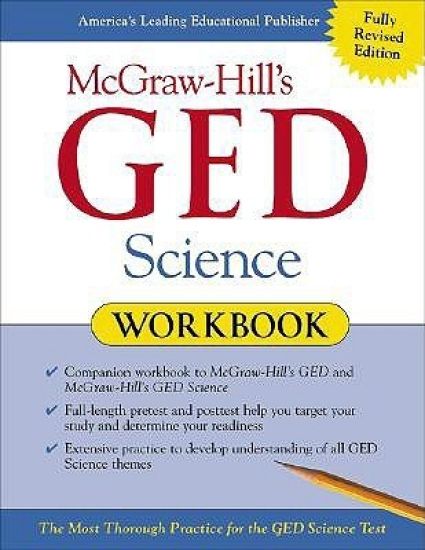
McGraw-Hill's GED Science Workbook

McGraw-Hill's GED Science Workbook

Robert Mitchell

McGraw-Hill Professional
2002
nidottu
Boost your confidence for taking the GED test with help from "McGraw-Hill's GED" workbook series. The newly revised "McGraw-Hill's GED" workbook series helps you practice the skills you need to pass all five areas of the GED test. Designed to complement "McGraw-Hill's GED" test series and the complete "McGraw-Hill's GED", these books provide extra practice and reinforcement to ensure success. The series covers: language arts, reading; language arts, writing; mathematics; social studies; and, science. "McGraw-Hill's GED Science Workbook" begins with an introduction that explains the content of the Science exam. Multiple-choice questions provide thorough testing of all aspects of the exam, including life sciences, physical sciences, earth and space sciences, and interdisciplinary themes.Finally, a full-length Practice Test in official GED format will help you evaluate your readiness for the GED test. Complete solutions and explanations are provided in the Answer Key. "McGraw-Hill's GED Science Workbook" includes: graphs and diagrams so that you can become comfortable interpreting the visual elements of the GED; high-interest readings to increase your understanding of all areas of science; and, hundreds of practice questions to develop your understanding of scientific themes and concepts. With "McGraw-Hill's GED Science Workbook", you will have that extra confidence for taking the GED test.
The Wildwood Workbook

The Wildwood Workbook

Robert Mitchell

Lulu.com
2019
pokkari
Do you want to see more, do more, and have more fun outdoors? Do you want to be more prepared for potential danger when you're out camping or hiking? Whether you're a seasoned woodsman or an inexperienced greenhorn, this straightforward, step-by-step workbook's 40+ exercises will deepen your relationship with nature and get your heart and mind engaged like never before. As lean as a coyote and straight as an arrow, this little book is packed with action and meaning. Includes: * Essential gear * ABCs of first aid * Woodland self-defense * When to stay put and when to self-rescue * The survival formula * Arts & crafts * Tracking exercises * Wild plant identification exercises * And much more!
Sympathy and the State in the Romantic Era
Sympathy and the State in the Romantic Era explores a fascinating connection between two seemingly unrelated Romantic-era discourses, outlining the extent to which eighteenth and early nineteenth century theories of sympathy were generated by crises of state finance. Through readings of authors such as David Hume, Adam Smith, William Wordsworth, and P.B. Shelley, this volume establishes the ways in which crises of state finance encouraged the development of theories of sympathy capable of accounting for both the fact of "social systems" as well as the modes of emotional communication by means of which such systems bound citizens to one another. Employing a methodology that draws on the systems theory of Niklas Luhmann, Michel Serres, and Giovanni Arrighi, as well as Gilles Deleuze’s theories of time and affect, this book argues that eighteenth and early nineteenth century philosophies of sympathy emerged as responses to financial crises. Individual chapters focus on specific texts by David Hume, Adam Smith, Jean-Jacques Rousseau, Ann Yearsley, William Wordsworth, and P.B. Shelley, but Mitchell also draws on periodicals, pamphlets, and parliamentary hearings to make the argument that Romantic era theories of sympathy developed new discourses about social systems intended both to explain, as well as contain, the often disruptive effects of state finance and speculation.
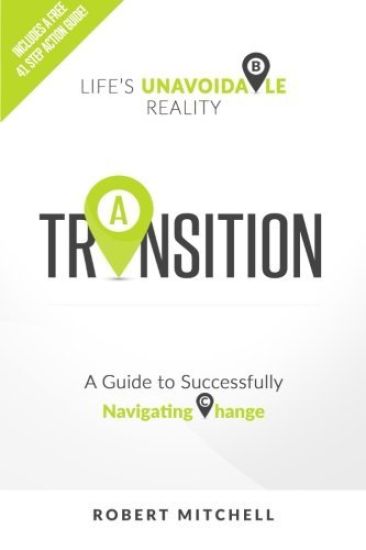
Transition: Life's Unavoidable Reality: A Guide to Successfully Navigating Change
Do you ever feel that, just as soon as you get comfortable in your life, everything changes? Why do bad things happen to good people? Have you ever wished you didn't have to go through hard times? Transitions are a constant in life and this book will help you successfully navigate those inevitable changes and look forward to the rest of your life with confidence. Those who are enduring the pressure brought on by transition, who know someone who is feeling overwhelmed, or who want to be equipped for what's coming next in their life will find hope and direction. Every transition has the potential to stop you from living out your dreams, causing you to arrive at the end of your life with tremendous regrets. Our natural tendency is to accept things as they are, with the belief that there's no way to relieve the anxiety associated with those transitions. In the midst of transitions, everyone wants to know, "How do I successfully get from here, where it's no longer comfortable, to there, a better place?" Where can I get help to walk through this inescapable experience in my life?Transition: Life's Unavoidable Reality uses practical life experiences to show how it's possible to not only survive transitions but to thrive in the midst of them, by exploring: -How to know when a transition is approaching-What fly fishers and entomologists have to do with transition-The three dimensions that are present in every life transition-The adventures that await those who take that uncomfortable step into the unknown-The transitions that accompany life's different stages: from birth to growing up, to relationships, and dealing with aging parents and growing children-How to thrive through vocational transitions-Life's final transitionFollow the steps in this book and get help in walking through the future transitions in your life. You are not alone on this journey What's stopping you from jumping right into your next transition with a workable plan for success, so you'll be positioned correctly when the next season of change comes?
Jubilee Line Extension

Jubilee Line Extension

Robert Mitchell

Thomas Telford Ltd
2003
sidottu
This major reference work details the story of London Underground’s award winning Jubilee Line Extension (JLE), how it came to being, how it was planned, how it was designed, built and commissioned, and how the millennium deadline imposed by the Dome was met. Always in the public eye and the political spotlight, the JLE has played a significant role in the success of the Canary Wharf development, improved public transport immeasurably in the areas of southeast and east London, and set new standards for London Underground and public transport. Despite the problems and the much publicised cost and time overruns, the project can still be considered to be a major construction achievement. The Jubilee Line Extension: From Concept to Completion describes in detail the history of the project, which goes back more than 50 years. The first concepts were defined in 1943, and the book traces developments to the East London Railway study that effectively defined the JLE Extension. Also presented is a detailed insight into the development of the Olympia & York funding contribution that was a key issue in achieving Government approval. With contributions from some of the major contractors personnel involved, the book offers a detailed and factual account of the completion of this ‘stunning’ new railway line. Much has been written about the construction work of the JLE, particularly the stations, however, this is the first book that provides a rounded view of how a major new underground railway line came to be built and presents key details of the JLE project activities relating to transport planning, the legal processes, comprehensive safety planning, procurement, contracting, engineering development, environmental issues, project management and commissioning. And all achieved under immense political and media scrutiny. The Jubilee Line Extension: From Concept to Completion will appeal to everyone who is interested in major transportation projects and in discovering how the JLE was able to deliver a major urban infrastructure project with the minimum of environmental disturbance and with an exemplary safety record. Project managers will find this detailed record of all that was involved an inspiration and an invaluable source of information, which they can apply to other projects they are working on now and in the future.
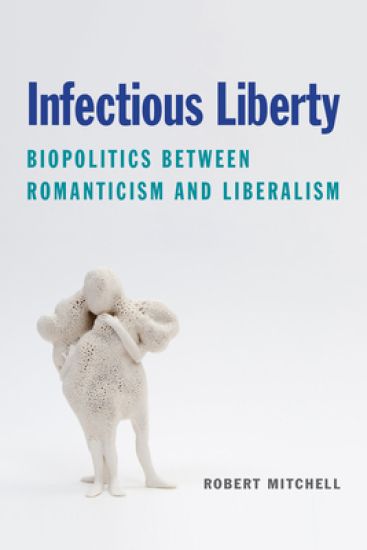
Infectious Liberty

Infectious Liberty

Robert Mitchell

Fordham University Press
2021
sidottu
Infectious Liberty traces the origins of our contemporary concerns about public health, world population, climate change, global trade, and government regulation to a series of Romantic-era debates and their literary consequences. Through a series of careful readings, Robert Mitchell shows how a range of elements of modern literature, from character-systems to free indirect discourse, are closely intertwined with Romantic-era liberalism and biopolitics. Eighteenth- and early-nineteenth century theorists of liberalism such as Adam Smith and Thomas Malthus drew upon the new sciences of population to develop a liberal biopolitics that aimed to coordinate differences among individuals by means of the culling powers of the market. Infectious Liberty focuses on such authors as Mary Shelley and William Wordsworth, who drew upon the sciences of population to develop a biopolitics beyond liberalism. These authors attempted what Roberto Esposito describes as an "affirmative" biopolitics, which rejects the principle of establishing security by distinguishing between valued and unvalued lives, seeks to support even the most abject members of a population, and proposes new ways of living in common. Infectious Liberty expands our understandings of liberalism and biopolitics—and the relationship between them—while also helping us to understand better the ways creative literature facilitates the project of reimagining what the politics of life might consist of. Infectious Liberty is available from the publisher on an open-access basis.
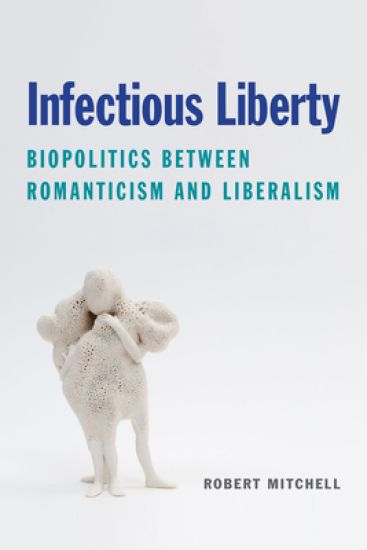
Infectious Liberty

Infectious Liberty

Robert Mitchell

Fordham University Press
2021
pokkari
Infectious Liberty traces the origins of our contemporary concerns about public health, world population, climate change, global trade, and government regulation to a series of Romantic-era debates and their literary consequences. Through a series of careful readings, Robert Mitchell shows how a range of elements of modern literature, from character-systems to free indirect discourse, are closely intertwined with Romantic-era liberalism and biopolitics. Eighteenth- and early-nineteenth century theorists of liberalism such as Adam Smith and Thomas Malthus drew upon the new sciences of population to develop a liberal biopolitics that aimed to coordinate differences among individuals by means of the culling powers of the market. Infectious Liberty focuses on such authors as Mary Shelley and William Wordsworth, who drew upon the sciences of population to develop a biopolitics beyond liberalism. These authors attempted what Roberto Esposito describes as an "affirmative" biopolitics, which rejects the principle of establishing security by distinguishing between valued and unvalued lives, seeks to support even the most abject members of a population, and proposes new ways of living in common. Infectious Liberty expands our understandings of liberalism and biopolitics—and the relationship between them—while also helping us to understand better the ways creative literature facilitates the project of reimagining what the politics of life might consist of. Infectious Liberty is available from the publisher on an open-access basis.
Sympathy and the State in the Romantic Era
Sympathy and the State in the Romantic Era explores a fascinating connection between two seemingly unrelated Romantic-era discourses, outlining the extent to which eighteenth and early nineteenth century theories of sympathy were generated by crises of state finance. Through readings of authors such as David Hume, Adam Smith, William Wordsworth, and P.B. Shelley, this volume establishes the ways in which crises of state finance encouraged the development of theories of sympathy capable of accounting for both the fact of "social systems" as well as the modes of emotional communication by means of which such systems bound citizens to one another. Employing a methodology that draws on the systems theory of Niklas Luhmann, Michel Serres, and Giovanni Arrighi, as well as Gilles Deleuze’s theories of time and affect, this book argues that eighteenth and early nineteenth century philosophies of sympathy emerged as responses to financial crises. Individual chapters focus on specific texts by David Hume, Adam Smith, Jean-Jacques Rousseau, Ann Yearsley, William Wordsworth, and P.B. Shelley, but Mitchell also draws on periodicals, pamphlets, and parliamentary hearings to make the argument that Romantic era theories of sympathy developed new discourses about social systems intended both to explain, as well as contain, the often disruptive effects of state finance and speculation.
Nurturing the Souls of Our Children

Nurturing the Souls of Our Children

Robert Mitchell

AuthorHouse
2005
pokkari
To devise a theory of education is to address the questions of culture, cultural values and cultural identity formation in the child. In this original study, Robert Mitchell gives us a scholarly overview of cultural education in America's schools. He demonstrates how the public trust of universal education fails our children and our democracy. He then advocates reframing our concept of education in terms of a sacred trust that teaches the culture of democracy. Turning to the question of the role of the teacher, Mr. Mitchell weaves together anecdotal evidence of a teacher archetype with advanced theories in archetypal psychology. This compelling work breaks new ground to provide us with a refreshingly new and visionary approach to K-12 education.
Experimental Life

Experimental Life

Robert Mitchell

Johns Hopkins University Press
2014
sidottu
If the objective of the Romantic movement was nothing less than to redefine the meaning of life itself, what role did experiments play in this movement? While earlier scholarship has established both the importance of science generally and vitalism specifically, with regard to Romanticism no study has investigated what it meant for artists to experiment and how those experiments related to their interest in the concept of life. Experimental Life draws on approaches and ideas from contemporary science studies, proposing the concept of experimental vitalism to show both how Romantic authors appropriated the concept of experimentation from the sciences and the impact of their appropriation on post-Romantic concepts of literature and art. Robert Mitchell navigates complex conceptual arenas such as network theory, gift exchange, paranoia, and biomedia and introduces new concepts, such as cryptogamia, chylopoietic discourse, trance-plantation, and the poetics of suspension. As a result, Experimental Life is a wide-ranging summation and extension of the current state of literary studies, the history of science, cultural critique, and theory.