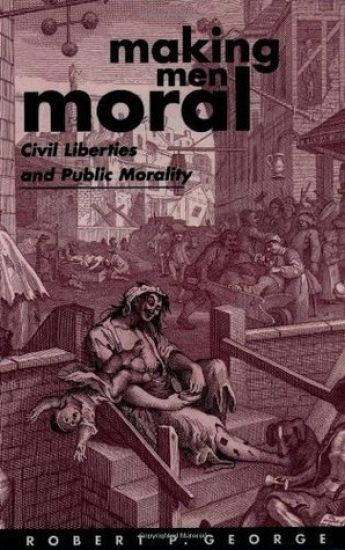
Contemporary liberal thinkers commonly suppose that there is something in principle unjust about the legal prohibition of putatively victimless immoralities. Against the prevailing liberal view, Robert P. George defends the proposition that `moral laws' can play a legitimate, if subsidiary, role in preserving the `moral ecology' of the cultural environment in which people make the morally significant choices by which they form their characters and influence, for good or ill, the moral lives of others. George shows that a defence of morals legislation is fully compatible with a `pluralistic perfectionist' political theory of civil liberties and public morality.
Germain Grisez has been a leading voice in moral philosophy and theology since the Second Vatican Council. In this book, such major thinkers as John Finnis, Ralph McInerny, and William E. May consider issues in ethics, metaphysics, and politics that have been central to Grisez's work. Grisez's reconsideration of the philosophical foundations of Christian moral teaching, seeking to eliminate both legalistic interpretation and theological dissent, has won the support of a number of leading Catholic moralists. In the past decade, moreover, many philosophers outside of Catholicism have weighed carefully Grisez's alternatives to theories that have long dominated secular moral philosophy. This book presents a broad spectrum of viewpoints on subjects ranging from contraception to capital punishment and considers such controversies as the scriptural basis of Grisez's work his interpretations of Aquinas, and his new natural law theory. This collection includes not only contributions from Grisez's supporters but also from critics of his thought, from proportionalist Edward Collins Vacek, SJ, to the neo-Thomist Ralph McInerny. A reply by Grisez, written with Joseph M. Boyle Jr., addresses the issues and viewpoints expressed, while an afterword by Russell Shaw reviews Grisez's pioneering work and conveys a vivid sense of the philosopher's personality. As Grisez's influence grows, this volume will serve as an important touchstone on his contributions to moral and political philosophy and theology.
In a series of fascinating interviews, a cradle Catholic (Robert P. George) and an adult convert (R. J. Snell), offer the stories of sixteen converts, each a public intellectual or leading voice in their respective fields, and each making a significant contribution to the life of the Church. Mind, Heart, and Soul is a Surprised by Truth for a new generation. It will reinvigorate the faith of Catholics and answer questions or address hurdles those discerning entering the Church may have...by people have had the same questions and the same road. While some of the converts are well-known, their stories are not. Here they speak for themselves, providing the reasons for belief that prompted these accomplished men and women to embrace the ancient faith. Included are interviews with a bishop, a leading theologian and priest, a member of the International Theological Commission, a former megachurch pastor, a prominent pro-life scholar, professors from Harvard and other universities, as well as journalists and writers, novelists and scholars. Each are interviewed by another leading scholar, many of whom are themselves converts and familiar with the hesitations, anxieties, discoveries, and hopes of those who discover the Faith. These conversion stories remind us that the Catholic Church retains her vitality, able to provide answers and reasons for hope to new generations of believers, always sustained by the Holy Spirit. It is all too-easy to become discouraged in our day and age, but God never fails to call people to Himself, as evidenced by these remarkable stories.
Profoundly important ethical and political controversies turn on the question of whether biological life is an essential aspect of a human person, or only an extrinsic instrument. Lee and George argue that human beings are physical, animal organisms - albeit essentially rational and free - and examine the implications of this understanding of human beings for some of the most controversial issues in contemporary ethics and politics. The authors argue that human beings are animal organisms and that their personal identity across time consists in the persistence of the animal organisms they are; they also argue that human beings are essentially rational and free and that there is a radical difference between human beings and other animals; criticize hedonism and hedonistic drug-taking; present detailed defenses of the prolife positions on abortion and euthanasia; and defend the traditional moral position on marriage and sexual acts.
Profoundly important ethical and political controversies turn on the question of whether biological life is an essential aspect of a human person, or only an extrinsic instrument. Lee and George argue that human beings are physical, animal organisms - albeit essentially rational and free - and examine the implications of this understanding of human beings for some of the most controversial issues in contemporary ethics and politics. The authors argue that human beings are animal organisms and that their personal identity across time consists in the persistence of the animal organisms they are; they also argue that human beings are essentially rational and free and that there is a radical difference between human beings and other animals; criticize hedonism and hedonistic drug-taking; present detailed defenses of the prolife positions on abortion and euthanasia; and defend the traditional moral position on marriage and sexual acts.
Natural Law Ethics in Theory and Practice brings together a selection of essays of the late Joseph Boyle. Boyle was, with Germain Grisez and John Finnis, a founder and developer of the New Classical Natural Law Theory, arguably the most important development in Catholic moral philosophy of the twentieth century. While this theory is indebted to the work of St. Thomas Aquinas, it incorporates an understanding and assessment of that work that is different from that found in other statements of natural law. Boyle made crucial contributions to a wide variety of aspects of this theory, and the volume is divided into two parts. Part One: Articulating a Theory of Natural Law contains three sections in which Boyle defends the reality of free choice and the view that the basic reasons for action, or first principles of natural law, are incommensurable in goodness. Boyle identifies the basic moral standard for choice and action, and develops an account of human action that elucidates the important role played by intention and double effect in their moral evaluation. The essays in Part Two: Natural Law Theory and Contemporary Moral Problems demonstrate the strength and scope of Boyle’s natural law account, as he brings it to bear upon just war theory, property and welfare rights, and issues in bioethics. The essays in bioethics address the difficult question of whether it is appropriate to tube-feed patients in persistent vegetative state, and include an unpublished essay, “Against Assisted Death,” which he delivered as the Anscombe Lecture at The Anscombe Bioethics Centre in Oxford about a year before he died.This volume also includes a Foreword by Princeton’s Robert P. George; an Introduction by the editors that highlights Boyle’s contribution to the development of the new classical natural law theory; and a bibliography of Boyle’s publications.
This book defends the conjugal view of marriage. Patrick Lee and Robert P. George argue that marriage is a distinctive type of community: the union of a man and a woman who have committed to sharing their lives on every level of their beings (bodily, emotionally, and spiritually) in the kind of union that would be fulfilled by conceiving and rearing children together. The comprehensive nature of this union, and its intrinsic orientation to procreation as its natural fulfillment, distinguishes marriage from other types of community and provides the basis for the norms of marital exclusivity and permanence. Lee and George detail how the basic moral norms regarding sexual acts follow from the ethical requirement to respect the good of marriage and explain how the law should treat marriage, given its conjugal nature, examining both the same-sex-marriage issue and civil divorce.
This book defends the conjugal view of marriage. Patrick Lee and Robert P. George argue that marriage is a distinctive type of community: the union of a man and a woman who have committed to sharing their lives on every level of their beings (bodily, emotionally, and spiritually) in the kind of union that would be fulfilled by conceiving and rearing children together. The comprehensive nature of this union, and its intrinsic orientation to procreation as its natural fulfillment, distinguishes marriage from other types of community and provides the basis for the norms of marital exclusivity and permanence. Lee and George detail how the basic moral norms regarding sexual acts follow from the ethical requirement to respect the good of marriage and explain how the law should treat marriage, given its conjugal nature, examining both the same-sex-marriage issue and civil divorce.
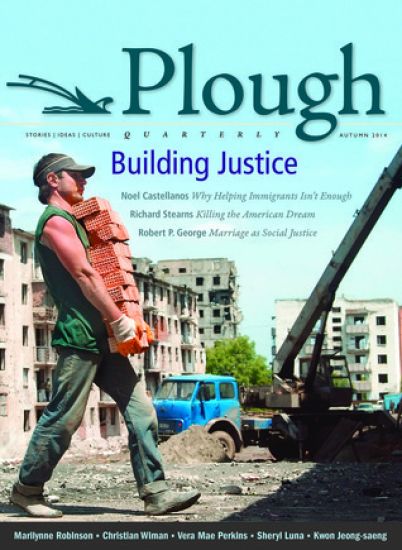
Christian Wiman; Johann Christoph Arnold; Fred Bahnson; Noel Castellanos; Robert P. George; Sheryl Luna; Jeong-saeng Kwon; Elizabeth Stoker Bruenig; Krish Kandiah; Eberhard Arnold; Richard Stearns; Charles Moore; Michael Lapsley; Maximilian Probst
“Justice” has become a rallying cry for many Christians today. And for good reason: justice is at the heart of the kingdom of God, as the Bible makes abundantly clear. Yet when our eyes are opened to the many injustices of today’s world, it’s easy to feel overwhelmed. Where is a person to start? And more fundamentally, what is the nature of the justice we ought to be pursuing? In this second issue, we explore how to build the justice that Jesus and the Hebrew prophets call for – not as a vague ideal, but as a way of life. Bold, hope-filled, and down-to-earth, Plough Quarterly features thought-provoking articles, commentary, interviews, short fiction, book reviews, poetry and artwork to inspire everyday faith and action. Each issue brings together essential voices from many traditions to give you fresh insights on a core theme such as peacemaking, biblical justice, children and family, building community, man and woman, nature and the environment, nonviolence, or simple living. Starting from the conviction that the teachings and example of Jesus can transform and renew our world, it aims to apply them to all aspects of life, seeking common ground with all people of goodwill regardless of creed.
Until very recently, no society had seen marriage as anything other than a conjugal partnership: a male–female union. What Is Marriage? identifies and defends the reasons for this historic consensus and shows why redefining civil marriage as something other than the conjugal union of husband and wife is a mistake. Originally published in the Harvard Journal of Law and Public Policy, this book’s core argument quickly became the year’s most widely read essay on the most prominent scholarly network in the social sciences. Since then, it has been cited and debated by scholars and activists throughout the world as the most formidable defense of the tradition ever written. Now revamped, expanded, and vastly enhanced, What Is Marriage? stands poised to meet its moment as few books of this generation have. Sherif Girgis, Ryan T. Anderson, and Robert P. George offer a devastating critique of the idea that equality requires redefining marriage. They show why both sides must first answer the question of what marriage really is. They defend the principle that marriage, as a comprehensive union of mind and body ordered to family life, unites a man and a woman as husband and wife, and they document the social value of applying this principle in law. Most compellingly, they show that those who embrace same-sex civil marriage leave no firm ground—none—for not recognizing every relationship describable in polite English, including polyamorous sexual unions, and that enshrining their view would further erode the norms of marriage, and hence the common good. Finally, What Is Marriage? decisively answers common objections: that the historic view is rooted in bigotry, like laws forbidding interracial marriage; that it is callous to people’s needs; that it can’t show the harm of recognizing same-sex couplings or the point of recognizing infertile ones; and that it treats a mere “social construct” as if it were natural or an unreasoned religious view as if it were rational.