Kirjojen hintavertailu. Mukana 12 390 323 kirjaa ja 12 kauppaa.

Kirjahaku

Etsi kirjoja tekijän nimen, kirjan nimen tai ISBN:n perusteella.

7 kirjaa tekijältä Robert Rauschenberg

Robert Rauschenberg

Robert Rauschenberg

Robert Rauschenberg

Museum of Modern Art
2017
nidottu
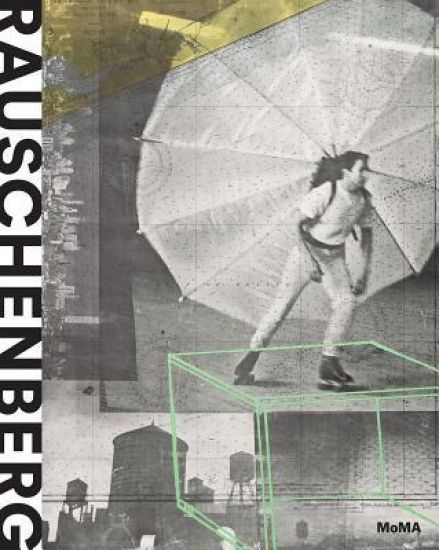
"Painting relates to both art and life. Neither can be made. (I try to act in the gap between the two.)" --Robert RauschenbergThe early 1950s, when Robert Rauschenberg launched his career, was the heyday of the heroic gestural painting of Abstract Expressionism. Rauschenberg challenged this tradition, inventing new interdisciplinary models of artistic practice that shaped the decades to come. Published in conjunction with this century's first retrospective of this defining figure in postwar art, this richly illustrated catalog reframes Rauschenberg's widely celebrated Combines (1954-64) and silkscreen paintings (1962-64) in fresh ways. It also illuminates lesser-known periods within Rauschenberg's career, including his work of the early 1950s and that from the late 1960s onward, now compelling and prescient to contemporary eyes. Sixteen short essays by eminent scholars and emerging new writers focus on specific moments throughout Rauschenberg's career, exploring his creative production across an extraordinary range of media and following him on his travels around the globe. Integrating new scholarship, documentary imagery and archival materials, Robert Rauschenberg is the first comprehensive catalogue of the artist's career in 20 years, an important contribution to American cultural and intellectual history and a necessary volume for anyone interested in contemporary art.Over the span of six decades, Robert Rauschenberg (1925-2008) worked in an astonishing range of mediums including painting, sculpture, prints, photography and performance. Working alone and in collaboration with artists, dancers, musicians and writers, Rauschenberg produced a vast body of work that set the course for art of the present day.
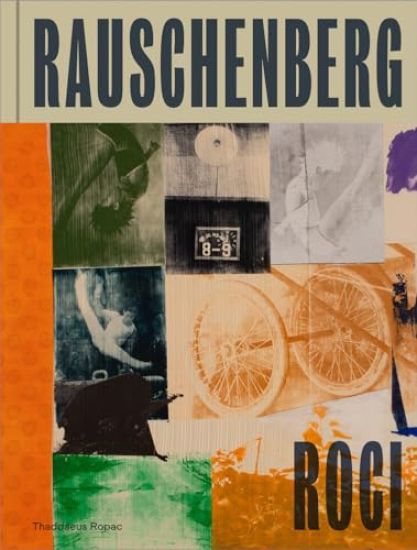
Robert Rauschenberg: Roci

Robert Rauschenberg: Roci

Robert Rauschenberg

Galerie Thaddaeus Ropac
2025
sidottu
The only in-print book exploring Rauschenberg's years-long, self-funded initiative to promote cultural and artistic exchange across the globeThe Rauschenberg Overseas Culture Interchange, or ROCI (pronounced "Rocky," the name of the artist's pet turtle), was a tangible expression of Robert Rauschenberg's (1925-2008) long-term commitment to human rights and to the freedom of artistic expression. Funded almost entirely by the artist himself, Rauschenberg traveled to countries around the world often where artistic experimentation had been suppressed with the purpose of sparking a dialogue and achieving a mutual understanding through the creative process. Between 1985 and 1990, the project was realized in 10 countries in the following order: Mexico, Chile, Venezuela, China, Tibet, Japan, Cuba, the Union of Soviet Socialist Republics (USSR), Germany and Malaysia, with a final exhibition held in 1991 at the National Gallery of Art, Washington, DC.This catalog is the only in-print publication on Rauschenberg's ROCI initiative, making it an invaluable text for understanding this important and long-running project.
Robert Rauschenberg: Japanese Clayworks

Robert Rauschenberg: Japanese Clayworks

Robert Rauschenberg

Galerie Thaddaeus Ropac
2023
sidottu
Rauschenberg's rarely seen ceramic experiments of the 1980sOver the course of a 15-year period, Robert Rauschenberg (1925-2008) frequently traveled to Japan, where he developed a keen interest in ceramics. The artist began to create his own, developing an idiosyncratic process that combined ancient Japanese pottery traditions with modern innovations.This striking volume charts Rauschenberg's foray into the medium. Including previously unpublished archival material, the book presents two of his rarely seen series, The Japanese Clayworks (1982/1985) and Japanese Recreational Clayworks (1982-83/1985). The former features sculptural elements and photographic imagery of ancient and modern Japan, as well as distinctive brushstrokes; the latter series comprises prefabricated reproductions of historical Western artworks on ceramic panels, to which Rauschenberg added his own imagery of contemporary Japan from photographs he took across the country, along with gestural brushwork.
Robert Rauschenberg

Robert Rauschenberg

Robert Rauschenberg

Museum of Modern Art
2016
sidottu
"Offering both a complete overview and fresh perspective of the momentous artist, nearly everything that Rauschenberg tackled in his career is included here, including his printmaking, photography, and famous silkscreen paintings." -Interview Magazine The early 1950s, when Robert Rauschenberg launched his career, was the heyday of the heroic gestural painting of Abstract Expressionism. Rauschenberg challenged this tradition, inventing new intermedia forms of art making that shaped the decades to come. Published in conjunction with the inaugural 21st-century retrospective of this defining figure, this book offers fresh perspectives on Rauschenberg's widely celebrated Combines (1954-64) and silkscreen paintings (1962-64). It also illuminates lesser-known periods within Rauschenberg's career, including his work of the early 1950s and that from the late 1960s onward, now compelling and prescient to contemporary eyes. Sixteen short essays by eminent scholars and emerging new writers focus on specific moments within Rauschenberg's career, examining his creative production across an extraordinary range of media. Integrating new scholarship, documentary imagery and archival materials, Robert Rauschenberg is the first comprehensive catalogue of the artist's career in 20 years, an important contribution to American cultural and intellectual history across disciplines and a necessary volume for anyone interested in art of the present day. Over the span of six decades, Robert Rauschenberg (1925-2008) worked in an astonishing range of mediums including painting, sculpture, prints, photography and performance, and became one of the most transformative figures in postwar American culture. Working alone and in collaboration with artists, dancers, musicians and writers, Rauschenberg produced a vast body of work that continues to resonate today.
Robert Rauschenberg: Borealis 1988-92

Robert Rauschenberg: Borealis 1988-92

Robert Rauschenberg

Galerie Thaddaeus Ropac
2020
sidottu
Robert Rauschenberg: Borealis 1988-92 is the first publication dedicated to the Borealis series by Robert Rauschenberg (1925-2008) and accompanies the eponymous exhibition held at Galerie Thaddaeus Ropac, Salzburg, in 2019. The essay by Corinna Thierolf, chief curator of the Pinakothek der Moderne, Munich, examines the iconography of one of Rauschenberg's most experimental series, for which he silk-screened his own photographs on reflective surfaces such as brass, copper and bronze. This comprehensive publication documents the exhibition and features other major Borealis works from museum collections. In addition to Thierolf's analysis, each work is accompanied by exclusive source images taken or found by the artist during his prescient global art project, the Robert Rauschenberg Overseas Culture Interchange (ROCI).
Rauschenberg and the Twentieth Century

Rauschenberg and the Twentieth Century

Robert Rauschenberg

Silvana Editoriale
2025
nidottu
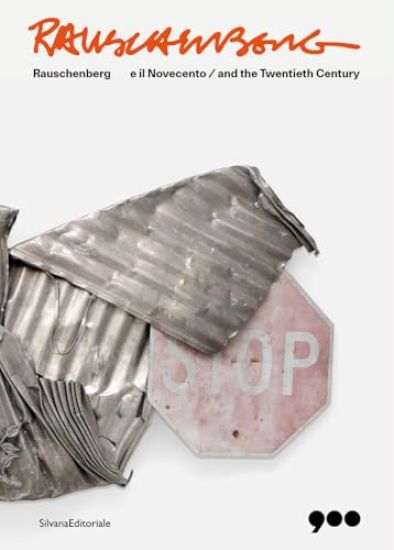
Reappraising Rauschenberg across the 20th century, with a particular focus on his relationship to Italy and its most salient artistic movements Italy has always been entwined with the work of Robert Rauschenberg (1925-2008)--from his first visit at the age of 26 to his capturing of the International Grand Prize in Painting at the 1964 Venice Biennale. He continued to reference the country in his oeuvre, whether through found objects and scrap metal picked up in Venice and Naples or through more metaphorical references such as his Bellini print series. In celebration of the centenary of his birth, the Museo del Novecento staged an exhibition to an artist who without hyperbole can be considered one of the 20th century's most revolutionary artists. This bilingual English/Italian catalog interweaves his tireless decades-long experimentation--across sculpture, painting, assemblage, installation and more--with the movements that shaped his philosophy, from Futurism to Arte Povera.
I Don't Think About Being Great

I Don't Think About Being Great

Robert Rauschenberg

YALE UNIVERSITY PRESS
2025
sidottu
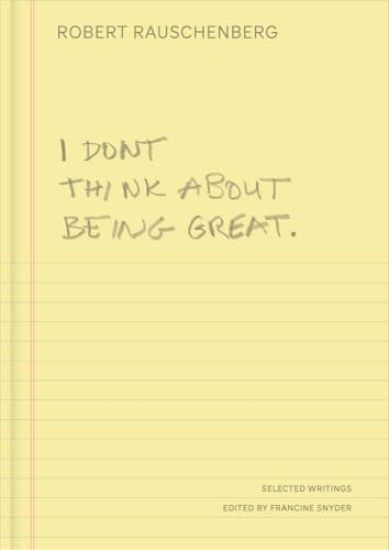
This collection of 100 writings by Robert Rauschenberg reveals the artist’s gift for prose and the importance of his relationship to language The American artist Robert Rauschenberg (1925–2008) won acclaim and awards for his diverse oeuvre that spanned six decades and included paintings, sculpture, prints, photography, and performance. Less well known is the role that writing played in his creative process. Rauschenberg self-identified as dyslexic and did not publish extensively, leading to the widely held assumption that he was not an artist who wrote. This book corrects the record, showcasing 100 passages, many published here for the first time, from Rauschenberg’s robust body of written work. Comprising correspondence, artist notes, testimony, speeches, and more, this collection brings to light the artist’s love of language and reveals that writing was, in fact, central to Rauschenberg’s practice. The writings, illustrated with reproductions in the artist’s distinctive hand, are infused with visual and intellectual lyricism, humor, and insight, and span topics from the freedom of artistic expression to environmental concerns. This beautiful volume, which also features an essay by artist Martha Tuttle (b. 1989) about why artists’ writings matter, adds new depth to our understanding of Rauschenberg’s life and work. Published in association with the Robert Rauschenberg Foundation