Kirjojen hintavertailu. Mukana 12 209 252 kirjaa ja 12 kauppaa.

Kirjahaku

Etsi kirjoja tekijän nimen, kirjan nimen tai ISBN:n perusteella.

51 kirjaa tekijältä Robert Ross

From the Isle of Serendip: Essays by Columnist & Writer Robert Ross
Want to be inspired? How about having your preconceived notions challenged a bit? Author Robert Ross does just that in this collection of articles and essays published during the past few decades. Your memories will be stirred, your emotions moved, and laughter provoked. Whether it's the high adventure of riding the Beast, venturing down the unchartered backroads of Burma, or aging with a dash of chutzpah-sit back, kick up your feet, turn on your reading lamp, and enjoy the ride.
Chinese Security Policy

Chinese Security Policy

Robert Ross

Routledge
2009
sidottu
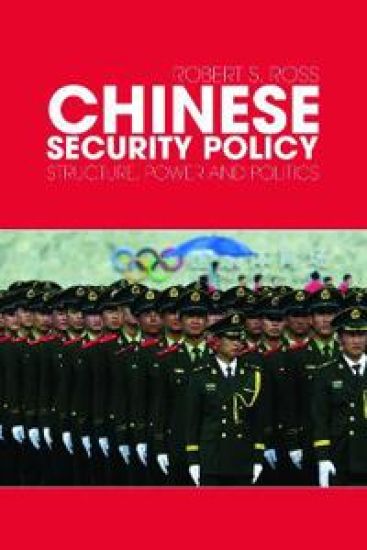
This volume provides a coherent and comprehensive understanding of Chinese security policy, comprising essays written by one of America's leading scholars.Chinese Security Policy covers such fundamental areas as the role of international structure in state behavior, the use of force in international politics (including deterrence, coercive diplomacy, and war), and the sources of great-power conflict and cooperation and balance of power politics, with a recent focus on international power transitions. The research integrates the realist literature with key issues in Chinese foreign policy, thereby placing China’s behaviour in the larger context of the international political system. Within this framework, Chinese Security Policy considers the importance of domestic politics and leadership in Chinese policy making.This book examines how Chinese strategic vulnerability since U.S.-China rapprochement in the early 1970s has compelled Beijing to seek cooperation with the United States and to avoid U.S.-China conflict over Taiwan. It also addresses the implications of the rise of China for the security of both United States and of Chinese neighbors in East Asia, and considers the implications of China’s rise for the regional balance of power and the emerging twenty-first century East Asian security order.This book will be of great interest to all students of Chinese Security and Foreign Policy, Chinese and Asian Politics, US foreign policy and International Security in general.
Chinese Security Policy

Chinese Security Policy

Robert Ross

Routledge
2009
nidottu
This volume provides a coherent and comprehensive understanding of Chinese security policy, comprising essays written by one of America's leading scholars.Chinese Security Policy covers such fundamental areas as the role of international structure in state behavior, the use of force in international politics (including deterrence, coercive diplomacy, and war), and the sources of great-power conflict and cooperation and balance of power politics, with a recent focus on international power transitions. The research integrates the realist literature with key issues in Chinese foreign policy, thereby placing China’s behaviour in the larger context of the international political system. Within this framework, Chinese Security Policy considers the importance of domestic politics and leadership in Chinese policy making.This book examines how Chinese strategic vulnerability since U.S.-China rapprochement in the early 1970s has compelled Beijing to seek cooperation with the United States and to avoid U.S.-China conflict over Taiwan. It also addresses the implications of the rise of China for the security of both United States and of Chinese neighbors in East Asia, and considers the implications of China’s rise for the regional balance of power and the emerging twenty-first century East Asian security order.This book will be of great interest to all students of Chinese Security and Foreign Policy, Chinese and Asian Politics, US foreign policy and International Security in general.
Slaves to Fashion

Slaves to Fashion

Robert Ross

The University of Michigan Press
2004
nidottu
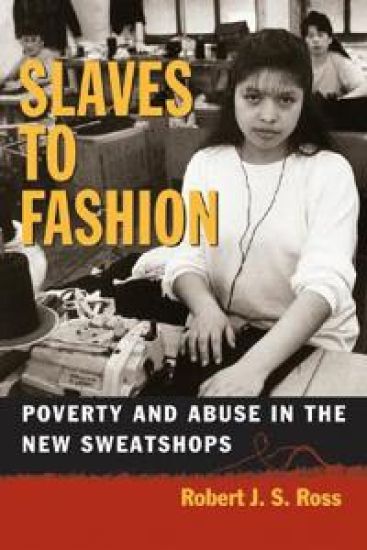
"A brilliant and beautiful book, the mature work of a lifetime, must reading for students of the globalization debate."---Tom Hayden"Slaves to Fashion is a remarkable achievement, several books in one: a gripping history of sweatshops, explaining their decline, fall, and return; a study of how the media portray them; an analysis of the fortunes of the current anti-sweatshop movement; an anatomy of the global traffic in apparel, in particular the South-South competition that sends wages and working conditions plummeting toward the bottom; and not least, a passionate declaration of faith that humanity can find a way to get its work done without sweatshops. This is engaged sociology at its most stimulating."---Todd Gitlin". . . unflinchingly portrays the reemergence of the sweatshop in our dog-eat-dog economy."---Los Angeles TimesJust as Barbara Ehrenreich's Nickel and Dimed uncovered the plight of the working poor in America, Robert J. S. Ross's Slaves to Fashion exposes the dark side of the apparel industry and its exploited workers at home and abroad. It's both a lesson in American business history and a warning about one of the most important issues facing the global capital economy-the reappearance of the sweatshop.Vividly detailing the decline and tragic rebirth of sweatshop conditions in the American apparel industry of the twentieth century, Ross explains the new sweatshops as a product of unregulated global capitalism and associated deregulation, union erosion, and exploitation of undocumented workers. Using historical material and economic and social data, the author shows that after a brief thirty-five years of fair practices, the U.S. apparel business has once again sunk to shameful abuse and exploitation. Refreshingly jargon-free but documented in depth, Slaves to Fashion is the only work to estimate the size of the sweatshop problem and to systematically show its impact on apparel workers' wages. It is also unique in its analysis of the budgets and personnel used in enforcing the Fair Labor Standards Act.Anyone who is concerned about this urgent social and economic topic and wants to go beyond the headlines should read this important and timely contribution to the rising debate on low-wage factory labor. Robert J.S. Ross is Professor of Sociology, Clark University. He is an expert in the area of sweatshops and globalization. He is an activist academic who travels and lectures extensively and has published numerous related articles.
Status and Respectability in the Cape Colony, 1750–1870
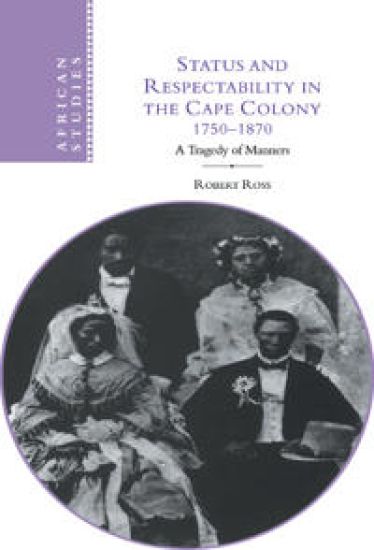
In a compelling example of the cultural history of South Africa, Robert Ross offers a subtle and wide-ranging study of status and respectability in the colonial Cape between 1750 and 1850. His 1999 book describes the symbolism of dress, emblems, architecture, food, language, and polite conventions, paying particular attention to domestic relationships, gender, education and religion, and analyses the values and the modes of thinking current in different strata of the society. He argues that these cultural factors were related to high political developments in the Cape, and offers a rich account of the changes in social identity that accompanied the transition from Dutch to British overrule, and of the development of white racism and of ideologies of resistance to white domination. The result is a uniquely nuanced account of a colonial society.
Status and Respectability in the Cape Colony, 1750–1870
In a compelling example of the cultural history of South Africa, Robert Ross offers a subtle and wide-ranging study of status and respectability in the colonial Cape between 1750 and 1850. His 1999 book describes the symbolism of dress, emblems, architecture, food, language, and polite conventions, paying particular attention to domestic relationships, gender, education and religion, and analyses the values and the modes of thinking current in different strata of the society. He argues that these cultural factors were related to high political developments in the Cape, and offers a rich account of the changes in social identity that accompanied the transition from Dutch to British overrule, and of the development of white racism and of ideologies of resistance to white domination. The result is a uniquely nuanced account of a colonial society.
A Concise History of South Africa

A Concise History of South Africa

Robert Ross

Cambridge University Press
2008
pokkari
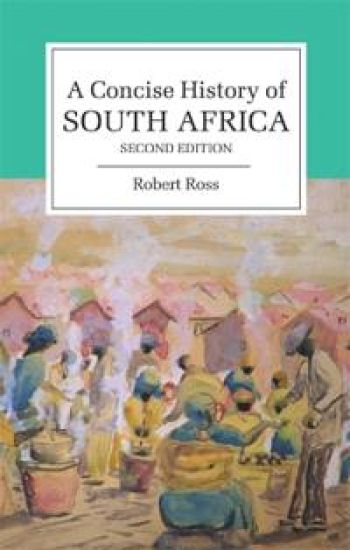
Lays emphasis on the continuing influence of the country's African heritage whilst also chronicling the processes of colonial conquest and of economic development stemming from the industrial revolution. This is followed by an analysis of the fundamental political changes South Africa has undergone, and a background for understanding those many things which have not changed.
Clothing

Clothing

Robert Ross

Polity Press
2008
sidottu
In virtually all the countries of the world, men, and to a lesser extent women, are today dressed in very similar clothing. This book gives a compelling account and analysis of the process by which this has come about. At the same time it takes seriously those places where, for whatever reason, this process has not occurred, or has been reversed, and provides explanations for these developments. The first part of this story recounts how the cultural, political and economic power of Europe and, from the later nineteenth century North America, has provided an impetus for the adoption of whatever was at that time standard Western dress. Set against this, Robert Ross shows how the adoption of European style dress, or its rejection, has always been a political act, performed most frequently in order to claim equality with colonial masters, more often a male option, or to stress distinction from them, which women, perhaps under male duress, more frequently did. The book takes a refreshing global perspective to its subject, with all continents and many countries being discussed. It investigates not merely the symbolic and message-bearing aspects of clothing, but also practical matters of production and, equally importantly, distribution.
Clothing

Clothing

Robert Ross

Polity Press
2008
nidottu
In virtually all the countries of the world, men, and to a lesser extent women, are today dressed in very similar clothing. This book gives a compelling account and analysis of the process by which this has come about. At the same time it takes seriously those places where, for whatever reason, this process has not occurred, or has been reversed, and provides explanations for these developments. The first part of this story recounts how the cultural, political and economic power of Europe and, from the later nineteenth century North America, has provided an impetus for the adoption of whatever was at that time standard Western dress. Set against this, Robert Ross shows how the adoption of European style dress, or its rejection, has always been a political act, performed most frequently in order to claim equality with colonial masters, more often a male option, or to stress distinction from them, which women, perhaps under male duress, more frequently did. The book takes a refreshing global perspective to its subject, with all continents and many countries being discussed. It investigates not merely the symbolic and message-bearing aspects of clothing, but also practical matters of production and, equally importantly, distribution.
Mission Possible

Mission Possible

Robert Ross

Transaction Publishers
2000
sidottu
The Latin American Agribusiness Development Corporation (LAAD) was one of many initiatives taken at the height of the Cold War to alleviate poverty in countries threatened by communist insurgencies. Its mission was to promote rural development by funding local agribusiness enterprises to create new permanent jobs and new economic activity. In Mission Possible, Ross, president of LAAD from 1972 to 1998, gives a richly detailed insider's account of the company's first three decades.Originally capitalized with a little over $2 million, and beginning with the small economies of Central America, it gradually expanded into the Caribbean islands and South America and now is a factor in 25 countries. To date, LAAD has provided over $300 million to 700 projects, generating tens of thousands of new jobs and new annual exports of $500 million. Always profitable, it has paid a dividend for twenty years. Its capitalization has grown to over $30 million by reinvesting most of its earnings in Latin America. Since LAAD was committed exclusively to Latin America, it had to contend with an often unsettled political environment; it could not simply stand on the sidelines and wait for conditions to improve. Indeed in a broader sense LAAD's mission was to help improve those conditions.Mission Possible describes a small but significant chapter in a broader context of how the world's rich countries have tried to raise living standards among their poorer neighbors. Students of economic development and international business management will learn much from the story of how this unique experiment grew into a dynamic enterprise."[Ross] offers innumerable studies [in Mission Possible] of investment projects that stimulated the commercial production of agricultural produce in the region. He recounts the frustrating negotiations with uncomprehending central bankers and the difficulties of developing marketing and other infrastructural networks that are so important for assuring the success of any business, and is pleased with what he identifies as the two most significant changes that profoundly affected agriculture: the decline in the role of the state in Latin America and in protectionism in the industrialized world. ... He stresses the fundamental roles that innovative entrepreneurs can play, taking advantage of opportunities created by organizations like LAAD, and using market information to reduce uncertainty." -David Barkin, Latin American Research ReviewRobert L. Ross, a Harvard-educated development economist, has worked for forty years in Latin America. He taught economics at the Latin American Economic and Social Planning Institute in Santiago, Chile and worked on the first development plans in Haiti and Paraguay. He was president of the Latin American Agribusiness Development Corporation from 1972 until his retirement in 1998.
Orchards of Privilege

Orchards of Privilege

Robert Ross

OHIO UNIVERSITY PRESS
2025
sidottu
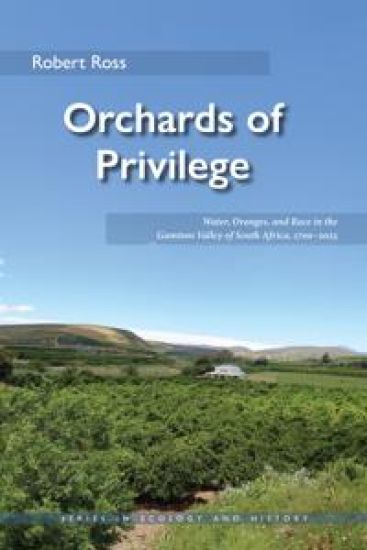
This study of the Gamtoos River floodplain in South Africa’s Eastern Cape Province traces its transformation from an eighteenth-century natural landscape of thick bush into an agricultural zone now threatened by climate change. The first half of the book explains how missionaries from the London Missionary Society and residents of the Hankey Mission Station introduced irrigation, turning the area into a community of small-scale farmers. Despite early failures, by 1849 they had constructed South Africa’s first major irrigation tunnel and aqueduct. However, conflicts between the missionaries and residents led to the loss of communal lands to privatization, which ultimately impoverished the local farmers. The second half explores efforts to develop the valley for large-scale agriculture, addressing challenges like drought, flash floods, and saline water. By the mid-twentieth century, Afrikaners dominated the area, benefiting from the construction in 1970 of the Kouga Dam, which provided fresh water for the floodplain. This led to the rise of a wealthy white farming community, sustained by apartheid policies and labor from the “Coloured” and African populations. In the early twenty-first century, however, this prosperity has become threatened by severe droughts linked to global climate change. In view of these historical transformations, the Gamtoos River floodplain exemplifies the complex interplay between human ambition, environmental challenges, and sociopolitical forces.
Orchards of Privilege

Orchards of Privilege

Robert Ross

OHIO UNIVERSITY PRESS
2025
pokkari
This study of the Gamtoos River floodplain in South Africa’s Eastern Cape Province traces its transformation from an eighteenth-century natural landscape of thick bush into an agricultural zone now threatened by climate change. The first half of the book explains how missionaries from the London Missionary Society and residents of the Hankey Mission Station introduced irrigation, turning the area into a community of small-scale farmers. Despite early failures, by 1849 they had constructed South Africa’s first major irrigation tunnel and aqueduct. However, conflicts between the missionaries and residents led to the loss of communal lands to privatization, which ultimately impoverished the local farmers. The second half explores efforts to develop the valley for large-scale agriculture, addressing challenges like drought, flash floods, and saline water. By the mid-twentieth century, Afrikaners dominated the area, benefiting from the construction in 1970 of the Kouga Dam, which provided fresh water for the floodplain. This led to the rise of a wealthy white farming community, sustained by apartheid policies and labor from the “Coloured” and African populations. In the early twenty-first century, however, this prosperity has become threatened by severe droughts linked to global climate change. In view of these historical transformations, the Gamtoos River floodplain exemplifies the complex interplay between human ambition, environmental challenges, and sociopolitical forces.
Marty Feldman: The Biography of a Comedy Legend
Mike Myers thinks he was "a genius", while John Cleese regards him as "a true cultural icon". He was an architect of British comedy, paving the way for Monty Python, and then became a major Hollywood star, forever remembered as Igor in Mel Brooks' Young Frankenstein. A writer, director, performer and true pioneer of his art, he died aged only 48. His name was Marty Feldman, and here, at last, is the fi rst ever biography. Acclaimed author Robert Ross has interviewed Marty's friends and family, including his sister Pamela, Tim Brooke-Taylor, Michael Palin and Terry Jones, and also draws from extensive, previously unpublished and often hilarious interviews with Marty himself, taped in preparation for the autobiography he never wrote. No one before or since has had a career quite like Marty's. Beginning in the dying days of variety theatre, he went from the behind the scenes scriptwriting triumphs of Round the Horne and The Frost Report to onscreen stardom in At Last the 1948 Show and his own hit series Marty. That led to transatlantic success, his work with Mel Brooks, and a five-picture deal to write and direct his own movies. From his youth as a tramp on the streets of London, to the height of his fame in America - where he encountered everyone from Orson Welles to Kermit the Frog, before his Hollywood dream became a nightmare - this is the fascinating story of a key figure in the history of comedy, fully told for the first time.
Cape of Torments

Cape of Torments

Robert Ross

TAYLOR FRANCIS LTD
2022
sidottu
Cape of Torments, first published in 1983, is a detailed examination of slavery in the Colony of the Cape of Good Hope. It describes the reactions of the slaves to their conditions of slavery, concentrating on those aspects of their lives which their masters considered criminal, and above all on the large numbers of occasions when slaves ran away in an attempt to start a new life elsewhere. The book examines Cape society and slave organization; the complex relations between slaves and the other groups of population at the Cape – Khoisan, Xhosa, Sotho-Tswana, Dutch East India Co servants and sailors – and the opportunities for escape; major uprisings and rebellions. The major theme of the book is the extent to which the Cape slaves were able to build a culture of their own, and the legacy of slavery to their descendants in modern South Africa.
Cape of Torments

Cape of Torments

Robert Ross

TAYLOR FRANCIS LTD
2024
nidottu
Cape of Torments, first published in 1983, is a detailed examination of slavery in the Colony of the Cape of Good Hope. It describes the reactions of the slaves to their conditions of slavery, concentrating on those aspects of their lives which their masters considered criminal, and above all on the large numbers of occasions when slaves ran away in an attempt to start a new life elsewhere. The book examines Cape society and slave organization; the complex relations between slaves and the other groups of population at the Cape – Khoisan, Xhosa, Sotho-Tswana, Dutch East India Co servants and sailors – and the opportunities for escape; major uprisings and rebellions. The major theme of the book is the extent to which the Cape slaves were able to build a culture of their own, and the legacy of slavery to their descendants in modern South Africa.