Kirjojen hintavertailu. Mukana 11 699 587 kirjaa ja 12 kauppaa.

Kirjahaku

Etsi kirjoja tekijän nimen, kirjan nimen tai ISBN:n perusteella.

6 kirjaa tekijältä Robert Shogan

Harry Truman and the Struggle for Racial Justice

Harry Truman and the Struggle for Racial Justice

Robert Shogan

University Press of Kansas
2013
sidottu
When Harry Truman was rescued from political obscurity to become Franklin Roosevelt’s running mate, black Americans were deeply troubled. Many believed that Truman, born and raised in former slave-holding Missouri, was a step back on civil rights from Henry Wallace, the liberal incumbent vice president. But by the end of his own presidency, black newspaper publishers cited Truman for having “awakened the conscience of America and given new strength to our democracy by his courageous efforts on behalf of freedom and equality.”In this first full-scale account of Truman’s evolving views on civil rights, Robert Shogan recounts how Truman outgrew the bigotry of his Jackson County upbringing to become the first president since Lincoln to attempt to redress the nation’s long history of injustice toward its black citizens—and in the process transformed the course of race relations in America. Shogan vividly demonstrates the full significance of the 33rd president’s contributions to that transformation. He ordered the integration of the armed forces and threw the weight of the Justice Department behind the long struggle against segregation in housing and education. And he used the platform of his presidency to relentlessly trumpet the cause of equal rights for those least favoured Americans, even making an unprecedented address to the NAACP. Going beyond other accounts of Truman, Shogan points out the political and personal factors that motivated the president and weighs the potential political costs and benefits of his civil rights actions. Shogan also explains Truman’s shift away from his formative racial prejudices by shedding light on the forces that shaped his character and leadership qualities. These included his political tutelage under “Boss Tom” Pendergast, which taught him the value of black voters, and the influence of populism, which fostered his support for underdogs such as black Americans. Illuminating how Truman became the first president to make racial injustice a political priority—and the first to denounce segregation as well as discrimination—Shogan’s book opens a new and provocative window on the struggle for civil rights in America.
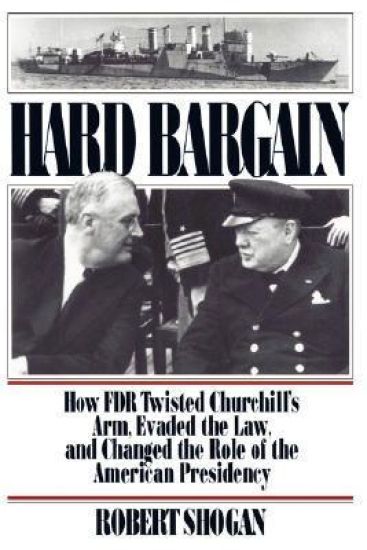
Hard Bargain

Hard Bargain

Robert Shogan

Basic Books
1999
pokkari
With Hard Bargain , Robert Shogan offers an account of one of World War II's most dramatic chapters,the story of how Franklin D. Roosevelt secretly brokered a deal to provide the destroyers Winston Churchill needed to save Britain from destruction. At the centre of the momentous events of 1940 are two extraordinary leaders: Churchill, the forthright pragmatist, and Roosevelt, the suave politician. As Hitler's war machine threatened to starve England into submission, these two men initiated a complex negotiation that would shatter all precedents for conducting foreign policy. FDR yearned to enter the war, but was handcuffed by domestic politics. Churchill had to plead for American intervention at a time when the United States was intensely isolationist. Drawing on archives on both sides of the Atlantic, Shogan masterfully recreates the President's maneuvers as FDR stepped around the Constitution in order to clinch the deal, a move that has had repercussions from Korea to the Persian Gulf.
Constant Conflict

Constant Conflict

Robert Shogan

Basic Books
2004
pokkari
America's culture war - which pits traditionalists, unrelenting defenders of the social orthodoxy, against modernists, agitators for social change - has simmered and seethed since the birth of the nation. But in the turbulent decade of the 1960s, the culture war erupted in the political arena, where it thunders on today. Constant Conflict examines how the evolution of cultural issues as political tools has rocked the balance of political power in America, and continues to do so. Through an expansive coverage of events - from Vietnam, Nixon, discrimination, abortion, economic imbalance, and morality in political behaviour - Washington journalist Robert Shogan provides an objective and informed look at how Americans feel about themselves and their country in the first decade of the new millennium. Updates to the paperback show how the culture war has reached new heights in the Bush presidency, with the emphasis on Godliness and the divisiveness against the Axis of Evil. Shogan also discusses how the cultural conflicts will impact the 2004 campaign.
The Fate Of The Union

The Fate Of The Union

Robert Shogan

Basic Books
2004
pokkari
The dreary presidential campaign of 1996 and Clinton's disillusioning presidency matched the convulsive pattern of events which yanked the nation in every direction except forward throughout the final decades of the twentieth century. The swings of the previous decade with the Republican ascension in Congress and the Democratic presence in the White House, were less an aberration than a continuation of the disruptions that haunted the post-depression American political system. The Fate of the Union: America's Rocky Road to Political Stalemate illustrates how the circumstances of each quadrennial American presidential contest have piled on the next, melding into the past and suggesting the future. The book explores the Clinton presidency as a continuum: first, placing it in the context of recent predecessors-from Truman to Bush-and then relating to the events that lead to his election in 1992, shaped his inaugural term, and enabled him to win four more years in the White House.Author Robert Shogan's timely examination shows that short of a thorough changing of the Constitution, the best prevention for an ever-worsening political system is to guard against self-delusion.
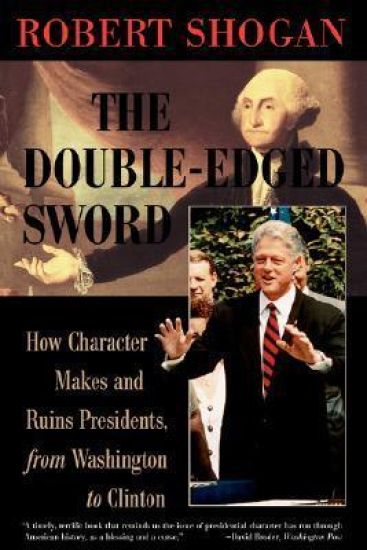
The Double Edged Sword

The Double Edged Sword

Robert Shogan

Basic Books
1999
pokkari
Ever since the Founding Fathers' faith in George Washington led them to create the presidency, the issue of character has been inextricably linked to the Oval Office. The American people have always expected their presidents to serve not only as political leaders but also role models of personal behaviour, setting standards for raising their children. But as the new millennium nears, character and values have taken on a significance never contemplated by Washington and the Founding Fathers. In the second half of the twentieth century, with the enfeeblement of traditional political institutions, and the explosion of electronic media, John F. Kennedy used his character to cross a new frontier into the era of the personal presidency. Democrat Kennedy blazed a trail in image manipulation which Republican Ronald Reagan carried to new heights. Then came Clinton. No president before him has been so calculating and determined in exploiting his personal life and values yet no chief executive in modern times has been so reviled and condemned because of his personal behaviour. The Double-Edged Sword: How Character Makes and Ruins Presidents, from Washington to Clinton rebuts the claim put forward by Clinton and his supporters that a President's private life can be separated from his performance in office. By examining the morality of some of our most prominent and influential Executive Chiefs,from the birth of the Republic and the launch of the New Deal to Watergate and the Clinton presidency,Robert Shogan illustrates how the so-called character issue, and the intertwined issue of values, are linked to the political process and governance. Based on extensive research as well as interviews with politicians and journalists, the book looks at how the strengths and weaknesses of character help shape presidential performance for good and for ill. It shows how presidents and their rivals on the political stage use the public's perceptions of presidential character to manipulate political audiences,namely, the press and the electorate. Ultimately, the book demonstrates that presidential character is a double-edged sword,a weapon that can discredit a president and destroy his credibility, but also a weapon that he can use to define himself and mobilize support,in sum, the ultimate weapon in modern American politics.
No Sense of Decency

No Sense of Decency

Robert Shogan

Ivan R Dee, Inc
2009
sidottu
"Have you no sense of decency, sir?" asked attorney Robert Welch in a climactic moment in the 1954 Senate hearings that pitted Joseph R. McCarthy against the United States Army, President Dwight Eisenhower, and the rest of the political establishment. What made the confrontation unprecedented and magnified its impact was its gavel-to-gavel coverage by television. Thirty-six days of hearings transfixed the nation. With a journalist's eye for revealing detail, Robert Shogan traces the phenomenon and analyzes television's impact on government. Despite McCarthy's fall, Mr. Shogan points out, the hearings left a major item of unfinished business—the issue of McCarthyism, the strategy based on fear, smear, and guilt by association.