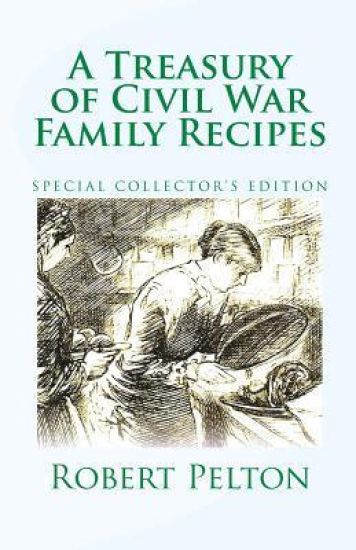
Baking Recipes From & Historical Trivia About Civil War Notables is a unique collection of special recipes dating from the Civil War period of our history. It's a practical baking book as well as the modern person's guide to authentic baking recipes from the Civil War period. These recipes were popular, or at least regularly used before, during and just after the Civil War or War Between the States. Many come from women who so expertly made bread and other baked goods for the legendary fighting men with the Union. These would include Generals Ulysses S. Grant, Abner Doubleday of later baseball fame, as well as the renowned George Armstrong Custer. And they are the recipes used by mothers, wives and daughters of the Confederacy when they baked for their heroic leaders-men such as Generals Jonathan "Stonewall" Jackson and James Longstreet as well as others including Lieutenant Harry Buford (Loreta Janeta Velazquez) and the illustrious President of the Confederacy, Jefferson Davis. Baking during the Civil War period was far from an easy task. The women of the house made an art out of making tasty loaves of bread, biscuits, pastry, pies, cakes, cookies, and all of their other homemade goodies. In those days, homemakers couldn't always purchase good flour. Every sack or barrel or bag might present new baking problems. Flour always had to be tested for quality before using it for baking. In the South, corn meal muffins, pound cake, rolls, cookies, pies, etc., were all baked in the oven of her wood stove. Good baking was simply a matter of experience. Women were able to satisfactorily prepare and bake these favorites with no reliable temperature gage. A good homemaker relied on how hot her oven "felt" when she was ready to bake. She simply stuck an arm in while counting 1001, 1002, 1003, etc. How hot her arm felt in a given number of seconds (or how long it took to scorch the hair on her arm) would determine whether or not her oven was at the correct temperature for whatever it was she wanted to bake. Homemakers of today, with all the modern conveniences in their kitchens, can hardly surpass the finished breads and cakes and pies baked so many years ago. Housewives of the mid-1800s baked, cooked, sewed, cleaned house and cut everyone's hair. She was the resident doctor of the house. And she was in charge of settling arguments by popping her kid's bottoms with the flat side of a cast iron skillet when a wooden paddle wasn't handy. Hot corn bread represented a Southern homemaker's hospitality. If cold corn bread was served, it was a sign that the particular guest was not welcome. This was her method of letting them know. Most of these baked items are not difficult to make. Each recipe has been updated for the convenience of today's homemaker. The end result will be exactly as it was for our Civil War ancestors. Every recipe in BAKING RECIPES & HISTORICAL TRIVIA ABGOUT CIVIL WAR NOTABLES is a classic in the historical sense. Each is known to have been a favorite of, or invention of, some family or individual that lived and loved and prayed while the Civil War raged on around them. Many were coveted treasures within a family, some famous, some not so famous, and handed down through the years or lost with the passage of time. Each delightful recipe is followed by often forgotten facts about the heroes and heroines of the as well as a few not so well known individuals. Also included are interesting biographical highlights about the person or family to whom the recipe is attributed. Each recipe was among the best used in the North and the South during the time the Civil War was raging. Here they are presented for the first time for today's American families to enjoy and experience the pleasure of preparing, baking and serving-just as it was done in the past.
The Colonial homemaker had to dry her spices in front of the fireplace. They were then pounded until finely powdered and sifted.Raisins are an example of the amount of effort it took to properly prepare everything for baking. Raisins, almonds, pineapples and chocolate were all imported from West Indies. Raisins had to first be washed and then firmly rubbed with a towel. This was done to remove the stems.Available flavorings commonly used in Colonial baking included honey, molasses and lemon. These were all readily available. Most spices were imported from the West Indies.Of all the foods enjoyed by the early Colonists, oats were one of the first to be imported. Oats initially came to New England on a British ship in 1602. Settlers in Plymouth began planting oats. Neither oats nor peanuts were initially used in the earlier Colonial baked goods. Oats were considered of no value other than horse feed. Peanuts were only to be fed to hogs. But both soon became a food staple on Colonial breakfast tables and for baking.The first wheat was sown in 1611 Colonial Virginia. And in 1626, samples of wheat grown in the Dutch Colony at New Netherlands were exhibited in Holland. Wheat was ordered from England in 1629 to be used as seed.It is probable that wheat was sown in the Plymouth Colony prior to 1629, although there is no record of this. In those days, homemakers couldn't always buy good flour. Almost every sack or barrel presented new baking problems. Flour always had to be tested for quality before using. Some disreputable businessmen added certain inexpensive ingredients (corn, peas or beans) to their flour in order to stretch the quantity when it was bagged and sold to the Colonial homemaker.Elizabeth Phillips, wife of Brigadier General Horatio Gates (1728-1806), wrote this tidbit: "If any corn has been ground with it, the flour will be a pale brown. If peas or beans have been ground with it, a still darker brown."
A Unique Collection of Family Recipes and Tidbits of History from Abraham Lincoln, Robert E. Lee and other Notables involved in the War of Northern Aggression. Measurements for ingredients used in recipes used in the past would not be recognizable to more modern homemakers. Look at some of those called for in the recipes given above - 1 gill of milk; 1 dessertspoonful meat extract; a tumblerful of water; a dash of ground mace; 1 saltspoonful. What exactly would they mean today? Or for example, when busily scurrying around the kitchen and preparing a meal, who would be able to properly measure ingredients in such things as a wineglassful? Or a pound of milk or water? Then try a dram of liquid? What about a pound of eggs? To sum everything up, each recipe found in this unique cook book was once popular, or at least commonly used during the Civil War period. They were all part of the history of a particular family, or person, who lived and loved and prayed and fought through this tragic time of our great nation. Many were coveted treasures within a family, some famous, some not so famous, and handed down through the years or lost with the passage of time. Each recipe has been meticulously updated. When the recipe is used today, it will turn out exactly as it did for the woman of the house that prepared it for her family so many long years ago. Here they are presented for the first time for today's American families to enjoy and experience the pleasure of preparing, cooking, baking and serving - exactly as it was done in the past. And lastly, to thankfully pass a blessing over before eating - be it for breakfast, lunch or dinner.