Kirjojen hintavertailu. Mukana 11 699 587 kirjaa ja 12 kauppaa.

Kirjahaku

Etsi kirjoja tekijän nimen, kirjan nimen tai ISBN:n perusteella.

6 kirjaa tekijältä Robert Weissberg

The Politics of Empowerment

The Politics of Empowerment

Robert Weissberg

Praeger Publishers Inc
1999
sidottu
On today's menu of remedies for our social and economic ills, empowerment has become immensely popular. The scholarly literature abounds with it: computerized searches yield thousands of citations in myriad disciplines. The education profession seems intoxicated by it; it infuses the entire political spectrum—from Marxists to feminists, from Black Power advocates to conservatives. As Weissberg points out, all assume, typically with more hope than proof, that if only people seized control of their lives, betterment would surely ensue. Allegedly, empowerment will cure everything from personal disorders to declining city centers. Weissberg conducts an FDA-like inquiry across numerous academic disciplines to assess the worthiness of this cure. He balances a close reading of the underlying theoretical foundations with empirically demonstrated effectiveness. Entire chapters are devoted to empowerment as a cure for personal problems ranging from health to homelessness, education, community development, and the problems afflicting African Americans. Despite all the promises, however, evidence of accomplishment is not forthcoming. Indeed, as Weissberg demonstrates, much of the evidence is twisted to disguise failure. Worse, much of this helpfulness is merely admonitions for greater dependency and misdirection away from cures of proven utility. Given that almost all this advice emanates from academics, the discrepancy between promise and result raises some troubling issues about today's academy. Clearly, professors do not suffer from ill-conceived remediation though their careers may flourish from publications about uplifting. Bound to be controversial, ^IThe Politics of Empowerment^R is a tonic for social scientists, policy makers, and citizens concerned with America's myriad sociopolitical problems.
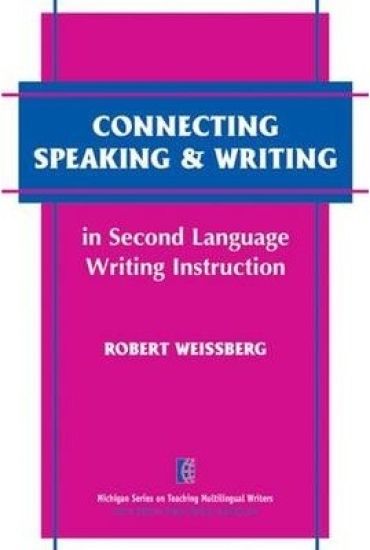
Connecting Speaking & Writing in Second Language Writing Instruction

Connecting Speaking & Writing in Second Language Writing Instruction

Robert Weissberg

The University of Michigan Press
2006
nidottu
Connecting Speaking & Writing in Second Language Writing Instruction provides both a theoretical perspective on the importance of L2 learners' development of written language as well as practical strategies for incorporating social interaction into the writing classroom.Weissberg provides a compelling argument for rethinking and reclaiming the speaking-writing connection. He reminds L2 writing specialists about the work of Vygotsky and other sociocultural theorists and how social interaction and inner speech play an integral role in writing. Weissberg also shows how encouraging concurrent oral-writing proficiencies affects L2 learners and how dialogue-writing relationships are developed through writing tasks, group activities, conferencing, dialogue journals, and teacher-written feedback. This well-researched and theoretical treatment of the speaking-writing connection is likely to encourage more teachers to "socialize" their L2 writing classrooms.
Bad Students, Not Bad Schools

Bad Students, Not Bad Schools

Robert Weissberg

Routledge
2017
nidottu
Americans are increasingly alarmed over our nation's educational deficiencies. Though anxieties about schooling are unending, especially with public institutions, these problems are more complex than institutional failure. Expenditures for education have exploded, and far exceed inflation and the rising costs of health care, but academic achievement remains flat. Many students are unable to graduate from high school, let alone obtain a college degree. And if they do make it to college, they are often forced into remedial courses. Why, despite this fiscal extravagance, are educational disappointments so widespread?In Bad Students, Not Bad Schools, Robert Weissberg argues that the answer is something everybody knows to be true but is afraid to say in public America's educational woes too often reflect the demographic mix of students. Schools today are filled with millions of youngsters, too many of whom struggle with the English language or simply have mediocre intellectual ability. Their lackluster performances are probably impervious to the current reform prescriptions regardless of the remedy's ideological derivation. Making matters worse, retention of students in school is embraced as a philosophy even if it impedes the learning of other students. Weissberg argues that most of America's educational woes would vanish if indifferent, troublesome students were permitted to leave when they had absorbed as much as they could learn; they would quickly be replaced by learning-hungry students, including many new immigrants from other countries.American education survives since we import highly intelligent, technically skillful foreigners just as we import oil, but this may not last forever. When educational establishments get serious about world-class mathematics and science, and permit serious students to learn, problems will dissolve. Rewarding the smartest, not spending fortunes in a futile quest to uplift the bottom, should become official policy. This book is a bracing reminder of the risks of political manipulation of education and argues that the measure of policy should be academic achievment.
Pernicious Tolerance

Pernicious Tolerance

Robert Weissberg

AldineTransaction
2008
sidottu
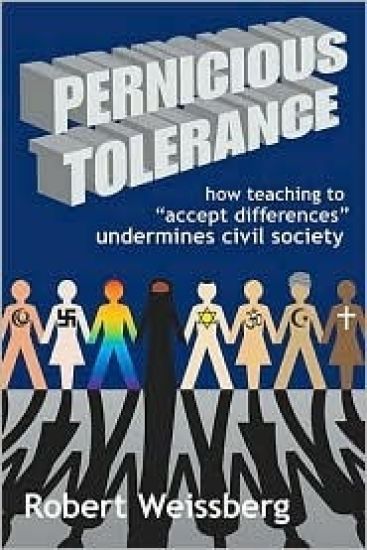
Recent decades have seen a consistent effort by the American educational establishment to instruct schoolchildren about the importance of "appreciating differences," all in the name of "tolerance," so as to quell burgeoning "hate." In Pernicious Tolerance, Robert Weissberg argues that educators' endless obsession with homophobia, sexism, racism, and other alleged hateful disorders is part of a much larger ongoing radical ideological quest to transform America, by first capturing education.In pursuing their objectives, radical pedagogues have abandoned the idea of tolerance of what some find objectionable. In its place they have adopted a fantasy—that tolerance can be replaced with a blank-check appreciation of diversity. Weissberg argues that this approach is guaranteed to promote civil strife. In rejecting a more workable version of tolerance, today's professional educators risk civic disaster in an effort to achieve legitimacy for those they believe are unfairly marginalized, stigmatized, underappreciated, and otherwise disdained.Weissberg also addresses the issue of an ever-expanding welfare state not only concerned with our material being, but, critically, also with our "mental health," defined as beliefs about the vulnerable or victims in waiting—women, ethnic and racial minorities, homosexuals, and others. He shows that this therapeutic state does not stop at imploring good thinking; it goes much further and criminalizes evil thoughts, as if thinking poorly of those at risk is tantamount to inflicting bodily harm. There is substantial collateral damage in this quest for tolerance; it facilitates intellectual sloth while raising anti-intellectualism to an honored professional norm.
Bad Students, Not Bad Schools

Bad Students, Not Bad Schools

Robert Weissberg

AldineTransaction
2010
sidottu
Americans are increasingly alarmed over our nation's educational deficiencies. Though anxieties about schooling are unending, especially with public institutions, these problems are more complex than institutional failure. Expenditures for education have exploded, and far exceed inflation and the rising costs of health care, but academic achievement remains flat. Many students are unable to graduate from high school, let alone obtain a college degree. And if they do make it to college, they are often forced into remedial courses. Why, despite this fiscal extravagance, are educational disappointments so widespread?In Bad Students, Not Bad Schools, Robert Weissberg argues that the answer is something everybody knows to be true but is afraid to say in public America's educational woes too often reflect the demographic mix of students. Schools today are filled with millions of youngsters, too many of whom struggle with the English language or simply have mediocre intellectual ability. Their lackluster performances are probably impervious to the current reform prescriptions regardless of the remedy's ideological derivation. Making matters worse, retention of students in school is embraced as a philosophy even if it impedes the learning of other students. Weissberg argues that most of America's educational woes would vanish if indifferent, troublesome students were permitted to leave when they had absorbed as much as they could learn; they would quickly be replaced by learning-hungry students, including many new immigrants from other countries.American education survives since we import highly intelligent, technically skillful foreigners just as we import oil, but this may not last forever. When educational establishments get serious about world-class mathematics and science, and permit serious students to learn, problems will dissolve. Rewarding the smartest, not spending fortunes in a futile quest to uplift the bottom, should become official policy. This book is a bracing reminder of the risks of political manipulation of education and argues that the measure of policy should be academic achievment.
Pernicious Tolerance

Pernicious Tolerance

Robert Weissberg

AldineTransaction
2011
nidottu
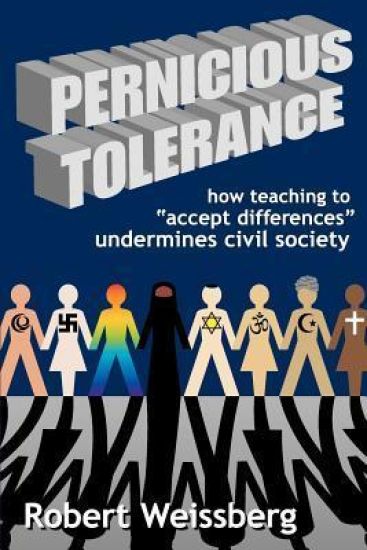
Recent decades have seen a consistent effort by the American educational establishment to instruct schoolchildren about the importance of "appreciating differences," all in the name of "tolerance," so as to quell burgeoning "hate." In Pernicious Tolerance, Robert Weissberg argues that educators' endless obsession with homophobia, sexism, racism, and other alleged hateful disorders is part of a much larger ongoing radical ideological quest to transform America, by first capturing education.In pursuing their objectives, radical pedagogues have abandoned the idea of tolerance of what some find objectionable. In its place they have adopted a fantasy—that tolerance can be replaced with a blank-check appreciation of diversity. Weissberg argues that this approach is guaranteed to promote civil strife. In rejecting a more workable version of tolerance, today's professional educators risk civic disaster in an effort to achieve legitimacy for those they believe are unfairly marginalized, stigmatized, underappreciated, and otherwise disdained.Weissberg also addresses the issue of an ever-expanding welfare state not only concerned with our material being, but, critically, also with our "mental health," defined as beliefs about the vulnerable or victims in waiting—women, ethnic and racial minorities, homosexuals, and others. He shows that this therapeutic state does not stop at imploring good thinking; it goes much further and criminalizes evil thoughts, as if thinking poorly of those at risk is tantamount to inflicting bodily harm. There is substantial collateral damage in this quest for tolerance; it facilitates intellectual sloth while raising anti-intellectualism to an honored professional norm.