Kirjojen hintavertailu. Mukana 11 244 527 kirjaa ja 12 kauppaa.

Kirjahaku

Etsi kirjoja tekijän nimen, kirjan nimen tai ISBN:n perusteella.

6 kirjaa tekijältä Robin Clark

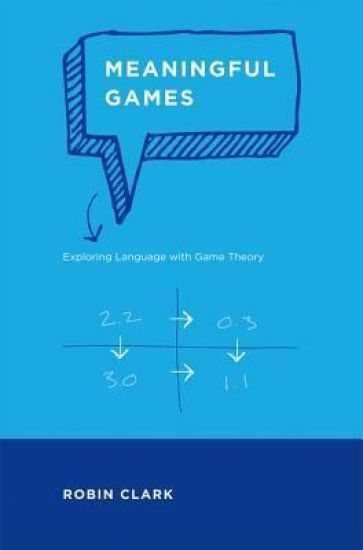
Meaningful Games

Meaningful Games

Robin Clark

MIT Press
2011
sidottu
An engaging introduction to the use of game theory to study lingistic meaning.In Meaningful Games, Robin Clark explains in an accessible manner the usefulness of game theory in thinking about a wide range of issues in linguistics. Clark argues that we use grammar strategically to signal our intended meanings: our choices as speaker are conditioned by what choices the hearer will make interpreting what we say. Game theory-according to which the outcome of a decision depends on the choices of others-provides a formal system that allows us to develop theories about the kind of decision making that is crucial to understanding linguistic behavior.Clark argues the only way to understand meaning is to grapple with its social nature-that it is the social that gives content to our mental lives. Game theory gives us a framework for working out these ideas. The resulting theory of use will allow us to account for many aspects of linguistic meaning, and the grammar itself can be simplified. The results are nevertheless precise and subject to empirical testing.Meaningful Games offers an engaging and accessible introduction to game theory and the study of linguistic meaning. No knowledge of mathematics beyond simple algebra is required; formal definitions appear in special boxes outside the main text. The book includes an extended argument in favor of the social basis of meaning; a brief introduction to game theory, with a focus on coordination games and cooperation; discussions of common knowledge and games of partial information; models of games for pronouns and politeness; and the development of a system of social coordination of reference.
Meaningful Games

Meaningful Games

Robin Clark

MIT PRESS LTD
2023
pokkari
An engaging introduction to the use of game theory to study lingistic meaning. In Meaningful Games, Robin Clark explains in an accessible manner the usefulness of game theory in thinking about a wide range of issues in linguistics. Clark argues that we use grammar strategically to signal our intended meanings: our choices as speaker are conditioned by what choices the hearer will make interpreting what we say. Game theory--according to which the outcome of a decision depends on the choices of others--provides a formal system that allows us to develop theories about the kind of decision making that is crucial to understanding linguistic behavior. Clark argues the only way to understand meaning is to grapple with its social nature--that it is the social that gives content to our mental lives. Game theory gives us a framework for working out these ideas. The resulting theory of use will allow us to account for many aspects of linguistic meaning, and the grammar itself can be simplified. The results are nevertheless precise and subject to empirical testing. Meaningful Games offers an engaging and accessible introduction to game theory and the study of linguistic meaning. No knowledge of mathematics beyond simple algebra is required; formal definitions appear in special boxes outside the main text. The book includes an extended argument in favor of the social basis of meaning; a brief introduction to game theory, with a focus on coordination games and cooperation; discussions of common knowledge and games of partial information; models of games for pronouns and politeness; and the development of a system of social coordination of reference.
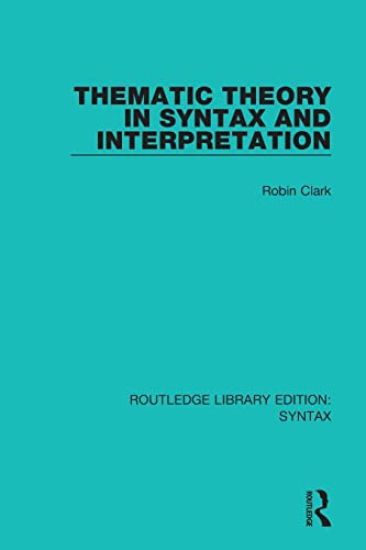
Thematic Theory in Syntax and Interpretation
In recent years, lexical argument structure, in the guise of thematic roles, has come to play an increasingly important part in syntactic theory. The first part of this book, first published in 1990, explores the interplay between thematic role assignment and movement processes, with particular reference to the explanatory problem of nominalisation. The second part explores the relationship between thematic roles and control. Particularly close attention is paid to implicit arguments, arbitrary control and adverbs of quantification. A theory of control is presented which unifies obligatory and non-obligatory control. The theory of control, furthermore, generalises to account for the binding gaps in purposive clauses, tough movement constructions, infinitival clauses and other constructions which have typically been analysed as involving long-distance dependencies. This title will be of interest to students of linguistics.
Thematic Theory in Syntax and Interpretation
In recent years, lexical argument structure, in the guise of thematic roles, has come to play an increasingly important part in syntactic theory. The first part of this book, first published in 1990, explores the interplay between thematic role assignment and movement processes, with particular reference to the explanatory problem of nominalisation. The second part explores the relationship between thematic roles and control. Particularly close attention is paid to implicit arguments, arbitrary control and adverbs of quantification. A theory of control is presented which unifies obligatory and non-obligatory control. The theory of control, furthermore, generalises to account for the binding gaps in purposive clauses, tough movement constructions, infinitival clauses and other constructions which have typically been analysed as involving long-distance dependencies. This title will be of interest to students of linguistics.