Kirjojen hintavertailu. Mukana 11 995 039 kirjaa ja 12 kauppaa.

Kirjahaku

Etsi kirjoja tekijän nimen, kirjan nimen tai ISBN:n perusteella.

4 kirjaa tekijältä Robin D. Rollinger

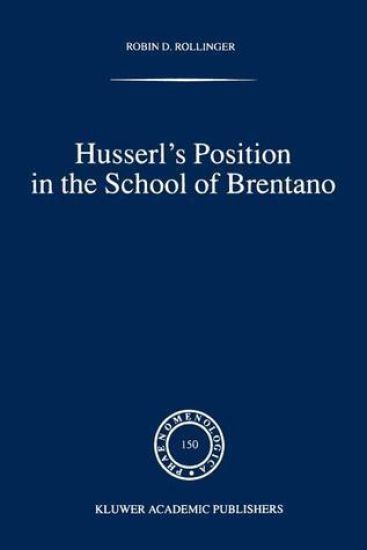
Husserl’s Position in the School of Brentano
Phenomenology, according to Husserl, is meant to be philosophy as rigorous science. It was Franz Brentano who inspired him to pursue the ideal of scientific philosophy. Though Husserl began his philosophical career as an orthodox disciple of Brentano, he eventually began to have doubts about this orientation. The Logische Unterschungen is the result of such doubts. Especially after the publication of that work, he became increasingly convinced that, in the interests of scientific philosophy, he had to go in a direction which diverged from Brentano and other members of this school (`Brentanists') who believed in the same ideal. An attempt is made here to ascertain Husserl's philosophical relation to Brentano and certain other Brentanists (Carl Stumpf, Benno Kerry, Kasimir Twardowski, Alexius Meinong, and Anton Marty). The crucial turning point in the development of these relations is to be found in the essay which Husserl wrote in 1894 (particularly in response to Twardowski) under the title `Intentional Objects' (which is translated as an appendix in this volume). This study will be of interest to historians of philosophy and phenomenology in particular, but also to anyone concerned with the ideal of scientific philosophy.
Austrian Phenomenology

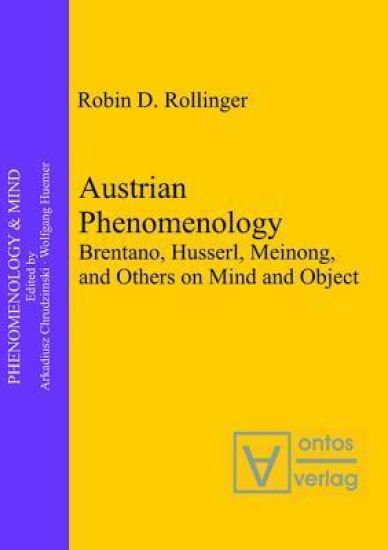
Austrian Phenomenology

Robin D. Rollinger

De Gruyter
2008
sidottu
While many of the phenomenological currents in philosophy allegedly utilize a peculiar method, the type under consideration here is characterized by Franz Brentano’s ambition to make philosophy scientific by adopting no other method but that of natural science. Brentano became particularly influential in teaching his students (such as Carl Stumpf, Anton Marty, Alexius Meinong, and Edmund Husserl) his descriptive psychology, which is concerned with mind as intentionally directed at objects. As Brentano and his students continued in their investigations in descriptive psychology, another side of Austrian phenomenology, namely object theory, became more and more prominent. The philosophical orientation under consideration in this collection of essays is accordingly a two-sided discipline, concerned with both mind and objects, and applicable to various areas of philosophy such as epistemology, philosophy of language, value theory, and ontology.
Concept and Judgment in Brentano's Logic Lectures: Analysis and Materials
Concept and Judgment in Brentano's Logic Lectures is concerned with a crucial aspect of Brentano's philosophy as it was developed in his logic lectures from c. 1870 to c. 1885. The first part of the volume is an analysis of his theory of concept and judgment. The second part consists of materials, including a German edition and English translation of notes that a student took from a lecture course that Brentano gave. A short book by this student on Brentano is also translated in the materials. The access to Brentano's philosophy is enhanced by this volume not only with regard to his logic as a theory of deductive inference, but also to his descriptive psychology, metaphysics, and philosophy of language.
Husserl’s Position in the School of Brentano
Phenomenology, according to Husserl, is meant to be philosophy as rigorous science. It was Franz Brentano who inspired him to pursue the ideal of scientific philosophy. Though Husserl began his philosophical career as an orthodox disciple of Brentano, he eventually began to have doubts about this orientation. The Logische Unterschungen is the result of such doubts. Especially after the publication of that work, he became increasingly convinced that, in the interests of scientific philosophy, he had to go in a direction which diverged from Brentano and other members of this school (`Brentanists') who believed in the same ideal. An attempt is made here to ascertain Husserl's philosophical relation to Brentano and certain other Brentanists (Carl Stumpf, Benno Kerry, Kasimir Twardowski, Alexius Meinong, and Anton Marty). The crucial turning point in the development of these relations is to be found in the essay which Husserl wrote in 1894 (particularly in response to Twardowski) under the title `Intentional Objects' (which is translated as an appendix in this volume). This study will be of interest to historians of philosophy and phenomenology in particular, but also to anyone concerned with the ideal of scientific philosophy.