Kirjojen hintavertailu. Mukana 11 717 486 kirjaa ja 12 kauppaa.

Kirjahaku

Etsi kirjoja tekijän nimen, kirjan nimen tai ISBN:n perusteella.

12 kirjaa tekijältä Robin Dunbar

Human Evolution: Our Brains and Behavior

Human Evolution: Our Brains and Behavior

Robin Dunbar

Oxford University Press
2016
sidottu
The story of human evolution has fascinated us like no other: we seem to have an insatiable curiosity about who we are and where we have come from. Yet studying the "stones and bones" skirts around what is perhaps the realest, and most relatable, story of human evolution - the social and cognitive changes that gave rise to modern humans. In Human Evolution: Our Brains and Behavior, Robin Dunbar appeals to the human aspects of every reader, as subjects of mating, friendship, and community are discussed from an evolutionary psychology perspective. With a table of contents ranging from prehistoric times to modern days, Human Evolution focuses on an aspect of evolution that has typically been overshadowed by the archaeological record: the biological, neurological, and genetic changes that occurred with each "transition" in the evolutionary narrative. Dunbar's interdisciplinary approach - inspired by his background as both an anthropologist and accomplished psychologist - brings the reader into all aspects of the evolutionary process, which he describes as the "jigsaw puzzle" of evolution that he and the reader will help solve. In doing so, the book carefully maps out each stage of the evolutionary process, from anatomical changes such as bipedalism and increase in brain size, to cognitive and behavioral changes, such as the ability to cook, laugh, and use language to form communities through religion and story-telling. Most importantly and interestingly, Dunbar hypothesizes the order in which these evolutionary changes occurred-conclusions that are reached with the "time budget model" theory that Dunbar himself coined. As definitive as the "stones and bones" are for the hard dates of archaeological evidence, this book explores far more complex psychological questions that require a degree of intellectual speculation: What does it really mean to be human (as opposed to being an ape), and how did we come to be that way?
Evolution

Evolution

Robin Dunbar

Oxford University Press Inc
2020
nidottu
Evolution is one of the most important processes in life. It not only explains the detailed history of life on earth, but its scope also extends into many aspects of our own contemporary behavior-who we are and how we got to be here, our psychology, our cultures-and greatly impacts modern advancements in medicine and conservation biology. Perhaps its most important claim for science is its ability to provide an overarching framework that integrates the many life sciences into a single unified whole. Yet, evolution-evolutionary biology in particular-has been, and continues to be, regarded with suspicion by many. Understanding how and why evolution works, and what it can tell us, is perhaps the single most important contribution to the public perception of science. This book provides an overview of the basic theory and showcases how widely its consequences reverberate across the life sciences, the social sciences and even the humanities. In this book, Robin Dunbar uses examples drawn from plant life, animals and humans to illustrate these processes. Evolutionary science has important advantages. Most of science deals with the microscopic world that we cannot see and invariably have difficulty understanding, but evolution deals with the macro-world in which we live and move. That invariably makes it much easier for the lay audience to appreciate, understand and enjoy. Evolution: What Everyone Needs to Know® takes a broad approach to evolution, dealing both with the core theory itself and its impact on different aspects of the world we live in, from the iconic debates of the nineteenth century, to viruses and superbugs, to human evolution and behavior.
Evolution

Evolution

Robin Dunbar

Oxford University Press Inc
2021
sidottu
Evolution is one of the most important processes in life. It not only explains the detailed history of life on earth, but its scope also extends into many aspects of our own contemporary behavior-who we are and how we got to be here, our psychology, our cultures-and greatly impacts modern advancements in medicine and conservation biology. Perhaps its most important claim for science is its ability to provide an overarching framework that integrates the many life sciences into a single unified whole. Yet, evolution-evolutionary biology in particular-has been, and continues to be, regarded with suspicion by many. Understanding how and why evolution works, and what it can tell us, is perhaps the single most important contribution to the public perception of science. This book provides an overview of the basic theory and showcases how widely its consequences reverberate across the life sciences, the social sciences and even the humanities. In this book, Robin Dunbar uses examples drawn from plant life, animals and humans to illustrate these processes. Evolutionary science has important advantages. Most of science deals with the microscopic world that we cannot see and invariably have difficulty understanding, but evolution deals with the macro-world in which we live and move. That invariably makes it much easier for the lay audience to appreciate, understand and enjoy. Evolution: What Everyone Needs to Know® takes a broad approach to evolution, dealing both with the core theory itself and its impact on different aspects of the world we live in, from the iconic debates of the nineteenth century, to viruses and superbugs, to human evolution and behavior.
How Religion Evolved: And Why It Endures

How Religion Evolved: And Why It Endures

Robin Dunbar

Oxford University Press
2022
sidottu
One of the world's foremost scholars of evolution tackles one of its essential mysteries: why we believe. Our species diverged from the great apes six to eight million years ago. Since then, our propensity toward spiritual thinking and ritual emerged. How, when, and why did this occur, and how did the earliest, informal shamanic practices evolve into the world religions familiar to us today? What is the evolutionary purpose of religion, and are some individuals more inclined than others to be religious? In How Religion Evolved, Robin Dunbar explores these and other questions, mining the distinctions between religions of experience--as practiced by the earliest hunter-gatherer societies--and doctrinal religions, from Judaism, Christianity, and Islam to Zoroastrianism, Hinduism, Buddhism, and their many derivatives. Examining religion's origins, social functions, its effects on the brain and body, and its place in the modern era, Dunbar offers a fascinating and far-reaching analysis of the quintessentially human impulse to believe.
How Religion Evolved

How Religion Evolved

Robin Dunbar

PENGUIN BOOKS LTD
2023
nidottu
A fascinating analysis of the evolution of religion from the internationally renowned evolutionary psychologistWhen did humans develop spiritual thought? What is religion's evolutionary purpose? And in our increasingly secular world, why has it endured?Every society in the history of humanity has lived with religion. In How Religion Evolved, evolutionary psychologist Professor Robin Dunbar tracks its origins back to what he terms the 'mystical stance' - the aspect of human psychology that predisposes us to believe in a transcendent world, and which makes an encounter with the spiritual possible. As he explores world religions and their many derivatives, as well as religions of experience practised by hunter-gatherer societies since time immemorial, Dunbar argues that this instinct is not a peculiar human quirk, an aberration on our otherwise efficient evolutionary journey. Rather, religion confers an advantage: it can benefit our individual health and wellbeing, but, more importantly, it fosters social bonding at large scale, helping hold fractious societies together. Dunbar suggests these dimensions might provide the basis for an overarching theory for why and how humans are religious, and so help unify the myriad strands that currently populate this field.Drawing on path-breaking research, clinical case studies and fieldwork from around the globe, as well as stories of charismatic cult leaders, mysterious sects and lost faiths, How Religion Evolved offers a fascinating and far-reaching analysis of this quintessentially human impulse - to believe.
Friends

Friends

Robin Dunbar

Little, Brown Book Group
2022
pokkari
'Fascinating...In essence, the number and quality of our friendships may have a bigger influence on our happiness, health and mortality risk than anything else in life save for giving up smoking' Guardian, Book of the DayFriends matter to us, and they matter more than we think. The single most surprising fact to emerge out of the medical literature over the last decade or so has been that the number and quality of the friendships we have has a bigger influence on our happiness, health and even mortality risk than anything else except giving up smoking.Robin Dunbar is the world-renowned psychologist and author who famously discovered Dunbar's number: how our capacity for friendship is limited to around 150 people. In Friends, he looks at friendship in the round, at the way different types of friendship and family relationships intersect, or at the complex of psychological and behavioural mechanisms that underpin friendships and make them possible - and just how complicated the business of making and keeping friends actually is.Mixing insights from scientific research with first person experiences and culture, Friends explores and integrates knowledge from disciplines ranging from psychology and anthropology to neuroscience and genetics in a single magical weave that allows us to peer into the incredible complexity of the social world in which we are all so deeply embedded.Working at the coalface of the subject at both research and personal levels, Robin Dunbar has written the definitive book on how and why we are friends.
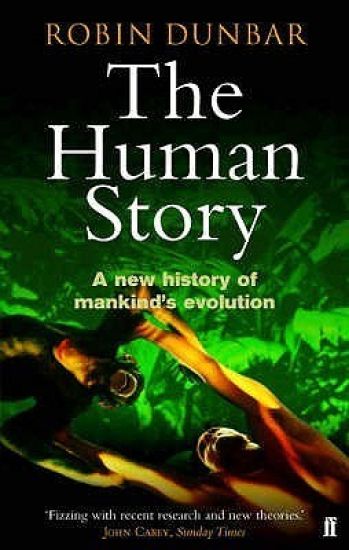
The Human Story

The Human Story

Robin Dunbar

Faber Faber
2005
pokkari
A wonderfully accessible, up-to-the-minute account of human evolution by 'one of the most respected evolutionary psychologists in Britain' (Guardian). Of the dozen or so hominid species once in existence, why are we the only one to have survived? What is it that sets us so firmly apart from all the other creatures with whom we share the planet? How and when did that separation come about?
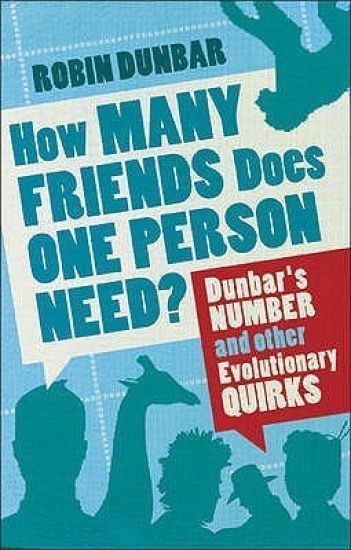
How Many Friends Does One Person Need?
We are the product of our evolutionary history and this history colours our everyday lives - from why we kiss to how religious we are. In How Many Friends Does One Person Need? Robin Dunbar explains how the distant past underpins our current behaviour, through the groundbreaking experiments that have changed the thinking of evolutionary biologists forever. He explains phenomena such as why 'Dunbar's Number' (150) is the maximum number of acquaintances you can have, why all babies are born premature and the science behind lonely hearts columns. Stimulating, provocative and highly enjoyable, this fascinating book is essential for understanding why humans behave as they do - what it is to be human.
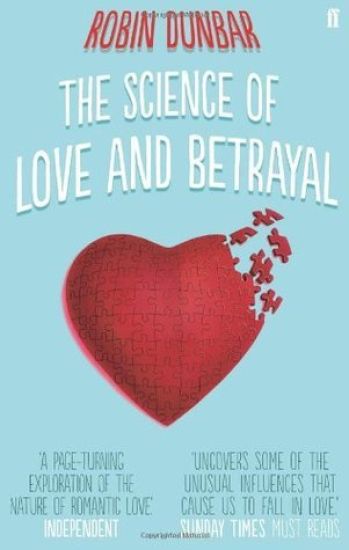
The Science of Love and Betrayal

The Science of Love and Betrayal

Robin Dunbar

Faber Faber
2013
pokkari
Falling in love is one of the strangest things we can do - and one of the things that makes us uniquely human. But what happens to our brains when our eyes meet across a crowded room? Why do we kiss each other, forget our friends, seek a 'good sense of humour' in Lonely Hearts adverts and try (and fail) to be monogamous? How are our romantic relationships different from our relationships with friends, family or even God? Can science help us, or are we better off turning back to the poets?Basing his arguments on new and experimental scientific research, Robin Dunbar explores the psychology and ethology of romantic love and how our evolutionary programming still affects our behaviour. Fascinating and illuminating, witty and accessible, The Science of Love and Betrayal is essential reading for anyone who's ever wondered why we fall in love and what on earth is going on when we do.
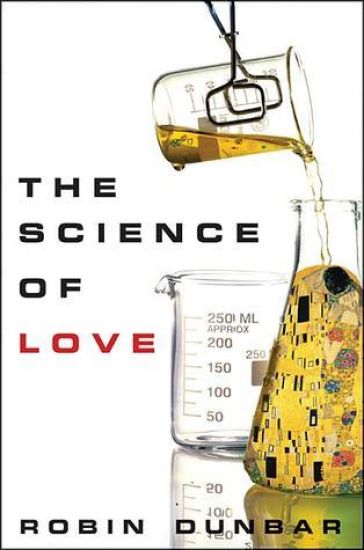
The Science of Love

The Science of Love

Robin Dunbar

Trade Paper Press
2012
sidottu
A scientific exploration of some of humanity's most puzzling questions: What is love? Why do we fall in (and out) of love? And why would we have evolved to feel something so weird, with so many downsides?Whether you live for Valentine's Day or are the type to forget your wedding anniversary, love is, quite simply, part of being human. In The Science of Love, renowned evolutionary anthropologist Robin Dunbar uses the latest science to explore every aspect of human love. Why do we kiss? What evolutionary benefit could there be to feeling like you would die for your mate? If love exists to encourage child-bearing and child-rearing, why do we love until death do us part (and beyond)? Is parental love anything like romantic love? Dunbar explores everything science has discovered about romance, passion, sex, and commitment, answering these questions and more.Draws on the latest scientific research to examine the many aspects of love--passion, commitment, intimacy, hugging, kissing, monogamy, cheating, and more--and explain why we have evolved to behave as we doFilled with fascinating insights into specific human behaviors and experiences, from the European air kiss on both cheeks to the phenomenon of love at first sightWritten by Robin Dunbar, a prominent anthropologist and evolutionary psychologist whose work have been featured in Malcolm Gladwell's The Tipping Point and many other books
Om religionernas uppkomst

Om religionernas uppkomst

Robin Dunbar

Fri Tanke
2023
sidottu
Under hela vår historia har religiös tro varit en del av den mänskliga tillvaron – från de förhistoriska människornas grottmålningar till andlighetens fortlevnad i dagens alltmer sekulära samhällen. Faktum är att religion tycks vara nära förbundet med människans evolution.I Om religionernas uppkomst argumenterar evolutionspsykologen Robin Dunbar för att religion varken är en nyck eller en avvikelse i en annars effektiv evolutionär resa. Snarare kan religiositet och andliga upplevelser utgöra en fördel, både för individens hälsa och välstånd och för bräckliga samhällens möjligheter till sammanhållning. Utifrån banbrytande forskning och fältarbete inom arkeologi, historia, neurovetenskap och evolutionspsykologi formulerar Robin Dunbar en nytänkande teori om hur religionerna uppkom – och varför de överlever.