Kirjojen hintavertailu. Mukana 11 244 527 kirjaa ja 12 kauppaa.

Kirjahaku

Etsi kirjoja tekijän nimen, kirjan nimen tai ISBN:n perusteella.

20 kirjaa tekijältä Rodrick Wallace

An Ecosystem Approach to Economic Stabilization
The creation of economic institutions that can function well under substantial uncertainties -- Black Swans -- is analogous to the dilemmas confronting our hunter-gatherer forefathers in the face of large-scale ecological unpredictability. The ultimate solution was not the development of a super hunter-gatherer technology that could ride out repeated catastrophe, but rather the invention, in neolithic times, of culturally-adapted 'farmed' ecosystems constructed to maximize food yield and minimize risks of famine. Recent advances in evolutionary and ecosystem theory applied to economic structure and process may permit construction of both new economic theory and new tools for data analysis that can help in the design of more robust economic institutions. This may result in less frequent and less disruptive transitions, and enable the design of culturally-specific systems less affected by those that do occur.This unique and innovative book applies cutting-edge methods from cognitive science and evolutionary theory to the problem of the necessary stabilization of economic processes. At the core of this book is the establishment of a statistics-like toolbox for the study of empirical data that is consistent with generalized evolutionary approaches. This toolbox enables the construction of both new economic theories and methods of data analysis that can help in the design of more robust economic institutions. This in turn will result in less frequent and less disruptive Black Swans, and enable as well the design of culturally-specific systems less affected by those that do occur.
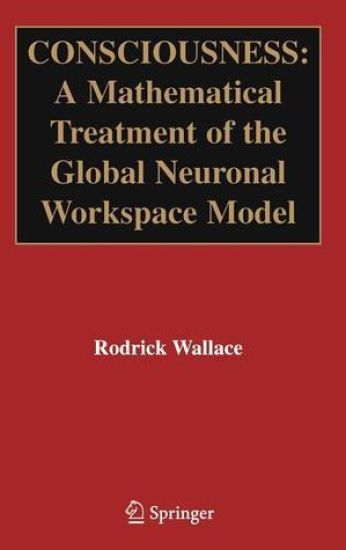
Consciousness

Consciousness

Rodrick Wallace

Springer-Verlag New York Inc.
2005
sidottu
This book is not an intellectual history or popular summary of recent work on consciousness in humans. Bernard Baars (1988), Edelman and Tononi (2000), and many others, have written such, and done it well indeed. This book, rather, brings the powerful analytic machinery of communication theory to bear on the Global Neuronal Workspace (GNW) model of consciousness which Baars introduced, and does so in a formal mathematical manner. It is not the first such attempt. The philospher Fred Dretske (1981), indep- dent of Baars, long ago outlined how information theory might illuminate the understanding of mind. Adapting his approach on the necessary conditions for mental process, we apply a previously-developed information theory analysis of interacting cognitive biological and social modules to Baars' GNW, which has become the principal candidate for a 'standard model' of consciousness. Invoking an obvious canonical homology with statistical physics, the method, when iterated in the spirit of the Hierarchical Linear Model of regression theory, generates a fluctuating dynamic threshold for consciousness which is similar to a tunable phase transition in a physical system. The phenomenon is, however, constrained to a manifold/atlas structure analogous to a retina; an adaptable Rate Distortion manifold, whose 'topology', in a large sense, reflects the hierarchy of embedding constraints acting on consciousness. This view greatly extends what Baars has characterized as 'contexts.
An Ecosystem Approach to Economic Stabilization
The creation of economic institutions that can function well under substantial uncertainties -- Black Swans -- is analogous to the dilemmas confronting our hunter-gatherer forefathers in the face of large-scale ecological unpredictability. The ultimate solution was not the development of a super hunter-gatherer technology that could ride out repeated catastrophe, but rather the invention, in neolithic times, of culturally-adapted 'farmed' ecosystems constructed to maximize food yield and minimize risks of famine. Recent advances in evolutionary and ecosystem theory applied to economic structure and process may permit construction of both new economic theory and new tools for data analysis that can help in the design of more robust economic institutions. This may result in less frequent and less disruptive transitions, and enable the design of culturally-specific systems less affected by those that do occur.This unique and innovative book applies cutting-edge methods from cognitive science and evolutionary theory to the problem of the necessary stabilization of economic processes. At the core of this book is the establishment of a statistics-like toolbox for the study of empirical data that is consistent with generalized evolutionary approaches. This toolbox enables the construction of both new economic theories and methods of data analysis that can help in the design of more robust economic institutions. This in turn will result in less frequent and less disruptive Black Swans, and enable as well the design of culturally-specific systems less affected by those that do occur.

Consciousness

Consciousness

Rodrick Wallace

Springer-Verlag New York Inc.
2014
nidottu
This book is not an intellectual history or popular summary of recent work on consciousness in humans. Bernard Baars (1988), Edelman and Tononi (2000), and many others, have written such, and done it well indeed. This book, rather, brings the powerful analytic machinery of communication theory to bear on the Global Neuronal Workspace (GNW) model of consciousness which Baars introduced, and does so in a formal mathematical manner. It is not the first such attempt. The philospher Fred Dretske (1981), indep- dent of Baars, long ago outlined how information theory might illuminate the understanding of mind. Adapting his approach on the necessary conditions for mental process, we apply a previously-developed information theory analysis of interacting cognitive biological and social modules to Baars' GNW, which has become the principal candidate for a 'standard model' of consciousness. Invoking an obvious canonical homology with statistical physics, the method, when iterated in the spirit of the Hierarchical Linear Model of regression theory, generates a fluctuating dynamic threshold for consciousness which is similar to a tunable phase transition in a physical system. The phenomenon is, however, constrained to a manifold/atlas structure analogous to a retina; an adaptable Rate Distortion manifold, whose 'topology', in a large sense, reflects the hierarchy of embedding constraints acting on consciousness. This view greatly extends what Baars has characterized as 'contexts.
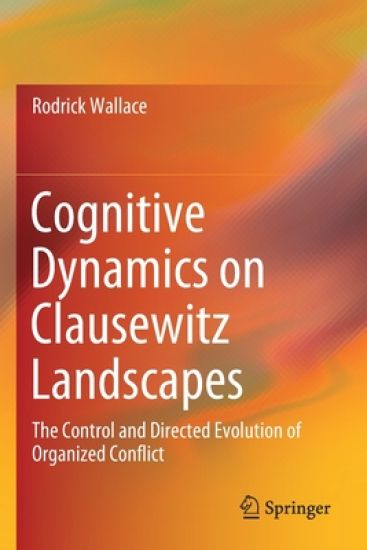
Cognitive Dynamics on Clausewitz Landscapes

Cognitive Dynamics on Clausewitz Landscapes

Rodrick Wallace

Springer Nature Switzerland AG
2019
sidottu
This book applies cutting-edge methods from cognitive and evolutionary theories to develop models of conflict between hierarchically-structured cognitive entities under circumstances of imprecision, uncertainty and stress. Characterized as friction and the fog-of-war by the Prussian military theorist Carl von Clausewitz, such conditions impair institutional cognition in real-time conflict and pose a real and continuing threat to organizations, such as the US military. In a linked collection of formal essays and a mathematical appendix, the book explores different aspects of cognitive and evolutionary process as conducted under the direction of doctrine that acts as a kind of genome for retention of what is learned through Lamarckian evolutionary selection pressures: armies and corporate entities learn from conflict, and incorporate that learning into their ongoing procedures. The book proposes models and policy solutions for strategic competence. A central feature of the book is a formal description of the famous OODA loop of the US military theorist John Boyd in terms of the Data Rate Theorem that links control and information theories. That description is expanded to cover more fully the impact of stochastic fog-of-war effects on tactical and operational scales of conflict. Subsequent chapters examine in more detail the role of doctrine, and the particular effect of embedding culture on cognitive and Lamarckian evolutionary processes associated with conflict on tactical, operational, and strategic scales and levels of organization. A scientifically sophisticated exercise in applied mathematics, history, evolutionary theory, and ecosystem theory, this book will be appropriate for researchers and students interested in defense, security, and international relations, as well as non-academic career professionals in government and industry.
Cognitive Dynamics on Clausewitz Landscapes

Cognitive Dynamics on Clausewitz Landscapes

Rodrick Wallace

Springer Nature Switzerland AG
2020
nidottu
This book applies cutting-edge methods from cognitive and evolutionary theories to develop models of conflict between hierarchically-structured cognitive entities under circumstances of imprecision, uncertainty and stress. Characterized as friction and the fog-of-war by the Prussian military theorist Carl von Clausewitz, such conditions impair institutional cognition in real-time conflict and pose a real and continuing threat to organizations, such as the US military. In a linked collection of formal essays and a mathematical appendix, the book explores different aspects of cognitive and evolutionary process as conducted under the direction of doctrine that acts as a kind of genome for retention of what is learned through Lamarckian evolutionary selection pressures: armies and corporate entities learn from conflict, and incorporate that learning into their ongoing procedures. The book proposes models and policy solutions for strategic competence. A central feature of the book is a formal description of the famous OODA loop of the US military theorist John Boyd in terms of the Data Rate Theorem that links control and information theories. That description is expanded to cover more fully the impact of stochastic fog-of-war effects on tactical and operational scales of conflict. Subsequent chapters examine in more detail the role of doctrine, and the particular effect of embedding culture on cognitive and Lamarckian evolutionary processes associated with conflict on tactical, operational, and strategic scales and levels of organization. A scientifically sophisticated exercise in applied mathematics, history, evolutionary theory, and ecosystem theory, this book will be appropriate for researchers and students interested in defense, security, and international relations, as well as non-academic career professionals in government and industry.
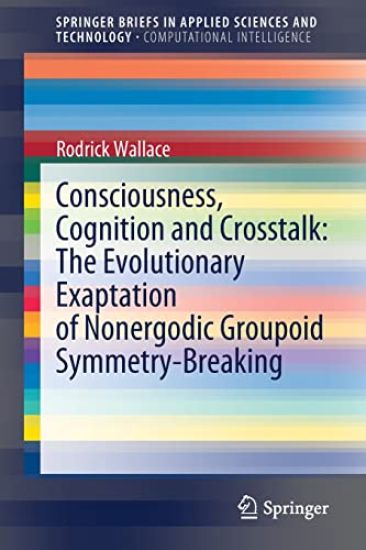
Consciousness, Cognition and Crosstalk: The Evolutionary Exaptation of Nonergodic Groupoid Symmetry-Breaking
This book makes application to the dynamics of arousal and distraction, and to other examples. A modified version of the Kadanoff picture of phase transitions in consciousness emerges from the Morse Function itself in a surprisingly standard manner, closely associated with the breaking of groupoid symmetries driven by fundamental equivalence class algebras. Although this is far indeed from the familiar world of physical theory, it should be possible, on the basis of the probability models developed in the book, to develop new statistical tools for the analysis of observational and empirical data regarding cognition and consciousness.
Deception and Delay in Organized Conflict

Deception and Delay in Organized Conflict

Rodrick Wallace

Springer Nature Switzerland AG
2022
nidottu
This book explores the role of deception, delay, and self-deception in the dynamics of organized conflict, taking a formal approach that hews closely to the asymptotic limit theorems of information and control theories. The resulting probability models can, with some effort—and some confidence—be converted to statistical tools for the analysis of real-time observational and ‘experimental’ data on institutionalized confrontation across both traditional and emerging ‘Clausewitz Landscapes’.
Essays on the Extended Evolutionary Synthesis

Essays on the Extended Evolutionary Synthesis

Rodrick Wallace

Springer International Publishing AG
2023
nidottu
From the ‘punctuated equilibrium' of Eldrege and Gould, through Lewontin's ‘triple helix' and the various visions and revisions of the Extended Evolutionary Synthesis (EES) of Laland and others, both data and theory have demanded an opening-up of the 1950's Evolutionary Synthesis that so firmly wedded evolutionary theory to the mathematics of gene frequency analysis. It can, however, be argued that a single deep and comprehensive mathematical theory may simply not be possible for the almost infinite varieties of evolutionary process active at and across the full range of scales of biological, social, institutional, and cultural phenomena. Indeed, the case history of 'meme theory' should have raised a red flag that narrow gene-centered models of evolutionary process may indeed have serious limitations. What is attempted here is less grand, but still broader than a gene-centered analysis. Following the instruction of Maturana and Varela that all living systems are cognitive, in a certainsense, and that living as a process is a process of cognition, the asymptotic limit theorems of information and control theories that bound all cognition provide a basis for constructing an only modestly deep but wider-ranging series of probability models that might be converted into useful statistical tools for the analysis of observational and experimental data related to evolutionary process. The line of argument in this series of interrelated essays proves to be surprisingly direct.
Mathematical Essays on Embodied Cognition

Mathematical Essays on Embodied Cognition

Rodrick Wallace

Springer International Publishing AG
2025
sidottu
This book provides a unique formal foundation for the development of statistical tools useful in the exploration of observational and experimental data related to embodied cognition. The asymptotic limit theorems of information and control theories can be used to construct statistical tools analogous to -- but different from -- regression models for the study of the often highly punctuated cognitive phenomena embedded in and hence influenced by a surrounding ecosystem of which the phenomena are themselves part. The book builds probability models based on those theorems that incorporate embodiment at a number of scales and levels of organization, ranging from the effects of stress on the immune system within a higher organism, through institutional (and machine) cognition under challenge from adversaries, to the failure of public health institutions under pathogen challenge. In distinct contrast to the existing literature, many detailed, worked-out examples provide templates for sophisticated readers to build their own model/tool constructs.
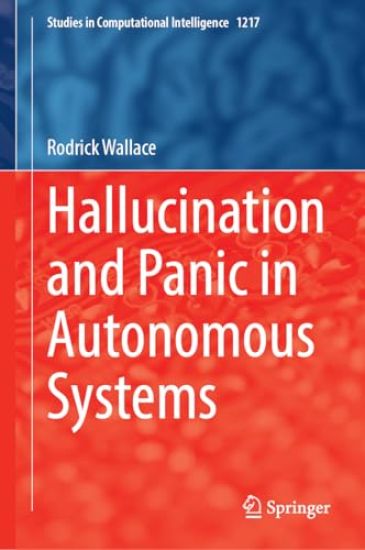
Hallucination and Panic in Autonomous Systems

Hallucination and Panic in Autonomous Systems

Rodrick Wallace

Springer International Publishing AG
2025
sidottu
This book applies the powerful asymptotic limit theorems of information and control theories to understanding the dynamics of dysfunction in cognitive cultural artifacts encompassing individual minds, small social groupings, institutions, machine systems, and their many critical composites. A particular focus is on attempts to build ‘intelligent machines’ that would supposedly rival or surpass human minds. All such efforts are blindsided by the reality that all such machines are cultural artifacts of those who build them, closely reflecting cultural priorities and blindness, and that intelligent entities lacking the feedback of high-speed embodiment must endure exaggerated levels of failure by fabulation and hallucination. A principal feature is the detailed working-out of many probability models that can serve as the foundation of statistical tools for the analysis of real-time, real-world data on cognitive failure across a broad range of modes, scales, and levels of organization.
Computational Psychiatry

Computational Psychiatry

Rodrick Wallace

Springer International Publishing AG
2017
sidottu
This book explores mental disorders from a uniquely evolutionary perspective. Although there have been many attempts to mathematically model neural processes and, to some extent, their dysfunction, there is very little literature that models mental function within a sociocultural, socioeconomic, and environmental context. Addressing this gap in the extant literature, this book explores essential aspects of mental disorders, recognizing the ubiquitous role played by the exaptation of crosstalk between cognitive modules at many different scales and levels of organization, the missing heritability of complex diseases, and cultural epigenetics. Further, it introduces readers to valuable control theory tools that permit the exploration of the environmental induction of neurodevelopmental disorders, as well as the study of the synergism between culture, psychopathology and sleep disorders, offering a distinctively unique resource.
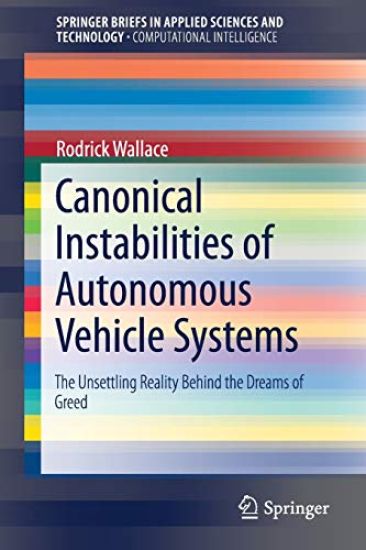
Canonical Instabilities of Autonomous Vehicle Systems

Canonical Instabilities of Autonomous Vehicle Systems

Rodrick Wallace

Springer International Publishing AG
2017
nidottu
The asymptotic limit theorems of control and information theories make it possible to explore the dynamics of collapse likely to afflict large-scale systems of autonomous ground vehicles that communicate with each other and with an embedding intelligent roadway. Any vehicle/road system is inherently unstable in the control theory sense as a consequence of the basic irregularities of the traffic stream, the road network, and their interactions, placing it in the realm of the Data Rate Theorem that mandates a minimum necessary rate of control information for stability. It appears that large-scale V2V/V2I systems will experience correspondingly large-scale failures analogous to the vast, propagating fronts of power network blackouts, and possibly less benign but more subtle patterns of individual vehicle, platoon, and mesoscale dysfunction. The central matter is the synergism between poorly-understood traffic flow dynamics and similarly cryptic multisource information network dynamics,leading to highly punctuated phase transition analogs.
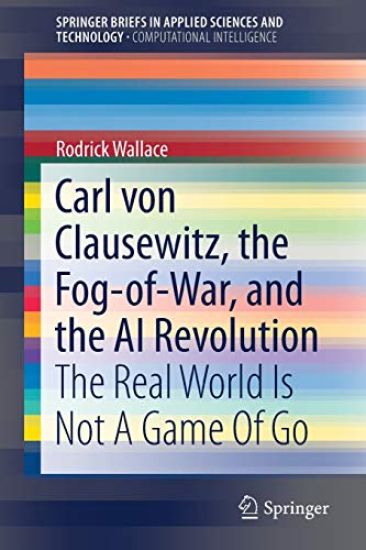
Carl von Clausewitz, the Fog-of-War, and the AI Revolution

Carl von Clausewitz, the Fog-of-War, and the AI Revolution

Rodrick Wallace

Springer International Publishing AG
2018
nidottu
The language of business is the language of dreams, but the language of war is the language of nightmare made real. Yet business dreams of driverless cars on intelligent roads, and of other real-time critical systems under the control of algorithmic entities, have much of war about them. Such systems, including military institutions at the tactical, operational and strategic scales, act on rapidly-shifting roadway topologies whose ‘traffic rules’ can rapidly change. War is never without both casualty and collateral damage, and realtime critical systems of any nature will inevitably partake of fog-of-war and frictional challenges almost exactly similar to those that have made warfare intractable for modern states. Into the world of Carl von Clausewitz, John Boyd, Mao Tse-Tung, Vo Nguyen Giap and Genghis Khan, come the brash, bright-eyed techies of Alphabet, Microsoft, Amazon, and Uber who forthrightly step in where a phalanx of angels has not feared to tread, but treaded badly indeed. In this book we use cutting-edge tools from information and control theories to examine canonical and idiosyncratic failure modes of real-time cognitive systems facing fog-of-war and frictional constraints. In sum, nobody ever navigates, or can navigate, the landscapes of Carl von Clausewitz unscathed.
Computational Psychiatry

Computational Psychiatry

Rodrick Wallace

Springer International Publishing AG
2018
nidottu
This book explores mental disorders from a uniquely evolutionary perspective. Although there have been many attempts to mathematically model neural processes and, to some extent, their dysfunction, there is very little literature that models mental function within a sociocultural, socioeconomic, and environmental context. Addressing this gap in the extant literature, this book explores essential aspects of mental disorders, recognizing the ubiquitous role played by the exaptation of crosstalk between cognitive modules at many different scales and levels of organization, the missing heritability of complex diseases, and cultural epigenetics. Further, it introduces readers to valuable control theory tools that permit the exploration of the environmental induction of neurodevelopmental disorders, as well as the study of the synergism between culture, psychopathology and sleep disorders, offering a distinctively unique resource.
Information Theory Models Of Instabilities In Critical Systems

Information Theory Models Of Instabilities In Critical Systems

Rodrick Wallace

World Scientific Publishing Co Pte Ltd
2016
sidottu
The book is a unique exploration of a spectrum of unexpected analogs to psychopathologies likely to afflict real-time critical systems, written by a specialist in the epidemiology of mental disorders. The purpose of this book is to develop a set of information-theoretic statistical tools for analyzing the instabilities of real-time cognitive systems at those varying scales and levels of organization, with special focus on high level machine function.The book should be of particular interest to both industry and academic scientists, and government regulators, concerned with driverless cars on intelligent roads. Many of the same concerns also afflict high-end automated weapons systems. The book should appeal to students, researchers, and industrial and governmental administrators facing the design, operation, and maintenance of real time critical systems ranging across manufacturing facilities, transportation, finance, and military operations.
Information Approach To Mitochondrial Dysfunction, An: Extending Swerdlow's Hypothesis
The monograph applies sophisticated topological symmetry tools to biological applications of information theory, along with a Black-Scholes model invocation of the Data Rate Theorem which links information and control theories. The focus is on statistical mechanics and other models that explore pathological phase transitions — driven by changes in available rates of mitochondrial free energy — in physiological functions, a cutting-edge topic in the study of chronic disease. One of the key focuses is Alzheimer's disease — a relatively simple canonical example.