Kirjojen hintavertailu. Mukana 11 244 527 kirjaa ja 12 kauppaa.

Kirjahaku

Etsi kirjoja tekijän nimen, kirjan nimen tai ISBN:n perusteella.

15 kirjaa tekijältä Roger Daniels

Franklin D. Roosevelt

Franklin D. Roosevelt

Roger Daniels

University of Illinois Press
2015
sidottu
Franklin D. Roosevelt, consensus choice as one of three great presidents, led the American people through the two major crises of modern times. The first volume of an epic two-part biography, Franklin D. Roosevelt: Road to the New Deal, 1882-1939 presents FDR from a privileged Hyde Park childhood through his leadership in the Great Depression to the ominous buildup to global war. Roger Daniels revisits the sources and closely examines Roosevelt's own words and deeds to create a twenty-first century analysis of how Roosevelt forged the modern presidency. Daniels's close analysis yields new insights into the expansion of Roosevelt's economic views; FDR's steady mastery of the complexities of federal administrative practices and possibilities; the ways the press and presidential handlers treated questions surrounding his health; and his genius for channeling the lessons learned from an unprecedented collection of scholars and experts into bold political action. Revelatory and nuanced, Franklin D. Roosevelt: Road to the New Deal, 1882-1939 reappraises the rise of a political titan and his impact on the country he remade.
Franklin D. Roosevelt

Franklin D. Roosevelt

Roger Daniels

University of Illinois Press
2016
sidottu
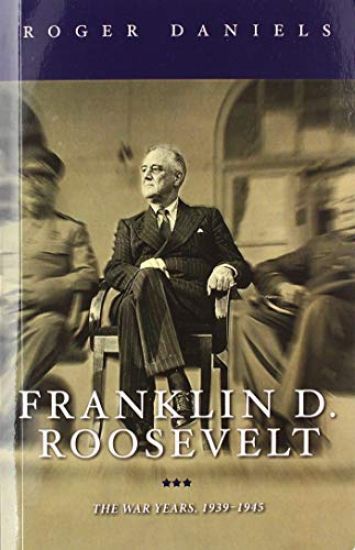
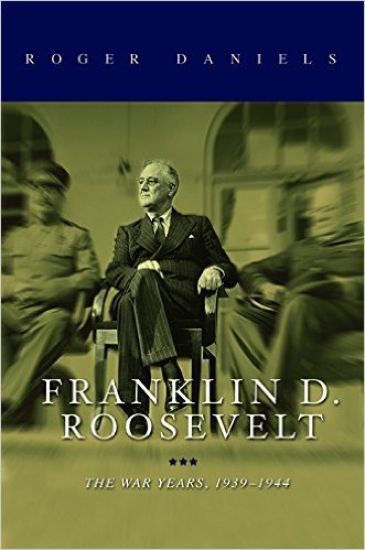
Having guided the nation through the worst economic crisis in its history, Franklin Delano Roosevelt by 1939 was turning his attention to a world on the brink of war. The second part of Roger Daniels's biography focuses on FDR's growing mastery in foreign affairs. Relying on FDR's own words to the American people and eyewitness accounts of the man and his accomplishments, Daniels reveals a chief executive orchestrating an immense wartime effort. Roosevelt had effective command of military and diplomatic information and unprecedented power over strategic military and diplomatic affairs. He simultaneously created an arsenal of democracy that armed the Allies while inventing the United Nations intended to ensure a lasting postwar peace. FDR achieved these aims while expanding general prosperity, limiting inflation, and continuing liberal reform despite an increasingly conservative and often hostile Congress. Although fate robbed him of the chance to see the victory he had never doubted, events in 1944 assured him that the victory he had done so much to bring about would not be long delayed. A compelling reconsideration of Roosevelt the president and campaigner, The War Years, 1939-1945 provides new views and vivid insights about a towering figure--and six years that changed the world.
Franklin D. Roosevelt

Franklin D. Roosevelt

Roger Daniels

University of Illinois Press
2018
nidottu
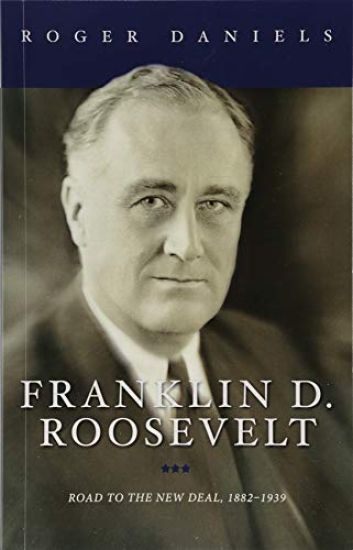
Franklin D. Roosevelt, consensus choice as one of three great presidents, led the American people through the two major crises of modern times. The first volume of an epic two-part biography, Franklin D. Roosevelt: Road to the New Deal, 1882-1939 presents FDR from a privileged Hyde Park childhood through his leadership in the Great Depression to the ominous buildup to global war. Roger Daniels revisits the sources and closely examines Roosevelt's own words and deeds to create a twenty-first century analysis of how Roosevelt forged the modern presidency. Daniels's close analysis yields new insights into the expansion of Roosevelt's economic views; FDR's steady mastery of the complexities of federal administrative practices and possibilities; the ways the press and presidential handlers treated questions surrounding his health; and his genius for channeling the lessons learned from an unprecedented collection of scholars and experts into bold political action. Revelatory and nuanced, Franklin D. Roosevelt: Road to the New Deal, 1882-1939 reappraises the rise of a political titan and his impact on the country he remade.
Franklin D. Roosevelt

Franklin D. Roosevelt

Roger Daniels

University of Illinois Press
2019
nidottu
Having guided the nation through the worst economic crisis in its history, Franklin Delano Roosevelt by 1939 was turning his attention to a world on the brink of war. The second part of Roger Daniels's biography focuses on FDR's growing mastery in foreign affairs. Relying on FDR's own words to the American people and eyewitness accounts of the man and his accomplishments, Daniels reveals a chief executive orchestrating an immense wartime effort. Roosevelt had effective command of military and diplomatic information and unprecedented power over strategic military and diplomatic affairs. He simultaneously created an arsenal of democracy that armed the Allies while inventing the United Nations intended to ensure a lasting postwar peace. FDR achieved these aims while expanding general prosperity, limiting inflation, and continuing liberal reform despite an increasingly conservative and often hostile Congress. Although fate robbed him of the chance to see the victory he had never doubted, events in 1944 assured him that the victory he had done so much to bring about would not be long delayed. A compelling reconsideration of Roosevelt the president and campaigner, The War Years, 1939-1945 provides new views and vivid insights about a towering figure--and six years that changed the world.
Asian America

Asian America

Roger Daniels

University of Washington Press
1990
pokkari
In this important and masterful synthesis of the Chinese and Japanese experience in America, historian Roger Daniels provides a new perspective on the significance of Asian immigration to the United States. Examining the period from the mid-nineteenth century to the early 1980s, Daniels presents a basic history comprising the political and socioeconomic background of Chinese and Japanese immigration and acculturation. He draws distinctions and points out similarities not only between Chinese and Japanese but between Asian and European immigration experiences, clarifying the integral role of Asians in American history.Daniels' research is impressive and his evidence is solid. In forthright prose, he suggests fresh assessments of the broad patterns of the Asian American experience, illuminating the recurring tensions within our modern multiracial society. His detailed supporting material is woven into a rich historical fabric which also gives personal voice to the tenacious individualism of the immigrant.The book is organized topically and chronologically, beginning with the emigration of each ethnic group and concluding with an epilogue that looks to the future from the perspective of the last two decades of Chinese and Japanese American history. Included in this survey are discussions of the reasons for emigration; the conditions of emigration; the fate of first generation immigrants; the reception of immigrants by the United States government and its people; the growth of immigrant communities; the effects of discriminatory legislation; the impact of World War II and the succeeding Cold War era on Chinese and Japanese Americans; and the history of Asian Americans during the last twenty years.This timely and thought-provoking volume will be of value not only to specialists in Asian American history and culture but to students and general historians of American life.
Asian America

Asian America

Roger Daniels

University of Washington Press
2015
sidottu
In this important and masterful synthesis of the Chinese and Japanese experience in America, historian Roger Daniels provides a new perspective on the significance of Asian immigration to the United States. Examining the period from the mid-nineteenth century to the early 1980s, Daniels presents a basic history comprising the political and socioeconomic background of Chinese and Japanese immigration and acculturation. He draws distinctions and points out similarities not only between Chinese and Japanese but between Asian and European immigration experiences, clarifying the integral role of Asians in American history.Daniels' research is impressive and his evidence is solid. In forthright prose, he suggests fresh assessments of the broad patterns of the Asian American experience, illuminating the recurring tensions within our modern multiracial society. His detailed supporting material is woven into a rich historical fabric which also gives personal voice to the tenacious individualism of the immigrant.The book is organized topically and chronologically, beginning with the emigration of each ethnic group and concluding with an epilogue that looks to the future from the perspective of the last two decades of Chinese and Japanese American history. Included in this survey are discussions of the reasons for emigration; the conditions of emigration; the fate of first generation immigrants; the reception of immigrants by the United States government and its people; the growth of immigrant communities; the effects of discriminatory legislation; the impact of World War II and the succeeding Cold War era on Chinese and Japanese Americans; and the history of Asian Americans during the last twenty years.This timely and thought-provoking volume will be of value not only to specialists in Asian American history and culture but to students and general historians of American life.
The Politics of Prejudice

The Politics of Prejudice

Roger Daniels

University of California Press
1999
pokkari
This classic study offers a history of anti-Japanese prejudice in California, extending from the late nineteenth century to 1924, when an immigration act excluded Japanese from entering the United States. The Politics of Prejudice details the political climate that helped to set the stage for the incarceration of Japanese Americans during World War II and reveals the racism present among middle-class American progressives, labor leaders, and other presumably liberal groups.
The Japanese American Cases

The Japanese American Cases

Roger Daniels

University Press of Kansas
2013
sidottu
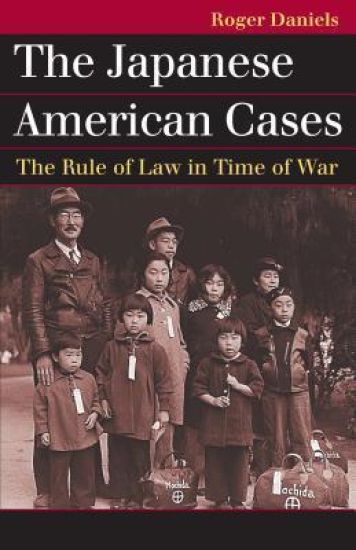
After Pearl Harbor, President Roosevelt, claiming a never documented “military necessity,” ordered the removal and incarceration of 120,000 Japanese Americans during World War II solely because of their ancestry. As Roger Daniels movingly describes, almost all reluctantly obeyed their government and went peacefully to the desolate camps provided for them. Daniels, however, focuses on four Nisei, second-generation Japanese Americans, who, aided by a handful of lawyers, defied the government and their own community leaders by challenging the constitutionality of the government’s orders. The 1942 convictions of three men—Min Yasui, Gordon Hirabayashi, and Fred Korematsu—who refused to go willingly were upheld by the Supreme Court in 1943 and 1944. But a woman, Mitsuye Endo, who obediently went to camp and then filed for a writ of habeas corpus, won her case. The Supreme Court subsequently ordered her release in 1944, following her two and a half years behind barbed wire. Neither the cases nor the fate of law-abiding Japanese attracted much attention during the turmoil of global warfare; in the postwar decades they were all but forgotten. Daniels traces how, four decades after the war, in an America whose attitudes about race and justice were changing, the surviving Japanese Americans achieved a measure of political and legal justice. Congress created a commission to investigate the legitimacy of the wartime incarceration. It found no military necessity, but rather that the causes were “race prejudice, war hysteria, and a failure of political leadership.” In 1982 it asked Congress to apologise and award $20,000 to each survivor. A bill providing that compensation was finally passed and signed into law in 1988. There is no way to undo a Supreme Court decision, but teams of volunteer lawyers, overwhelmingly Sansei—third-generation Japanese Americans—used revelations in 1983 about the suppression of evidence by federal attorneys to persuade lower courts to overturn the convictions of Hirabayashi and Korematsu. Daniels traces the continuing changes in attitudes since the 1980s about the wartime cases and offers a sobering account that resonates with present-day issues of national security and individual freedom.
The Japanese American Cases

The Japanese American Cases

Roger Daniels

University Press of Kansas
2013
nidottu
After Pearl Harbor, President Roosevelt, claiming a never documented “military necessity,” ordered the removal and incarceration of 120,000 Japanese Americans during World War II solely because of their ancestry. As Roger Daniels movingly describes, almost all reluctantly obeyed their government and went peacefully to the desolate camps provided for them. Daniels, however, focuses on four Nisei, second-generation Japanese Americans, who, aided by a handful of lawyers, defied the government and their own community leaders by challenging the constitutionality of the government’s orders. The 1942 convictions of three men—Min Yasui, Gordon Hirabayashi, and Fred Korematsu—who refused to go willingly were upheld by the Supreme Court in 1943 and 1944. But a woman, Mitsuye Endo, who obediently went to camp and then filed for a writ of habeas corpus, won her case. The Supreme Court subsequently ordered her release in 1944, following her two and a half years behind barbed wire. Neither the cases nor the fate of law-abiding Japanese attracted much attention during the turmoil of global warfare; in the postwar decades they were all but forgotten. Daniels traces how, four decades after the war, in an America whose attitudes about race and justice were changing, the surviving Japanese Americans achieved a measure of political and legal justice. Congress created a commission to investigate the legitimacy of the wartime incarceration. It found no military necessity, but rather that the causes were “race prejudice, war hysteria, and a failure of political leadership.” In 1982 it asked Congress to apologise and award $20,000 to each survivor. A bill providing that compensation was finally passed and signed into law in 1988. There is no way to undo a Supreme Court decision, but teams of volunteer lawyers, overwhelmingly Sansei—third-generation Japanese Americans—used revelations in 1983 about the suppression of evidence by federal attorneys to persuade lower courts to overturn the convictions of Hirabayashi and Korematsu. Daniels traces the continuing changes in attitudes since the 1980s about the wartime cases and offers a sobering account that resonates with present-day issues of national security and individual freedom.
Guarding the Golden Door

Guarding the Golden Door

Roger Daniels

HILL WANG INC.,U.S.
2005
nidottu
As renowned historian Roger Daniels shows in this brilliant new work, America's inconsistent, often illogical, and always cumbersome immigration policy has profoundly affected our recent past. The federal government's efforts to pick and choose among the multitude of immigrants seeking to enter the United States began with the Chinese Exclusion Act of 1882. Conceived in ignorance and falsely presented to the public, it had undreamt of consequences, and this pattern has been rarely deviated from since. Immigration policy in Daniels' skilled hands shows Americans at their best and worst, from the nativist violence that forced Theodore Roosevelt's 1907 "gentlemen's agreement" with Japan to the generous refugee policies adopted after World War Two and throughout the Cold War. And in a conclusion drawn from today's headlines, Daniels makes clear how far ignorance, partisan politics, and unintended consequences have overtaken immigration policy during the current administration's War on Terror. Irreverent, deeply informed, and authoritative, Guarding the Golden Door presents an unforgettable interpretation of modern American history.
Prisoners Without Trial

Prisoners Without Trial

Roger Daniels

Hill Wang
2004
pokkari
Prisoners Without Trail is part of Hill and Wang's Critical Issues Series and well established on college reading lists. This book presents a concise introduction to a shameful chapter in American history: the incarceration of nearly 120,000 Japanese Americans during World War II. With a revised final chapter and expanded recommended readings, Roger Daniels's updated edition examines a tragic event in our nation's past and thoughtfully asks if it could happen again.
Not Like Us

Not Like Us

Roger Daniels

Ivan R Dee, Inc
1997
sidottu
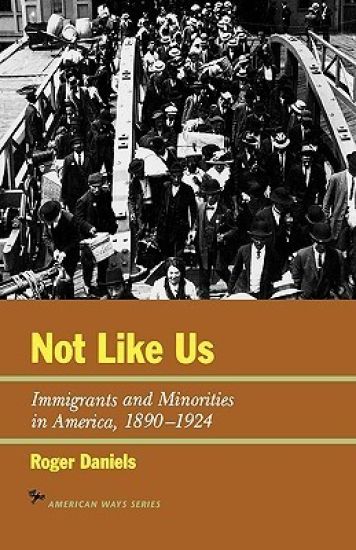
In the thirty-five years after 1890, more than 20 million immigrants came to the United States—a greater number than in any comparable period, before or since. They were often greeted in hostile fashion, a reflection of American nativism that by the 1890s was already well developed. In this analytical narrative, Roger Daniels examines the condition of immigrants, Native Americans, and African Americans during a period of supposed progress for American minorities. He shows that they experienced as much repression as advance. Not Like Us opens by considering the Chinese Exclusion Act of 1882, the hinge on which U.S. immigration policy turned and a symbol of the unfriendly climate toward minorities that would prevail for decades. Mr. Daniels continues the story through the 1890s, the so-called Progressive Era, the opportunities and conflicts arising out of World War I, and the “tribal twenties,” when nativism and xenophobia dominated American society. An epilogue points out gains and losses since the 1924 National Origins Act. Throughout Mr. Daniels’s focus is on legislation, judicial decisions, mob violence, and the responses of minority groups. The record is scarcely one of unalloyed progress.
Not Like Us

Not Like Us

Roger Daniels

Ivan R Dee, Inc
1998
pokkari
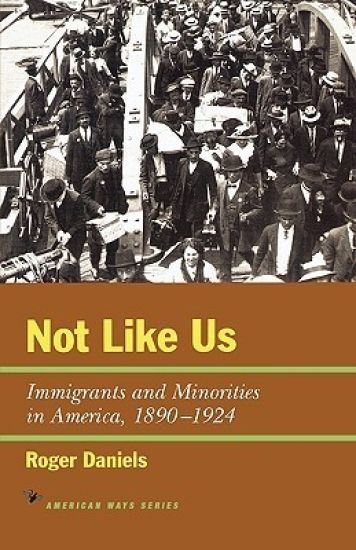
In the thirty-five years after 1890, more than 20 million immigrants came to the United States—a greater number than in any comparable period, before or since. They were often greeted in hostile fashion, a reflection of American nativism that by the 1890s was already well developed. In this analytical narrative, Roger Daniels examines the condition of immigrants, Native Americans, and African Americans during a period of supposed progress for American minorities. He shows that they experienced as much repression as advance. Not Like Us opens by considering the Chinese Exclusion Act of 1882, the hinge on which U.S. immigration policy turned and a symbol of the unfriendly climate toward minorities that would prevail for decades. Mr. Daniels continues the story through the 1890s, the so-called Progressive Era, the opportunities and conflicts arising out of World War I, and the “tribal twenties,” when nativism and xenophobia dominated American society. An epilogue points out gains and losses since the 1924 National Origins Act. Throughout Mr. Daniels’s focus is on legislation, judicial decisions, mob violence, and the responses of minority groups. The record is scarcely one of unalloyed progress.