Kirjojen hintavertailu. Mukana 11 244 527 kirjaa ja 12 kauppaa.

Kirjahaku

Etsi kirjoja tekijän nimen, kirjan nimen tai ISBN:n perusteella.

13 kirjaa tekijältä Roger Pearson

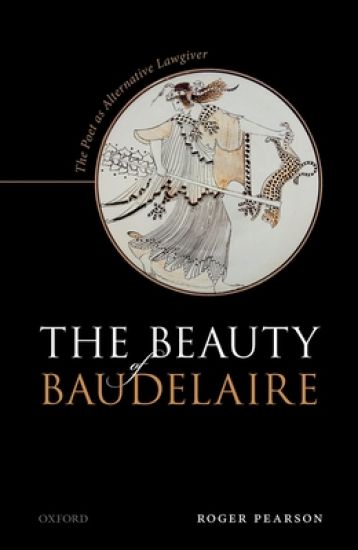
The Beauty of Baudelaire

The Beauty of Baudelaire

Roger Pearson

Oxford University Press
2021
sidottu
This book offers the first comprehensive close reading in any language of the complete works of Charles Baudelaire (1821-1867). Taking full account of his critical writings on literature and the fine arts, it provides fresh readings of Les Fleurs du Mal and Le Spleen de Paris. It situates these works within the context of nineteenth-century French literature and culture and reassesses Baudelaire's reputation as the 'father' of modern poetry. Whereas he is traditionally considered to have rejected the public role of the writer as moralist, educator, and political leader and to have dedicated himself instead to the exclusive pursuit of beauty in art, this book contends not only that he rejected Art for Art's sake but that he saw in 'beauty'--defined not as an inherent quality but as an effect of harmony and rich conjecture--an alternative ethos with which to resist the tyrannies of ideology and conformism. Contrarian in his thinking and provocatively innovative in his poetic practice, Baudelaire fell foul of the law when six poems in Les Fleurs du Mal (1857) were banned for obscenity. In the second edition (1861), substantially recast and enlarged, the poet as alternative lawgiver made plainer still his resistance to the orthodoxies of his day. In a series of major critical articles he proclaimed the 'government of the imagination', while from 1855 until his death he developed an alternative literary form, the prose poem--a thing of beauty and an invitation to imagine the world afresh, to make our own rules.
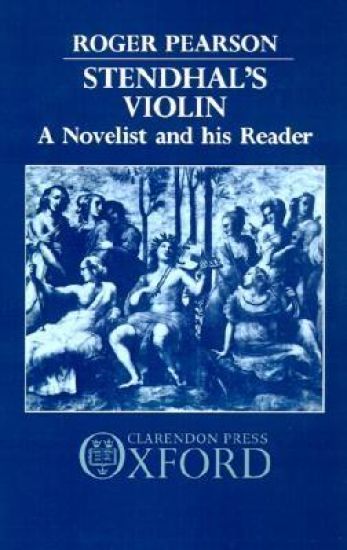
Stendhal's Violin

Stendhal's Violin

Roger Pearson

Clarendon Press
1988
sidottu
This new study of Stendhal's novels takes its title from Stendhal's dictum `Un roman est comme un archet, la caisse du violon qui rend les sons, c'est l'âme du lecteur.' Its central theme is the relationship between novelist and reader, as orchestrated in Armance, Le Rouge et le Noir, Lucien Leuwen and La Chartreuse de Parme. From the author's analyses of these novels it emerges that Stendhal plays upon the reader's reactions and makes him or her experience in the act of reading what his protagonists experience in the act of living. Well written, and without obscure theoretical terminology, Stendhal's Violin is aimed at both the first-degree scholar and specialist reader. It contains full discussion of the views of other critics, and presents individual, challenging new interpretations of Stendhal's novels.
The Fables of Reason

The Fables of Reason

Roger Pearson

Clarendon Press
1993
sidottu
Almost three hundred years after his birth in 1694, this is the first comprehensive study of Voltaire's contes philosophiques - the philosophical tales for which he is now best remembered and which include the masterpiece Candide. The Fables of Reason situates each of the twenty-six stories in its historical and intellectual context and offers new readings and approaches in the light of modern critical thinking. It rejects the traditional view that Voltaire's contes were the private expression of his philosophical perplexity, written merely in the margins of his historiography and his campaigns against the Establishment. Arguing that narrative is Voltaire's essential mode of thought, the book stresses the role of the reader and shows how the contes are designed less to communicate a set of truths than to encourage independence of mind. Roger Pearson has written a witty, lucid and scholarly guide to the `fables of reason' with which Voltaire undermined - and continues to undermine - the religious, philosophical, and economic `fables', by which other thinkers have tried to explain and direct human experience.
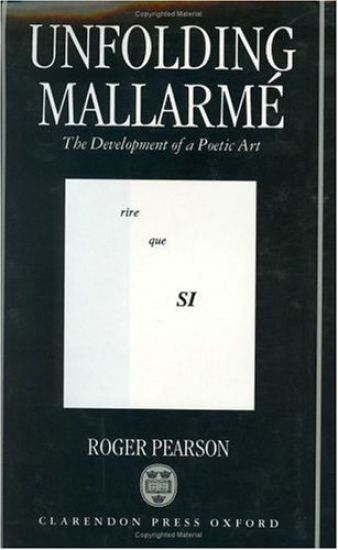
Unfolding Mallarmé

Unfolding Mallarmé

Roger Pearson

Clarendon Press
1996
sidottu
Unfolding Mallarme proposes new meanings in Mallarme's poetry and seeks to promote the development of his poetic art as a successful search for linguistic and textual mastery. This development is systematically traced from Mallarme's earliest verse through to `Un coup de Des', the radically innovative poem which was about to be published in a fine-art edition at the time of his untimely death in 1898. In a series of close readings, Roger Pearson examines Mallarme's poetic output up to and including the central `Sonnet en yx', which is discussed both in its earliest version and within the context of `Plusieurs sonnets'. These readings are followed by analyses of other major sonnets, of `Prose (pour des Esseintes)', and of `Un coup de Des' itself. The `profound calculation' on which Mallarme claimed to have based this seemingly random text is here unfolded in all its structural and semantic complexity.
Unacknowledged Legislators

Unacknowledged Legislators

Roger Pearson

Oxford University Press
2016
sidottu
What is the public value of poetry? How do poets envisage their own role and function within society? How do we? Do poets seek to shape public opinion and behaviour? Should they? Or do they offer alternatives--perhaps sacred alternatives--to political and religious ideologies? Are they what Shelley in 1821 called 'the unacknowledged legislators of the World'? And what might that mean? During the decades immediately preceding the Revolution of 1789 the status of contemporary poetry in France was at its lowest ebb. At the same time the perceived power of the writer to influence public events reached a high-water mark with Voltaire's triumphant return to Paris in 1778. In the course of the next century French poetry enjoyed an extraordinary renaissance and flowering, perhaps its greatest. But what of the poet's public influence? In 1881 the people of Paris processed for six hours past the home of Victor Hugo on the occasion of his 79th birthday, and in 1885 an estimated two million people witnessed his state funeral. But who or what were they acknowledging? Poetry or republicanism? Or perhaps their own power? For with each Revolution that passed--1789, 1830, 1848--French poets themselves felt increasingly marginalised. This study addresses the first part of this story and focuses on the role and function of the poet during the so-called Romantic Period. Beginning with an account of the literary climate in pre-revolutionary France it then maps the changes in that climate wrought by the events of the 1789 Revolution. It describes the new politico-literary agendas set by Chateaubriand and others on the monarchist Right, and by Staël and others on the liberal Left. Against this background it then analyses in detail the poetic output and public exploits of the three major French poets of the period: Lamartine, Hugo, and Vigny. The Romantic figure of the poet as prophet and magus is habitually dismissed as a cliché. But by focusing on the role of the poet as lawgiver this book reveals the rich and complex terms in which the public function of poetry was debated in post-revolutionary France - and how amidst the centenary celebrations of 1889, as Romanticism gave way to Symbolism, the poet as lawgiver continued to play a central part in that debate.
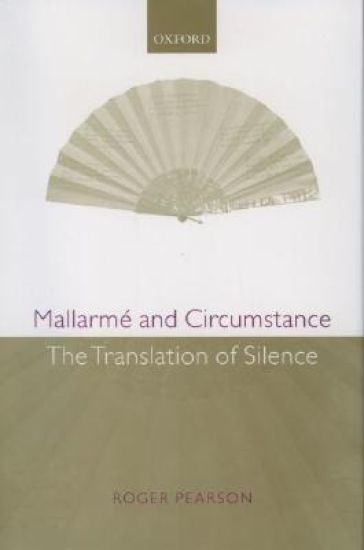
Mallarmé and Circumstance

Mallarmé and Circumstance

Roger Pearson

Clarendon Press
2004
sidottu
Following his Unfolding Mallarmé: The Development of a Poetic Art, this book is the second in Roger Pearson's authoritative two-volume study of the work of Stéphanie Mallarmé (1842-1898), and the first comprehensive study of Mallarmé's 'poetry of circumstance' in any language. For Mallarmé, in a world without God, the role of the poet is to break the silence with language and to confer upon the contingency of circumstance a therapeutic semblance of formal and semantic pattern. Literature provides a 'translation of silence', 'intimate galas' in which the mysterious drama of the human condition is performed for and by the reader on the stage of the verse poem, the prose poem, and what Mallarmé calls the 'poëme critique'. In Part 1, Pearson examines the prose poems within the context of Mallarmé's writing about the theatre. In Part II, he focuses on the 'circumstanzas' - the famous 'Tombeaux', 'Hommages', 'Eventails', and 'vers de circonstance' - in which Mallarmé invests the quotidian with the 'glorious lie' of poetry. In a series of close readings Pearson demonstrates how complex poetic structures, and especially the sonnet, may serve to guide the human search for meaning and shape our anguish in a 'ceremony of the Book.'
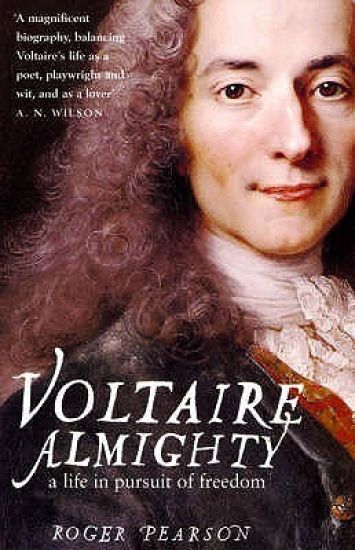
Voltaire Almighty

Voltaire Almighty

Roger Pearson

Bloomsbury Publishing PLC
2006
nidottu
During much of his life Voltaire's plays and verse made him the toast of society, but his barbed wit and commitment to reason also got him into trouble. Jailed twice and eventually banished by the King, he was an outspoken critic of religious intolerance and persecution. His personal life was as colourful as his intellectual one. Voltaire never married, but had long-term affairs with two women: Emilie, who died after giving birth to the child of another lover, and his niece, Marie-Louise, with whom he spent his last twenty-five years. With its tales of illegitimacy, prison, stardom, exile, love affairs and tireless battles against critics, Church and King, Roger Pearson's brilliant biography brings Voltaire vividly to life.
Stendhal

Stendhal

Roger Pearson

Routledge
2017
sidottu
Both critic and writer, Stendhal has now become established as one of realism's founding fathers. Dr Pearson's book maps out, for the first time, the critical reception of Stendhal's two most widely read novels, The Red and the Black and The Charterhouse of Parma since their publication in 1830 and 1839 respectively. In part one he provides generous samples of the most important nineteenth-century responses to the novels, almost all of them translated into English for the first time. Part two presents a full range of the most authoritative and influential readings since 1945, which illustrate a wide variety of critical approaches.
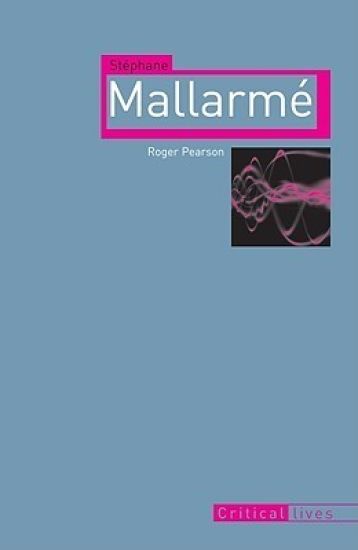
Stéphane Mallarmé

Stéphane Mallarmé

Roger Pearson

Reaktion Books
2010
nidottu
At the age of fifty Stéphane Mallarmé (1842-98) spoke of his published work as ‘very precise reference points on my mind’s journey’. In Stéphane Mallarmé, Roger Pearson charts that journey for the first time, blending a biographical account of the poet's life with a detailed analysis of his evolving poetic theory and practice. ‘A poet on this earth must be uniquely a poet’, he declared at the age of twenty-two, and he duly lived a poet’s life. But what is a poet's life? What is a poet’s function? In his poems, in complex prose statements, and by the example of his life, Mallarmé provided answers to these questions.To Mallarmé, being a poet meant many things: a continuous, lifelong investigation of language and its expressive potential; and bringing people together, as much in life as in poetry. His Tuesday salons were famous with visitors including Yeats, Rilke and Verlaine, as well as the artists Manet, Renoir, Whistler and Gauguin; his poetry inspired music by Debussy, Ravel and Boulez; and his poem ‘A Throw of the Dice will Never Abolish Chance’ - spread over 20 pages and combining verse with varied typography - inspires poets and visual artists to this day. Poetry was a way of bringing all human beings together in heightened awareness and an understanding of the ‘magnificent act of living’.Stéphane Mallarmé chronicles a fascinating and utterly unique voice in French poetry. It will not only prove an essential resource for students of English and French literature, but an engaging book for anyone interested in nineteenth-century France.