Kirjojen hintavertailu. Mukana 11 244 527 kirjaa ja 12 kauppaa.

Kirjahaku

Etsi kirjoja tekijän nimen, kirjan nimen tai ISBN:n perusteella.

23 kirjaa tekijältä Roger Trigg

Faith

Faith

Roger Trigg

Oxford University Press
2024
nidottu
Very Short Introductions: Brilliant, Sharp, Inspiring What is faith? It usually means religious belief, and sometimes diverse religions are grouped together as 'faiths', with reference to 'faith leaders' or 'faith schools'. What we have faith in matters, and that involves our reason, involving claims to truths that affect everyone. Faith is not just a personal attribute, like tastes, but should be open to public examination and debate. In this Very Short Introduction, Roger Trigg argues that all faith needs reason. He puts contemporary discussions into historical perspective, particularly in the context of Christianity. The author argues that faith also involves a commitment to action and that matters for all social life. Because religion is typically directed at what is seen as of crucial importance for human life, faith should not be marginalized or privatized. It will permeate every idea of how people should behave, and has a role in the public square, however respectful it should be to competing views within a democracy. ABOUT THE SERIES: The Very Short Introductions series from Oxford University Press contains hundreds of titles in almost every subject area. These pocket-sized books are the perfect way to get ahead in a new subject quickly. Our expert authors combine facts, analysis, perspective, new ideas, and enthusiasm to make interesting and challenging topics highly readable.

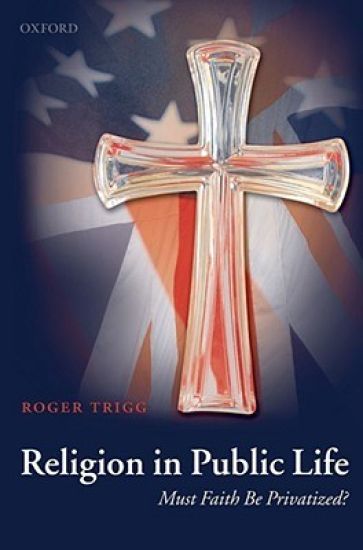
Religion in Public Life

Religion in Public Life

Roger Trigg

Oxford University Press
2007
sidottu
How far can religion play a part in the public sphere, or should it be only a private matter? Roger Trigg examines this question in the context of today's pluralist societies, where many different beliefs clamour for attention. Should we celebrate diversity, or are matters of truth at stake? In particular, can we maintain our love of freedom, while cutting it off from religious roots? In societies in which there are many conflicting beliefs, the place of religion is a growing political issue. Should all religions be equally welcomed in the public square? Favouring one religion over others may appear to be a failure to treat all citizens equally, yet for citizens in many countries their Christian heritage is woven into their way of life. Whether it is the issue of same-sex marriages, the right of French schoolgirls to wear Islamic headscarves, or just the public display of Christmas trees, all societies have to work out a consistent approach to the public influence of religion.
Religion in Public Life

Religion in Public Life

Roger Trigg

Oxford University Press
2008
nidottu
How far can religion play a part in the public sphere, or should it be only a private matter? Roger Trigg examines this question in the context of today's pluralist societies, where many different beliefs clamour for attention. Should we celebrate diversity, or are matters of truth at stake? In particular, can we maintain our love of freedom, while cutting it off from religious roots? In societies in which there are many conflicting beliefs, the place of religion is a growing political issue. Should all religions be equally welcomed in the public sphere? Favouring one religion over others may appear to be a failure to treat all citizens equally, yet for citizens in many countries their Christian heritage is woven into their way of life. Whether it is the issue of same-sex marriages, the right of French schoolgirls to wear Islamic headscarves, or just the public display of Christmas trees, all societies have to work out a consistent approach to the public influence of
Equality, Freedom, and Religion

Equality, Freedom, and Religion

Roger Trigg

Oxford University Press
2012
sidottu
Is religious freedom being curtailed in pursuit of equality, and the outlawing of discrimination? Is enough effort made to accommodate those motivated by a religious conscience? All rights matter but at times the right to put religious beliefs into practice increasingly takes second place in the law of different countries to the pursuit of other social priorities. The right to freedom of belief and to manifest belief is written into all human rights charters. In the United States religious freedom is sometimes seen as 'the first freedom'. Yet increasingly in many jurisdictions in Europe and North America, religious freedom can all too easily be 'trumped' by other rights. Roger Trigg looks at the assumptions that lie behind the subordination of religious liberty to other social concerns, especially the pursuit of equality. He gives examples from different Western countries of a steady erosion of freedom of religion. The protection of freedom of worship is often seen as sufficient, and religious practices are separated from the beliefs which inspire them. So far from religion in general, and Christianity in particular, providing a foundation for our beliefs in human dignity and human rights, religion is all too often seen as threat and a source of conflict, to be controlled at all costs. The challenge is whether any freedom can preserved for long, if the basic human right to freedom of religious belief and practice is dismissed as of little account, with no attempt to provide any reasonable accommodation. Given the central role of religion in human life, unnecessary limitations on its expression are attacks on human freedom itself.
Equality, Freedom, and Religion

Equality, Freedom, and Religion

Roger Trigg

Oxford University Press
2013
nidottu
Is religious freedom being curtailed in pursuit of equality, and the outlawing of discrimination? Is enough effort made to accommodate those motivated by a religious conscience? All rights matter but at times the right to put religious beliefs into practice increasingly takes second place in the law of different countries to the pursuit of other social priorities. The right to freedom of belief and to manifest belief is written into all human rights charters. In the United States religious freedom is sometimes seen as 'the first freedom'. Yet increasingly in many jurisdictions in Europe and North America, religious freedom can all too easily be 'trumped' by other rights. Roger Trigg looks at the assumptions that lie behind the subordination of religious liberty to other social concerns, especially the pursuit of equality. He gives examples from different Western countries of a steady erosion of freedom of religion. The protection of freedom of worship is often seen as sufficient, and religious practices are separated from the beliefs which inspire them. So far from religion in general, and Christianity in particular, providing a foundation for our beliefs in human dignity and human rights, religion is all too often seen as threat and a source of conflict, to be controlled at all costs. The challenge is whether any freedom can preserved for long, if the basic human right to freedom of religious belief and practice is dismissed as of little account, with no attempt to provide any reasonable accommodation. Given the central role of religion in human life, unnecessary limitations on its expression are attacks on human freedom itself.
Does Science Undermine Faith?

Does Science Undermine Faith?

Roger Trigg

SPCK Publishing
2018
nidottu
Many people assume that science `disproves’ the idea of God, and that we no longer need faith in order to understand the world or why we are in it. Roger Trigg examines these assumptions and considers whether recent developments in science may in fact support religious faith. He goes on to consider the increasing scientific evidence for the inherent orderliness and comprehensibility of the universe, which leads him to ask an even more radical question: Might there be aspects of religious belief that can help to support our science?
Reason and Commitment

Reason and Commitment

Roger Trigg

Cambridge University Press
1973
pokkari
Can we justify our most basic beliefs about morality, religion and the nature of the world? Can there be a rational and objective way of choosing between alternative societies, modes of life or world-views? Dr Trigg shows how philosophical analysis is relevant to these questions and criticizes the tendency to emphasize notions of commitment and convention at the expense of truth and reason. He draws parallels between issues that are often too isolated from each other and identifies a cluster of related ideas, all of which stress the notion of self-contained conceptual systems that define their own standards of rationality. First published in 1973, this book will interest professional philosophers as a vigorous and distinctive exposition of several fundamental philosophical problems and more especially it can be used as an introduction for students to a wide range of philosophical problems.
Reason & Commitment

Reason & Commitment

Roger Trigg

Cambridge University Press
1973
sidottu
Can we justify our most basic beliefs about morality, religion and the nature of the world? Can there be a rational and objective way of choosing between alternative societies, modes of life or world-views? Dr Trigg shows how philosophical analysis is relevant to these questions and criticizes the tendency to emphasize notions of commitment and convention at the expense of truth and reason. He draws parallels between issues that are often too isolated from each other and identifies a cluster of related ideas, all of which stress the notion of self-contained conceptual systems that define their own standards of rationality. First published in 1973, this book will interest professional philosophers as a vigorous and distinctive exposition of several fundamental philosophical problems and more especially it can be used as an introduction for students to a wide range of philosophical problems.
Rationality and Science

Rationality and Science

Roger Trigg

Blackwell Publishers
1993
nidottu
In this important new work, Professor Trigg deals with the question of the rational foundations of science. In so doing, he explains and evaluates the views of Rorty, Wittgensteing, Quine, Putnam, and Hawking, amongst others. The limits of science and rationality are explored and the power of human reason is in the end upheld.
Ideas of Human Nature

Ideas of Human Nature

Roger Trigg

Blackwell Publishers
1999
sidottu
Ideas of Human Nature (second edition) presents twelve of the most influential Western thinkers on the topic of human nature. Roger Trigg examines the thinkers in their historical context and discusses their relevance to contemporary controversies.
Ideas of Human Nature

Ideas of Human Nature

Roger Trigg

JOHN WILEY AND SONS LTD
1999
nidottu
Ideas of Human Nature (second edition) presents twelve of the most influential Western thinkers on the topic of human nature. Roger Trigg examines the thinkers in their historical context and discusses their relevance to contemporary controversies.
Understanding Social Science

Understanding Social Science

Roger Trigg

Blackwell Publishers
2000
sidottu
In this lucid and engaging introductory volume on the nature of society, Roger Trigg examines the scientific basis of social science and shows that philosophical presuppositions are a necessary starting point for the study of society.
Understanding Social Science

Understanding Social Science

Roger Trigg

Blackwell Publishers
2000
nidottu
In this lucid and engaging introductory volume on the nature of society, Roger Trigg examines the scientific basis of social science and shows that philosophical presuppositions are a necessary starting point for the study of society.
Philosophy Matters

Philosophy Matters

Roger Trigg

JOHN WILEY AND SONS LTD
2001
nidottu
Written for those who may be approaching the subject for the first time, Philosophy Matters shows that philosophy is crucial in questioning our presuppositions, and for helping us to establish our own beliefs about the nature of the world.
Morality Matters

Morality Matters

Roger Trigg

Blackwell Publishers
2004
sidottu
Morality still matters, argues philosopher Roger Trigg, in this accessible introduction to moral thinking. Written for general readers with no background in philosophy. Argues that we need a shared moral vision in order to live together, both nationally and internationally. Considers the need for a shared morality in relation to subjects of vital importance such as human rights. Stresses that private behaviour cannot be kept separate from public choices. Discusses matters of topical debate on both sides of the Atlantic.
Morality Matters

Morality Matters

Roger Trigg

Blackwell Publishers
2004
nidottu
Morality still matters, argues philosopher Roger Trigg, in this accessible introduction to moral thinking. Written for general readers with no background in philosophy. Argues that we need a shared moral vision in order to live together, both nationally and internationally. Considers the need for a shared morality in relation to subjects of vital importance such as human rights. Stresses that private behaviour cannot be kept separate from public choices. Discusses matters of topical debate on both sides of the Atlantic.
Religious Diversity

Religious Diversity

Roger Trigg

Cambridge University Press
2014
sidottu
Should we merely celebrate diversity in the sphere of religion? What of the social cohesion of a country? There is a constant tug between belief in religious truth and the need for respect for other religions. Religious Diversity: Philosophical and Political Dimensions examines how far a firm faith can allow for toleration of difference and respect the need for religious freedom. It elucidates the philosophical credentials of different approaches to truth in religion, ranging from a dogmatic fundamentalism to a pluralism that shades into relativism. Must we resort to a secularism that treats all religion as a personal and private matter, with nothing to contribute to discussions about the common good? How should law approach the issue of religious freedom? Introducing the relevance of central discussions in modern philosophy of religion, the book goes on to examine the political implications of increasing religious diversity in a democracy.