Kirjojen hintavertailu. Mukana 12 537 441 kirjaa ja 12 kauppaa.

Kirjahaku

Etsi kirjoja tekijän nimen, kirjan nimen tai ISBN:n perusteella.

7 kirjaa tekijältä Ronald J. Tallarida

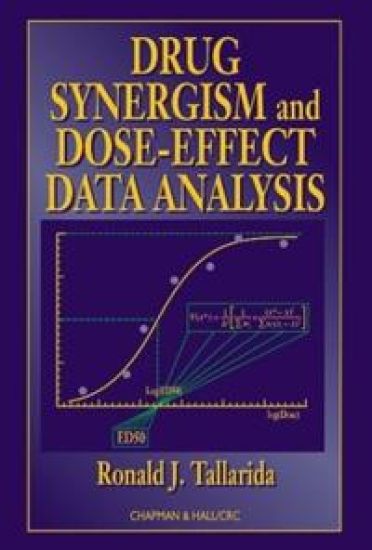
Drug Synergism and Dose-Effect Data Analysis
Not since this author's bestselling Manual of Pharmacologic Calculation-long out of print-has there been a reference available for drug data analysis, and even that work did not deal with drug combinations. Although pharmacologists and most other scientists know what synergism is, mainstream textbooks tend to neglect it as a quantitative topic. Few researchers are familiar with the quantitative methodology needed to differentiate synergistic responses from the simply additive responses expected from drug combinations or a single drug's interaction with endogenous chemicals. In Drug Synergism and Dose-Effect Data Analysis, noted pharmacologist, mathematician, and author Ronald J. Tallarida finally brings these methods to light. Drawing on statistical theory and methods but keeping the special needs of the pharmacologist in mind, he begins his treatment with dose-response relations, the statistical analysis of the data, and the models that describe them. He also offers the only modern presentation of probit and logit analysis and provides detailed calculation methods not found in typical statistics books. Numerous examples accompany a presentation that clearly illustrates the calculations and experimental design considerations for modern drug analysis. You'll find the conceptual background, the algorithms, and new research developments. In short, Drug Synergism and Dose-Effect Data Analysis has everything you need to perform, with confidence, the quantitative analysis of dose response data.
Pocket Book of Integrals and Mathematical Formulas
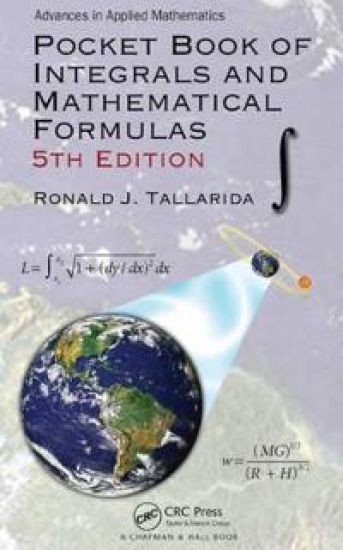
Pocket Book of Integrals and Mathematical Formulas, 5th Edition covers topics ranging from precalculus to vector analysis and from Fourier series to statistics, presenting numerous worked examples to demonstrate the application of the formulas and methods. This popular pocket book is an essential source for students of calculus and higher mathematics courses. It also provides an easy-to-use, accessible reference for mathematicians, engineers, scientists, and others seeking vital mathematical formulas, concepts, and definitions. Enlarging the type without sacrificing special topics involving financial mathematics and number theory, this 5th Edition: Includes several classic calculus applications that illustrate the power and practical use of calculus Discusses an interesting offshoot of Fermat‘s last theorem, namely, "near misses" Reformats and revises the table of integrals for improved clarity and accuracy Through careful selection of topics and detail, Pocket Book of Integrals and Mathematical Formulas, 5th Edition remains a portable yet comprehensive resource for students and professionals, containing the most important mathematical formulas for engineering and scientific applications.
Pocket Book of Integrals and Mathematical Formulas

Pocket Book of Integrals and Mathematical Formulas

Ronald J. Tallarida

Productivity Press
2015
nidottu
Pocket Book of Integrals and Mathematical Formulas, 5th Edition covers topics ranging from precalculus to vector analysis and from Fourier series to statistics, presenting numerous worked examples to demonstrate the application of the formulas and methods. This popular pocket book is an essential source for students of calculus and higher mathematics courses. It also provides an easy-to-use, accessible reference for mathematicians, engineers, scientists, and others seeking vital mathematical formulas, concepts, and definitions. Enlarging the type without sacrificing special topics involving financial mathematics and number theory, this 5th Edition:Includes several classic calculus applications that illustrate the power and practical use of calculusDiscusses an interesting offshoot of Fermat’s last theorem, namely, "near misses"Reformats and revises the table of integrals for improved clarity and accuracyThrough careful selection of topics and detail, Pocket Book of Integrals and Mathematical Formulas, 5th Edition remains a portable yet comprehensive resource for students and professionals, containing the most important mathematical formulas for engineering and scientific applications.
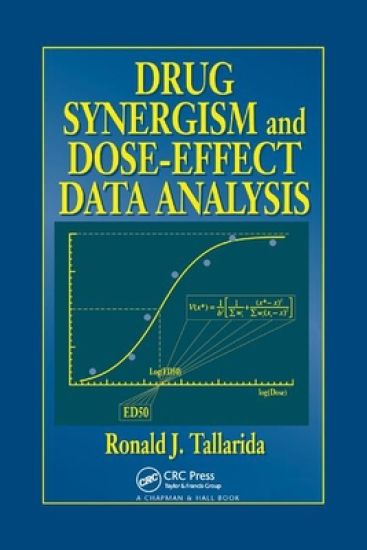
Drug Synergism and Dose-Effect Data Analysis

Drug Synergism and Dose-Effect Data Analysis

Ronald J. Tallarida

CRC Press Inc
2000
sidottu
Not since this author's bestselling Manual of Pharmacologic Calculation-long out of print-has there been a reference available for drug data analysis, and even that work did not deal with drug combinations. Although pharmacologists and most other scientists know what synergism is, mainstream textbooks tend to neglect it as a quantitative topic. Few researchers are familiar with the quantitative methodology needed to differentiate synergistic responses from the simply additive responses expected from drug combinations or a single drug's interaction with endogenous chemicals. In Drug Synergism and Dose-Effect Data Analysis, noted pharmacologist, mathematician, and author Ronald J. Tallarida finally brings these methods to light. Drawing on statistical theory and methods but keeping the special needs of the pharmacologist in mind, he begins his treatment with dose-response relations, the statistical analysis of the data, and the models that describe them. He also offers the only modern presentation of probit and logit analysis and provides detailed calculation methods not found in typical statistics books. Numerous examples accompany a presentation that clearly illustrates the calculations and experimental design considerations for modern drug analysis. You'll find the conceptual background, the algorithms, and new research developments. In short, Drug Synergism and Dose-Effect Data Analysis has everything you need to perform, with confidence, the quantitative analysis of dose response data.
Manual of Pharmacologic Calculations

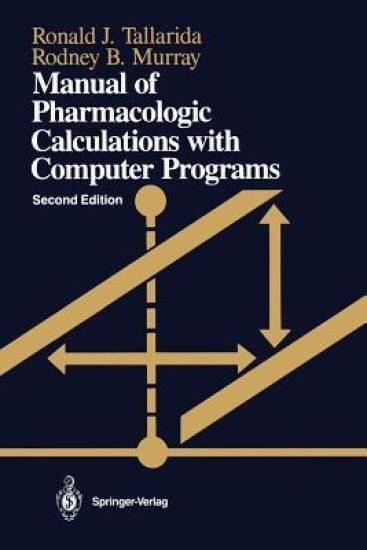
Manual of Pharmacologic Calculations

Ronald J. Tallarida; Rodney B. Murray

Springer-Verlag New York Inc.
2011
nidottu
This book contains a collection of quantitative procedures in common use in pharmacology and related disciplines. It is intended for students and researchers in all fields who work with drugs. Many physicians, especially those concerned with clinical pharmacology, will also find much that is useful. The procedures included may be considered "core" since they are generally applicable to all classes of drugs. Some of the procedures deal with statistics and, hence, have even wider application. In this new edition we have increased the number of procedures from 33 (in the first edition) to 48. Other procedures have been revised and expanded. Yet the basic philosophy of this new edition remains unchanged from the first. That is, the pharmacologic basis of each procedure is presented, along with the necessary formulas and one or more worked examples. An associated computer program is included for each procedure and its use is illustrated with the same worked example used in the text. The discussions of theory and the sample computations are brief and self-contained, so that all computations can be made with the aid of a pocket calculator and the statistical tables contained in Appendix A. Yet it is realized that the proliferation of lower-priced microcom­ puters is likely to mean that more and more readers will utilize a computer for most calculations. Accordingly, we have modified the format of the book to facilitate computer usage.
The Dose—Response Relation in Pharmacology

The Dose—Response Relation in Pharmacology

Ronald J. Tallarida; Leonard S. Jacob

Springer-Verlag New York Inc.
2012
nidottu
This book is designed to meet the modern need for a better understanding of drug-receptor interaction as applied to the gathering and interpretation of dose-response data. It is an introduction suitable for any student who has had a first course in pharmacology. This book is an extension of the pharmacology course into one area of what is now known as molecular pharmacology. The material included is an outgrowth of courses that we have given in recent years to health-science students in several professional schools and universities. The area of drug-receptor theory, although just a part of molecular phar­ macology, is already very broad. One major line of investigation is concerned with the chemical and structural nature of specific receptors and with efforts to isolate specific receptors. Another line of investigation is concerned with the kinetic theories of drug-receptor interaction, the effort there being to provide a general theory that is applicable to wide classes of drugs. We have chosen to deal with the latter. There are several reasons for our choice of topics. First, the information is very practical; that is, it permits one to use properly and consistently terms such as "efficacy," "partial agonist," "pure antagonist," "potency," "pA2'" etc., when describing drug action. Second, many students fail to appreciate the differences in and the limitations of the various theories, beginning with the classical theory of A. J. Clark, on up to the very recent allosteric theories.