Kirjojen hintavertailu. Mukana 11 342 296 kirjaa ja 12 kauppaa.

Kirjahaku

Etsi kirjoja tekijän nimen, kirjan nimen tai ISBN:n perusteella.

7 kirjaa tekijältä Ronald W. Langacker

Essentials of Cognitive Grammar

Essentials of Cognitive Grammar

Ronald W. Langacker

Oxford University Press Inc
2013
nidottu
Ronald W. Langacker created an approach to linguistics called Cognitive Grammar, which is essentially a system of symbols that can be used to organize and analyze how semantics and phonology interact with each other in human language. Cognitive Grammar lays the groundwork for cognitive linguistics, which has become a major sub-field over the past 30 years. Langacker's 2008 OUP book Cognitive Grammar is the authoritative introduction to CG. But for an introduction it's rather long-584 pages, divided into four sections, two of which are truly introductory and two of which offer a more detailed methodology for researchers. This abridged version of Cognitive Grammar makes the two introductory sections available for course adoption at a reduced price. It will reinvigorate this copyright by tailoring it to the course market that has become its primary audience, and by positioning Langacker's authoritative work as an accessible, attractive cornerstone of cognitive linguistics as the field continues to evolve.
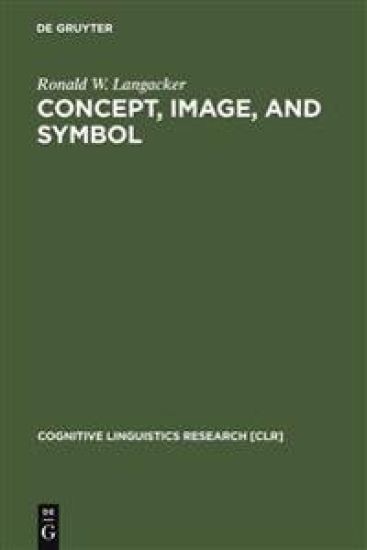
Concept, Image, and Symbol

Concept, Image, and Symbol

Ronald W. Langacker

De Gruyter Mouton
1994
sidottu
This classic research monograph develops and illustrates the theory of linguistic structure known as Cognitive Grammar, and applies it to representative phenomena in English and other languages. Cognitive grammar views language as an integral facet of cognition and claims that grammatical structure cannot be understood or revealingly described independently of semantic considerations.
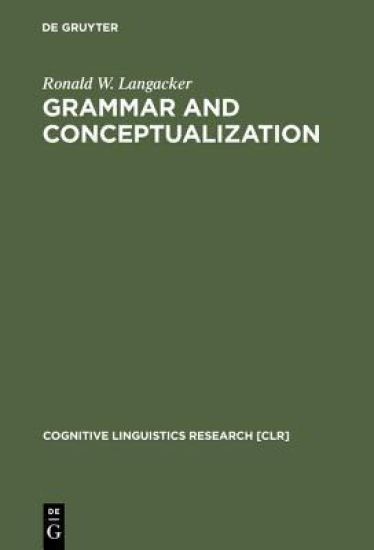
Grammar and Conceptualization

Grammar and Conceptualization

Ronald W. Langacker

De Gruyter Mouton
1999
sidottu
Grammar and Conceptualization documents some major developments in the theory of cognitive grammar during the last decade. By further articulating the framework and showing its application to numerous domains of linguistic structure, this book substantiates the claim that lexicon, morphology, and syntax form a gradation consisting of assemblies of symbolic structures (form-meaning pairings).
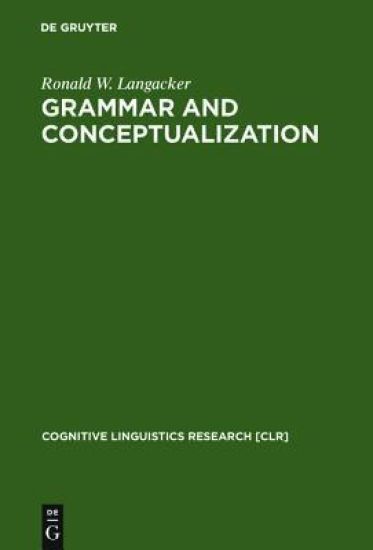
Grammar and Conceptualization

Grammar and Conceptualization

Ronald W. Langacker

De Gruyter Mouton
2000
isokokoinen pokkari
Grammar and Conceptualization documents some major developments in the theory of cognitive grammar during the last decade. By further articulating the framework and showing its application to numerous domains of linguistic structure, this book substantiates the claim that lexicon, morphology, and syntax form a gradation consisting of assemblies of symbolic structures (form-meaning pairings).
Concept, Image, and Symbol

Concept, Image, and Symbol

Ronald W. Langacker

De Gruyter Mouton
2001
isokokoinen pokkari
This classic research monograph develops and illustrates the theory of linguistic structure known as Cognitive Grammar, and applies it to representative phenomena in English and other languages. Cognitive grammar views language as an integral facet of cognition and claims that grammatical structure cannot be understood or revealingly described independently of semantic considerations. It argues that grammar forms a continuum with the lexicon and is reducible to symbolic relationships (i.e. form-meaning pairings), and consequently that all valid grammatical constructs have some kind of conceptual import. The coherence and descriptive potential of cognitive grammar are exemplified by application to a broad variety of grammatical phenomena drawn from numerous languages.
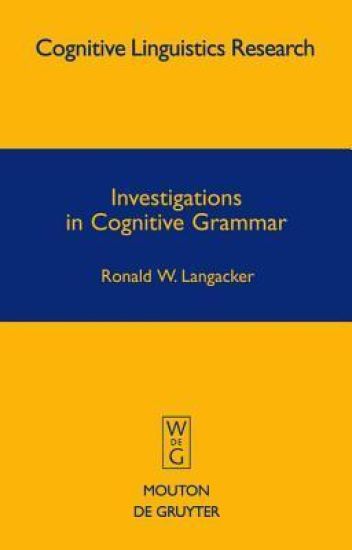
Investigations in Cognitive Grammar

Investigations in Cognitive Grammar

Ronald W. Langacker

De Gruyter Mouton
2009
sidottu
This volume makes accessible a substantial range of recent research in Cognitive Grammar. From disparate sources, it brings together a dozen innovative papers, revised and integrated to form a coherent whole. This work continues the ongoing program of progressively articulating the theoretical framework and showing its descriptive application to varied grammatical phenomena. A number of major topics are examined in depth through multiple chapters viewing them from different perspectives: grammatical constructions (their general nature, their metonymic basis, their role in grammaticization), nominal grounding (quantifiers, possessives, impersonal it), clausal grounding (its relation to nominal grounding, an epistemic account of tense, a systemic view of the English auxiliary), the "control cycle" (an abstract cognitive model with many linguistic manifestations), finite clauses (their internal structure and external grammar), and complex sentences (complementation, subordination, coordination). In each case the presentation builds from fundamentals and introduces the background needed for comprehension. At the same time, by bringing fresh approaches and new descriptive insights to classic problems, it represents a significant advance in understanding grammar and indicates future directions of theory and research in the Cognitive Grammar framework. The book is of great interest to students and practitioners of cognitive linguistics and to scholars in related areas.
Investigations in Cognitive Grammar

Investigations in Cognitive Grammar

Ronald W. Langacker

De Gruyter Mouton
2010
isokokoinen pokkari
This volume makes accessible a substantial range of recent research in Cognitive Grammar. From disparate sources, it brings together a dozen innovative papers, revised and integrated to form a coherent whole. This work continues the ongoing program of progressively articulating the theoretical framework and showing its descriptive application to varied grammatical phenomena. A number of major topics are examined in depth through multiple chapters viewing them from different perspectives: grammatical constructions (their general nature, their metonymic basis, their role in grammaticization), nominal grounding (quantifiers, possessives, impersonal it), clausal grounding (its relation to nominal grounding, an epistemic account of tense, a systemic view of the English auxiliary), the "control cycle" (an abstract cognitive model with many linguistic manifestations), finite clauses (their internal structure and external grammar), and complex sentences (complementation, subordination, coordination). In each case the presentation builds from fundamentals and introduces the background needed for comprehension. At the same time, by bringing fresh approaches and new descriptive insights to classic problems, it represents a significant advance in understanding grammar and indicates future directions of theory and research in the Cognitive Grammar framework. The book is of great interest to students and practitioners of cognitive linguistics and to scholars in related areas.