Kirjojen hintavertailu. Mukana 12 595 353 kirjaa ja 12 kauppaa.

Kirjahaku

Etsi kirjoja tekijän nimen, kirjan nimen tai ISBN:n perusteella.

28 kirjaa tekijältä Rosi Braidotti

Nomadic Theory

Nomadic Theory

Rosi Braidotti

Columbia University Press
2012
sidottu
Rosi Braidotti's nomadic theory outlines a sustainable modern subjectivity as one in flux, never opposed to a dominant hierarchy yet intrinsically other, always in the process of becoming, and perpetually engaged in dynamic power relations both creative and restrictive. Nomadic theory offers an original and powerful alternative for scholars working in cultural and social criticism and has, over the past decade, crept into continental philosophy, queer theory, and feminist, postcolonial, techno-science, media, and race studies, as well as into architecture, history, and anthropology. This collection provides a core introduction to Braidotti's nomadic theory and its innovative formulations, which playfully engage with Deleuze, Foucault, Irigaray, and a host of political and cultural issues. Arranged thematically, essays begin with such concepts as sexual difference and embodied subjectivity and follow with explorations in technoscience, feminism, postsecular citizenship, and the politics of affirmation. Braidotti develops a distinctly positive critical theory that rejuvenates the experience of political scholarship. Inspired yet not confined by Deleuzian vitalism, with its commitment to the ontology of flows, networks, and dynamic transformations, she emphasizes affects, imagination, and creativity and the politics of radical immanence. Incorporating ideas from Nietzsche and Spinoza as well, Braidotti establishes a critical-theoretical framework equal parts critique and creation. Ever mindful of the perils of defining difference in terms of denigration and the related tendency to subordinate sexualized, racialized, and naturalized others, she explores the eco-philosophical implications of nomadic theory, feminism, and the irreducibility of sexual difference and sexuality. Her dialogue with technoscience is crucial to nomadic theory, which deterritorializes the established understanding of what counts as human, along with our relationship to animals, the environment, and changing notions of materialism. Keeping her distance from the near-obsessive focus on vulnerability, trauma, and melancholia in contemporary political thought, Braidotti promotes a politics of affirmation that has the potential to become its own generative life force.

Nomadic Theory

Nomadic Theory

Rosi Braidotti

Columbia University Press
2012
pokkari
Rosi Braidotti's nomadic theory outlines a sustainable modern subjectivity as one in flux, never opposed to a dominant hierarchy yet intrinsically other, always in the process of becoming, and perpetually engaged in dynamic power relations both creative and restrictive. Nomadic theory offers an original and powerful alternative for scholars working in cultural and social criticism and has, over the past decade, crept into continental philosophy, queer theory, and feminist, postcolonial, techno-science, media, and race studies, as well as into architecture, history, and anthropology. This collection provides a core introduction to Braidotti's nomadic theory and its innovative formulations, which playfully engage with Deleuze, Foucault, Irigaray, and a host of political and cultural issues. Arranged thematically, essays begin with such concepts as sexual difference and embodied subjectivity and follow with explorations in technoscience, feminism, postsecular citizenship, and the politics of affirmation. Braidotti develops a distinctly positive critical theory that rejuvenates the experience of political scholarship. Inspired yet not confined by Deleuzian vitalism, with its commitment to the ontology of flows, networks, and dynamic transformations, she emphasizes affects, imagination, and creativity and the politics of radical immanence. Incorporating ideas from Nietzsche and Spinoza as well, Braidotti establishes a critical-theoretical framework equal parts critique and creation. Ever mindful of the perils of defining difference in terms of denigration and the related tendency to subordinate sexualized, racialized, and naturalized others, she explores the eco-philosophical implications of nomadic theory, feminism, and the irreducibility of sexual difference and sexuality. Her dialogue with technoscience is crucial to nomadic theory, which deterritorializes the established understanding of what counts as human, along with our relationship to animals, the environment, and changing notions of materialism. Keeping her distance from the near-obsessive focus on vulnerability, trauma, and melancholia in contemporary political thought, Braidotti promotes a politics of affirmation that has the potential to become its own generative life force.
Nomadic Subjects

Nomadic Subjects

Rosi Braidotti

Columbia University Press
2011
sidottu
For more than fifteen years, Nomadic Subjects has guided discourse in continental philosophy and feminist theory, exploring the constitution of contemporary subjectivity, especially the concept of difference within European philosophy and political theory. Rosi Braidotti's creative style vividly renders a productive crisis of modernity. From a feminist perspective, she recasts embodiment, sexual difference, and complex concepts through relations to technology, historical events, and popular culture. This thoroughly revised and expanded edition retains all but two of Braidotti's original essays, including her investigations into epistemology's relation to the "woman question;" feminism and biomedical ethics; European feminism; and the possible relations between American feminism and European politics and philosophy. A new piece integrates Deleuze and Guattari's concept of the "becoming-minoritarian" more deeply into modern democratic thought, and a chapter on methodology explains Braidotti's methods while engaging with her critics. A new introduction muses on Braidotti's provocative legacy.
Nomadic Subjects

Nomadic Subjects

Rosi Braidotti

Columbia University Press
2011
pokkari
For more than fifteen years, Nomadic Subjects has guided discourse in continental philosophy and feminist theory, exploring the constitution of contemporary subjectivity, especially the concept of difference within European philosophy and political theory. Rosi Braidotti's creative style vividly renders a productive crisis of modernity. From a feminist perspective, she recasts embodiment, sexual difference, and complex concepts through relations to technology, historical events, and popular culture. This thoroughly revised and expanded edition retains all but two of Braidotti's original essays, including her investigations into epistemology's relation to the "woman question;" feminism and biomedical ethics; European feminism; and the possible relations between American feminism and European politics and philosophy. A new piece integrates Deleuze and Guattari's concept of the "becoming-minoritarian" more deeply into modern democratic thought, and a chapter on methodology explains Braidotti's methods while engaging with her critics. A new introduction muses on Braidotti's provocative legacy.
Patterns of Dissonance

Patterns of Dissonance

Rosi Braidotti

Polity Press
1991
nidottu
The first part of this book examines contemporary French philosophy as practised by men, in particular by Foucault, Derrida and Deleuze. The second part is concerned with feminist thinkers in Europe and the United States. It examines the work of Irigaray, Daly and le Doueff, in particular.
Metamorphoses

Metamorphoses

Rosi Braidotti

Polity Press
2001
sidottu
The discussions about the ethical, political and human implications of the postmodernist condition have been raging for longer than most of us care to remember. They have been especially fierce within feminism. After a brief flirtation with postmodern thinking in the 1980s, mainstream feminist circles seem to have turned their back on the staple notions of poststructuralist philosophy. Metamorphoses takes stock of the situation and attempts to reset priorities within the poststructuralist feminist agenda. Cross-referring in a creative way to Deleuze's and Irigaray's respective philosophies of difference, the book addresses key notions such as embodiment, immanence, sexual difference, nomadism and the materiality of the subject. Metamorphoses also focuses on the implications of these theories for cultural criticism and a redefinition of politics. It provides a vivid overview of contemporary culture, with special emphasis on technology, the monstrous imaginary and the recurrent obsession with 'the flesh' in the age of techno-bodies. This highly original contribution to current debates is written for those who find changes and transformations challenging and necessary. It will be of great interest to students and scholars of philosophy, feminist theory, gender studies, sociology, social theory and cultural studies.
Metamorphoses

Metamorphoses

Rosi Braidotti

JOHN WILEY AND SONS LTD
2001
nidottu
The discussions about the ethical, political and human implications of the postmodernist condition have been raging for longer than most of us care to remember. They have been especially fierce within feminism. After a brief flirtation with postmodern thinking in the 1980s, mainstream feminist circles seem to have turned their back on the staple notions of poststructuralist philosophy. Metamorphoses takes stock of the situation and attempts to reset priorities within the poststructuralist feminist agenda. Cross-referring in a creative way to Deleuze's and Irigaray's respective philosophies of difference, the book addresses key notions such as embodiment, immanence, sexual difference, nomadism and the materiality of the subject. Metamorphoses also focuses on the implications of these theories for cultural criticism and a redefinition of politics. It provides a vivid overview of contemporary culture, with special emphasis on technology, the monstrous imaginary and the recurrent obsession with 'the flesh' in the age of techno-bodies. This highly original contribution to current debates is written for those who find changes and transformations challenging and necessary. It will be of great interest to students and scholars of philosophy, feminist theory, gender studies, sociology, social theory and cultural studies.
Transpositions

Transpositions

Rosi Braidotti

Polity Press
2006
sidottu
This major new book offers a highly original account of ethical and political subjectivity in contemporary culture. It makes a strong case for a non-unitary or nomadic conception of the subject, in opposition to the claims of ideologies such as conservatism, liberal individualism and techno-capitalism. Braidotti takes a bold stand against moral universalism, while offering a vigorous defence of nomadic ethics against the charges of relativism and nihilism. She calls for a new form of ethical accountability that takes "Life" as the subject, not the object, of enquiry. This ethics is presented as a fundamental reconfiguration of our being in the world and it calls for more conceptual creativity in the production of worldviews that can better enable us to behave ethically in a technologically and globally mediated world. The nomadic ethical subject negotiates successfully the complex tension between the multiplicity of political forces on the one hand and the sustained commitment to emancipatory politics on the other. Transpositions provides an intellectually rich guide to the leading critical debates of our time and will be of great interest to scholars and students throughout the humanities and social sciences.
Transpositions

Transpositions

Rosi Braidotti

Polity Press
2006
nidottu
This major new book offers a highly original account of ethical and political subjectivity in contemporary culture. It makes a strong case for a non-unitary or nomadic conception of the subject, in opposition to the claims of ideologies such as conservatism, liberal individualism and techno-capitalism. Braidotti takes a bold stand against moral universalism, while offering a vigorous defence of nomadic ethics against the charges of relativism and nihilism. She calls for a new form of ethical accountability that takes "Life" as the subject, not the object, of enquiry. This ethics is presented as a fundamental reconfiguration of our being in the world and it calls for more conceptual creativity in the production of worldviews that can better enable us to behave ethically in a technologically and globally mediated world. The nomadic ethical subject negotiates successfully the complex tension between the multiplicity of political forces on the one hand and the sustained commitment to emancipatory politics on the other. Transpositions provides an intellectually rich guide to the leading critical debates of our time and will be of great interest to scholars and students throughout the humanities and social sciences.
The Posthuman

The Posthuman

Rosi Braidotti

Polity Press
2013
sidottu
The Posthuman offers both an introduction and major contribution to contemporary debates on the posthuman. Digital 'second life', genetically modified food, advanced prosthetics, robotics and reproductive technologies are familiar facets of our globally linked and technologically mediated societies. This has blurred the traditional distinction between the human and its others, exposing the non-naturalistic structure of the human. The Posthuman starts by exploring the extent to which a post-humanist move displaces the traditional humanistic unity of the subject. Rather than perceiving this situation as a loss of cognitive and moral self-mastery, Braidotti argues that the posthuman helps us make sense of our flexible and multiple identities.Braidotti then analyzes the escalating effects of post-anthropocentric thought, which encompass not only other species, but also the sustainability of our planet as a whole. Because contemporary market economies profit from the control and commodification of all that lives, they result in hybridization, erasing categorical distinctions between the human and other species, seeds, plants, animals and bacteria. These dislocations induced by globalized cultures and economies enable a critique of anthropocentrism, but how reliable are they as indicators of a sustainable future?The Posthuman concludes by considering the implications of these shifts for the institutional practice of the humanities. Braidotti outlines new forms of cosmopolitan neo-humanism that emerge from the spectrum of post-colonial and race studies, as well as gender analysis and environmentalism. The challenge of the posthuman condition consists in seizing the opportunities for new social bonding and community building, while pursuing sustainability and empowerment.
The Posthuman

The Posthuman

Rosi Braidotti

Polity Press
2013
nidottu
The Posthuman offers both an introduction and major contribution to contemporary debates on the posthuman. Digital 'second life', genetically modified food, advanced prosthetics, robotics and reproductive technologies are familiar facets of our globally linked and technologically mediated societies. This has blurred the traditional distinction between the human and its others, exposing the non-naturalistic structure of the human. The Posthuman starts by exploring the extent to which a post-humanist move displaces the traditional humanistic unity of the subject. Rather than perceiving this situation as a loss of cognitive and moral self-mastery, Braidotti argues that the posthuman helps us make sense of our flexible and multiple identities.Braidotti then analyzes the escalating effects of post-anthropocentric thought, which encompass not only other species, but also the sustainability of our planet as a whole. Because contemporary market economies profit from the control and commodification of all that lives, they result in hybridization, erasing categorical distinctions between the human and other species, seeds, plants, animals and bacteria. These dislocations induced by globalized cultures and economies enable a critique of anthropocentrism, but how reliable are they as indicators of a sustainable future?The Posthuman concludes by considering the implications of these shifts for the institutional practice of the humanities. Braidotti outlines new forms of cosmopolitan neo-humanism that emerge from the spectrum of post-colonial and race studies, as well as gender analysis and environmentalism. The challenge of the posthuman condition consists in seizing the opportunities for new social bonding and community building, while pursuing sustainability and empowerment.
Posthuman Feminism

Posthuman Feminism

Rosi Braidotti

Polity Press
2021
sidottu
In a context marked by the virulent return of patriarchal and white supremacist attitudes, a new generation of feminist activists are continuing the struggle: these are very feminist times. But how do these and other movements relate to the contemporary posthuman condition? In this important new book, Rosi Braidotti examines the implications of the posthuman turn for feminist theory and practice. She defines the posthuman turn as a convergence between posthumanism on the one hand and post-anthropocentrism on the other, and she examines their complex relationship and joint impact. Braidotti claims that mainstream posthuman scholarship has neglected feminist theory, while in fact feminism is one of the precursors of the posthuman turn, through diverse social movements and political traditions. Posthuman Feminism is an analytic and creative response to contemporary conditions and a call to action. It highlights the constraints but also the potentialities available to feminist political subjects as they confront the ever-growing injustices of sexism, racism, ecocide and neoliberal capitalism. This bold new text by a leading feminist philosopher will be of great interest to students and scholars throughout the humanities and social sciences.
Posthuman Feminism

Posthuman Feminism

Rosi Braidotti

Polity Press
2021
nidottu
In a context marked by the virulent return of patriarchal and white supremacist attitudes, a new generation of feminist activists are continuing the struggle: these are very feminist times. But how do these and other movements relate to the contemporary posthuman condition? In this important new book, Rosi Braidotti examines the implications of the posthuman turn for feminist theory and practice. She defines the posthuman turn as a convergence between posthumanism on the one hand and post-anthropocentrism on the other, and she examines their complex relationship and joint impact. Braidotti claims that mainstream posthuman scholarship has neglected feminist theory, while in fact feminism is one of the precursors of the posthuman turn, through diverse social movements and political traditions. Posthuman Feminism is an analytic and creative response to contemporary conditions and a call to action. It highlights the constraints but also the potentialities available to feminist political subjects as they confront the ever-growing injustices of sexism, racism, ecocide and neoliberal capitalism. This bold new text by a leading feminist philosopher will be of great interest to students and scholars throughout the humanities and social sciences.
Posthuman Knowledge

Posthuman Knowledge

Rosi Braidotti

Polity Press
2019
sidottu
The question of what defines the human, and of what is human about the humanities, have been shaken up by the radical critiques of humanism and the displacement of anthropomorphism that have gained currency in recent years, propelled in part by rapid advances in our knowledge of living systems and of their genetic and algorithmic codes coupled with the global expansion of a knowledge-intensive capitalism. In Posthuman Knowledge, Rosi Braidotti takes a closer look at the impact of these developments on three major areas: the constitution of our subjectivity, the general production of knowledge and the practice of the academic humanities. Drawing on feminist, postcolonial and anti-racist theory, she argues that the human was never a neutral category but one always linked to power and privilege. Hence we must move beyond the old dualities in which Man defined himself, beyond the sexualized and racialized others that were excluded from humanity. Posthuman knowledge, as Braidotti understands it, is not so much an alternative form of knowledge as a critical call: a call to build a multi-layered and multi-directional project that displaces anthropocentrism while pursuing the analysis of the discriminatory and violent aspects of human activity and interaction wherever they occur.Situated between the exhilaration of scientific and technological advances on the one hand and the threat of climate change devastation on the other, the posthuman convergence encourages us to think hard and creatively about what we are in the process of becoming.
Posthuman Knowledge

Posthuman Knowledge

Rosi Braidotti

Polity Press
2019
nidottu
The question of what defines the human, and of what is human about the humanities, have been shaken up by the radical critiques of humanism and the displacement of anthropomorphism that have gained currency in recent years, propelled in part by rapid advances in our knowledge of living systems and of their genetic and algorithmic codes coupled with the global expansion of a knowledge-intensive capitalism. In Posthuman Knowledge, Rosi Braidotti takes a closer look at the impact of these developments on three major areas: the constitution of our subjectivity, the general production of knowledge and the practice of the academic humanities. Drawing on feminist, postcolonial and anti-racist theory, she argues that the human was never a neutral category but one always linked to power and privilege. Hence we must move beyond the old dualities in which Man defined himself, beyond the sexualized and racialized others that were excluded from humanity. Posthuman knowledge, as Braidotti understands it, is not so much an alternative form of knowledge as a critical call: a call to build a multi-layered and multi-directional project that displaces anthropocentrism while pursuing the analysis of the discriminatory and violent aspects of human activity and interaction wherever they occur.Situated between the exhilaration of scientific and technological advances on the one hand and the threat of climate change devastation on the other, the posthuman convergence encourages us to think hard and creatively about what we are in the process of becoming.
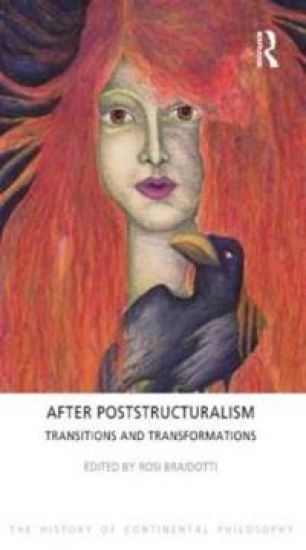
After Poststructuralism

After Poststructuralism

Rosi Braidotti

Acumen Publishing Ltd
2013
sidottu
The end of the Cold War revitalised continental philosophy and, more particularly, interest in it from outside philosophy. "After Poststructuralism: Transitions and Transformations" analyses the main developments in continental philosophy between 1980-1995, a time of great upheaval and profound social change. The volume ranges across the birth of postmodernism, the differing traditions of France, Germany and Italy, third generation critical theory, radical democracy, postcolonial philosophy, the turn to ethics, feminist philosophies, the increasing engagement with religion, and the rise of performativity and post-analytic philosophy. Analyses of the major figures are integrated within the discussion. After Poststructuralism reveals how continental philosophy - fuelled by an intense ethical and political desire to reflect changing social and political conditions - responded to the changing world and to the key issues of the time, notably globalisation, technology and ethnicity.
After Poststructuralism

After Poststructuralism

Rosi Braidotti

Acumen Publishing Ltd
2013
nidottu
The end of the Cold War revitalised continental philosophy and, more particularly, interest in it from outside philosophy. "After Poststructuralism: Transitions and Transformations" analyses the main developments in continental philosophy between 1980-1995, a time of great upheaval and profound social change. The volume ranges across the birth of postmodernism, the differing traditions of France, Germany and Italy, third generation critical theory, radical democracy, postcolonial philosophy, the turn to ethics, feminist philosophies, the increasing engagement with religion, and the rise of performativity and post-analytic philosophy. Analyses of the major figures are integrated within the discussion. After Poststructuralism reveals how continental philosophy - fuelled by an intense ethical and political desire to reflect changing social and political conditions - responded to the changing world and to the key issues of the time, notably globalisation, technology and ethnicity.
Posthuman Knowledge and the Critical Posthumanities
On the advanced knowledge economy, which perpetuates patterns of discrimination and exclusion, and the threat of climate change devastation for both human and nonhuman entities. Robots designed to care for people and neglected landscapes of digital trash. The promise of synthetic biology and the panic of living on a dying planet. Wonderful feats of intelligence and systemic acts of violence. Exhilaration and exhaustion. Rosi Braidotti argues that we must think about these apparent contradictions all together in order to make differences that actually matter. Posthuman Knowledge and the Critical Posthumanities oscillates between evocations and transections of contemporary conditions, for which Braidotti offers what she calls the "posthuman convergence" as a new paradigm for situating and navigating their problems and possibilities. Reflecting on the knotted situation of the academic humanities, cognitive capitalism, and advanced climate change, she delivers an intersectional critique of humanism and anthropocentrism, and targets their exclusions and aporias to address subjectivity, knowledge production, and academic structures within that posthuman convergence. Braidotti's convergence demands imagination, endurance, connectivity, and perspectives multiplied, embodied, and grounded in the only world we have.