Kirjojen hintavertailu. Mukana 11 699 587 kirjaa ja 12 kauppaa.

Kirjahaku

Etsi kirjoja tekijän nimen, kirjan nimen tai ISBN:n perusteella.

8 kirjaa tekijältä Roslyn Weiss

Socrates Dissatisfied

Socrates Dissatisfied

Roslyn Weiss

Oxford University Press Inc
1998
sidottu
Roslyn Weiss contends that, contrary to prevailing notions, Plato's Crito does not show an allegiance between Socrates and the state that condemned him. Denying that the speech of the Laws represents the views of Socrates, Weiss deftly brings to light numerous indications that Socrates provides to the attentive reader that he and the Laws are not partners but antagonists in the argument and that he is singularly unimpressed by the case against escaping prison presented by the Laws. Weiss's greatest innovation is her contention that the Laws are very much like the judges who preside at Socrates' trial--interested not in justice and truth but in being shown deference and submission. If Weiss's argument is correct, then the standard conception of the history of political thought is in error--political philosophy begins not with the primacy of the state over the citizen but with the affirmation of the individual's duty to act in accordance with his own careful determination of what justice demands.
Virtue in the Cave

Virtue in the Cave

Roslyn Weiss

Oxford University Press Inc
2001
sidottu
This book is radically new interpretation of Plato's Meno. Roslyn Weiss takes and defends the position that the Meno is a self-conscious analysis and assessment of the worth not of inquiry itself, but of moral inquiry. Her coherent reading of the Meno identifies serious problems for orthodox interpretations and will appeal to anyone interested in ancient philosophy and the classics.
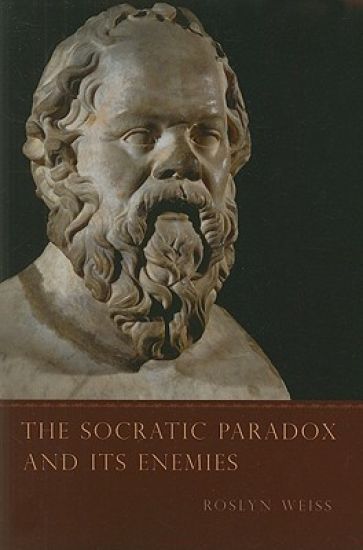
The Socratic Paradox and Its Enemies

The Socratic Paradox and Its Enemies

Roslyn Weiss

University of Chicago Press
2008
nidottu
In "The Socratic Paradox and Its Enemies", Roslyn Weiss argues that the Socratic paradoxes - no one does wrong willingly, virtue is knowledge, and all the virtues are one - are best understood as Socrates' way of combating sophistic views: that no one is willingly just, those who are just and temperate are ignorant fools, and only some virtues (courage and wisdom) but not others (justice, temperance, and piety) are marks of true excellence.In Weiss' view, the paradoxes express Socrates' belief that wrongdoing fails to yield the happiness that all people want; it is therefore the unjust and immoderate who are the fools. The paradoxes thus emerge as Socrates' means of championing the cause of justice in the face of those who would impugn it. Her fresh approach - ranging over six of Plato's dialogues - is sure to spark debate in philosophy, classics, and political theory.
Virtue in the Cave

Virtue in the Cave

Roslyn Weiss

Lexington Books
2008
nidottu
Virtue in the Cave is a study of Plato's Meno. Taking the dialogue's central theme to be the question of what virtue is, this book explores the limits of moral inquiry. It argues that, unlike mathematical problems that can be resolved definitively, and unlike technical enterprises whose success can be objectively assessed, moral matters can be only tentatively settled by reasoned argument—at least in the material world to which we all are confined. Whereas Meno is not satisfied with an inquiry whose final result falls short of knowledge, Socrates sees value in joint moral investigation that culminates in true opinion. This study attends closely to the literary aspects of the dialogue and to its rhetorical nuances, raising doubts about Socrates' allegiance to the metaphysical doctrines—transmigration of souls and the theory of recollection—that he himself introduces. It suggests that Socrates tailors these notions specifically to Meno, in order to encourage him to pursue doggedly the inquiry into virtue, an inquiry he is all too prepared to abandon when the going gets rough.
Socrates Dissatisfied

Socrates Dissatisfied

Roslyn Weiss

Rowman Littlefield Publishers
2002
nidottu
For whom do the personified Laws in the latter part of the Crito speak? Who is it in the dialogue who demands of the citizen utter submission to whatever the city bids whether right or wrong, just or unjust? If it is Socrates for whom the Laws speak and if it is he who sets the city's commands above the considered moral judgement of the individual, what, one must wonder, has become of the radically independent Socrates of the Apologywho defiantly resists calls to injustice regardless of their source? In Socrates Dissatisfied, Weiss argues against the prevailing view that the Laws are Socrates' spokesmen. She reveals and explores many indications that Socrates and the Laws are, both in style and in substance, adversaries: whereas the Laws are rhetoricians who defend their own absolute authority, Socrates is a dialectician who defends—in the Crito no less than in the Apology—the overriding claim of each individual's own reason when assiduously applied to questions of justice. It is only for the sake of an unphilosophical Crito, Weiss suggests, that Socrates invents the speech of the Laws; he resorts to rhetoric in a desperate attempt to save Crito's soul even as Crito seeks to save his body. Indeed, as Weiss shows, Socrates' own philosophical reasons for remaining in prison rather than escaping as Crito wishes are clearly and fully articulated before the speech of the Laws begins. Deft, provocative, and compelling, with new translations providing groundbreaking interpretations of key passages, Socrates Dissatisfied challenges the standard conception of the history of political thought: if its argument is correct, political philosophy begins not with the assertion of the supremacy of the state over the citizen, but with the affirmation of the primacy of the citizen in his deliberative exercise of reason with respect to justice. Socrates Dissatisfiedis vital reading for students and scholars of ancient philosophy, classics, and political philosophy.
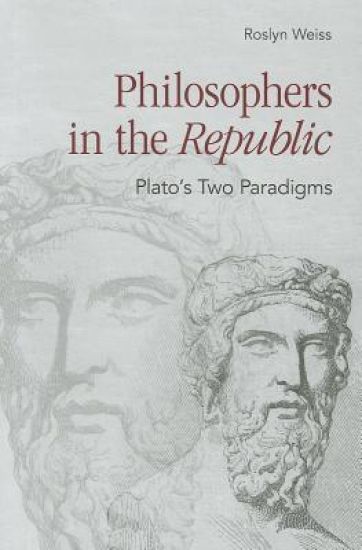
Philosophers in the "Republic"

Philosophers in the "Republic"

Roslyn Weiss

Cornell University Press
2012
sidottu
In Plato's Republic Socrates contends that philosophers make the best rulers because only they behold with their mind's eye the eternal and purely intelligible Forms of the Just, the Noble, and the Good. When, in addition, these men and women are endowed with a vast array of moral, intellectual, and personal virtues and are appropriately educated, surely no one could doubt the wisdom of entrusting to them the governance of cities. Although it is widely—and reasonably—assumed that all the Republic's philosophers are the same, Roslyn Weiss argues in this boldly original book that the Republic actually contains two distinct and irreconcilable portrayals of the philosopher. According to Weiss, Plato's two paradigms of the philosopher are the "philosopher by nature" and the "philosopher by design." Philosophers by design, as the allegory of the Cave vividly shows, must be forcibly dragged from the material world of pleasure to the sublime realm of the intellect, and from there back down again to the "Cave" to rule the beautiful city envisioned by Socrates and his interlocutors. Yet philosophers by nature, described earlier in the Republic, are distinguished by their natural yearning to encounter the transcendent realm of pure Forms, as well as by a willingness to serve others—at least under appropriate circumstances. In contrast to both sets of philosophers stands Socrates, who represents a third paradigm, one, however, that is no more than hinted at in the Republic. As a man who not only loves "what is" but is also utterly devoted to the justice of others—even at great personal cost—Socrates surpasses both the philosophers by design and the philosophers by nature. By shedding light on an aspect of the Republic that has escaped notice, Weiss's new interpretation will challenge Plato scholars to revisit their assumptions about Plato's moral and political philosophy.
Justice in Plato's Republic

Justice in Plato's Republic

Roslyn Weiss

Cambridge University Press
2025
sidottu
In Book 4 of Plato's Republic, Socrates introduces what is regarded by scholars as the Platonic account of justice, according to which it is essentially internal and self-regarding, a matter of relations among the parts of a city or soul. In this book, Roslyn Weiss contends that there is another notion of justice, as other-regarding and external, which is to be found in a series of conversations in Book 1 between Socrates and three successive interlocutors. Weiss considers the relationship between justice as conceived in Book 1 and Book 4, and carefully examines what can be learned from each of the arguments. Her close analysis of Book 1 brings to light what Socrates really believed about justice, and extracts and explores this Book's many insights concerning justice—at both the political and the personal level.
Philosophers in the "Republic"

Philosophers in the "Republic"

Roslyn Weiss

Cornell University Press
2016
pokkari
In Plato's Republic Socrates contends that philosophers make the best rulers because only they behold with their mind's eye the eternal and purely intelligible Forms of the Just, the Noble, and the Good. When, in addition, these men and women are endowed with a vast array of moral, intellectual, and personal virtues and are appropriately educated, surely no one could doubt the wisdom of entrusting to them the governance of cities. Although it is widely—and reasonably—assumed that all the Republic's philosophers are the same, Roslyn Weiss argues in this boldly original book that the Republic actually contains two distinct and irreconcilable portrayals of the philosopher. According to Weiss, Plato's two paradigms of the philosopher are the "philosopher by nature" and the "philosopher by design." Philosophers by design, as the allegory of the Cave vividly shows, must be forcibly dragged from the material world of pleasure to the sublime realm of the intellect, and from there back down again to the "Cave" to rule the beautiful city envisioned by Socrates and his interlocutors. Yet philosophers by nature, described earlier in the Republic, are distinguished by their natural yearning to encounter the transcendent realm of pure Forms, as well as by a willingness to serve others—at least under appropriate circumstances. In contrast to both sets of philosophers stands Socrates, who represents a third paradigm, one, however, that is no more than hinted at in the Republic. As a man who not only loves "what is" but is also utterly devoted to the justice of others—even at great personal cost—Socrates surpasses both the philosophers by design and the philosophers by nature. By shedding light on an aspect of the Republic that has escaped notice, Weiss's new interpretation will challenge Plato scholars to revisit their assumptions about Plato's moral and political philosophy.