Kirjojen hintavertailu. Mukana 11 475 414 kirjaa ja 12 kauppaa.

Kirjahaku

Etsi kirjoja tekijän nimen, kirjan nimen tai ISBN:n perusteella.

6 kirjaa tekijältä Ross Hassig

Time, History, and Belief in Aztec and Colonial Mexico

Time, History, and Belief in Aztec and Colonial Mexico

Ross Hassig

University of Texas Press
2001
pokkari
Based on their enormously complex calendars that recorded cycles of many kinds, the Aztecs and other ancient Mesoamerican civilizations are generally believed to have had a cyclical, rather than linear, conception of time and history. This boldly revisionist book challenges that understanding. Ross Hassig offers convincing evidence that for the Aztecs time was predominantly linear, that it was manipulated by the state as a means of controlling a dispersed tribute empire, and that the Conquest cut off state control and severed the unity of the calendar, leaving only the lesser cycles. From these, he asserts, we have inadequately reconstructed the pre-Columbian calendar and so misunderstood the Aztec conception of time and history. Hassig first presents the traditional explanation of the Aztec calendrical system and its ideological functions and then marshals contrary evidence to argue that the Aztec elite deliberately used calendars and timekeeping to achieve practical political ends. He further traces how the Conquest played out in the temporal realm as Spanish conceptions of time partially displaced the Aztec ones. His findings promise to revolutionize our understanding of how the Aztecs and other Mesoamerican societies conceived of time and history.
War and Society in Ancient Mesoamerica

War and Society in Ancient Mesoamerica

Ross Hassig

University of California Press
1992
sidottu
In this study of warfare in ancient Mesoamerica, Ross Hassig offers new insight into three thousand years of Mesoamerican history, from roughly 1500 B.C. to the Spanish conquest. He examines the methods, purposes, and values of warfare as practiced by the major pre-Columbian societies and shows how warfare affected the rise of the state.
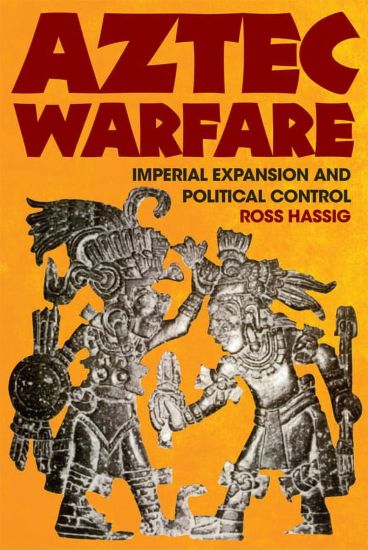
Aztec Warfare

Aztec Warfare

Ross Hassig

University of Oklahoma Press
1995
nidottu
In exploring the pattern and methods of Aztec expansion, Ross Hassig focuses on political and economic factors. Because they lacked numerical superiority, faced logistical problems presented by the terrain, and competed with agriculture for manpower, the Aztecs relied as much on threats and the image of power as on military might to subdue enemies and hold them in their orbit. Hassig describes the role of war in the everyday life of the capital, Tenochtitlan: the place of the military in Aztec society; the education and training of young warriors; the organization of the army; the use of weapons and armor; and the nature of combat.
Mexico and the Spanish Conquest

Mexico and the Spanish Conquest

Ross Hassig

University of Oklahoma Press
2006
nidottu
What role did indigenous peoples play in the Spanish conquest of Mexico? Ross Hassig explores this question in Mexico and the Spanish Conquest by incorporating primary accounts from the Indians of Mexico and revisiting the events of the conquest against the backdrop of the Aztec empire, the culture and politics of Mesoamerica, and the military dynamics of both sides. He analyzes the weapons, tactics, and strategies employed by both the Indians and the Spaniards, and concludes that the conquest was less a Spanish victory than it was a victory of Indians over other Indians, which the Spaniards were able to exploit to their own advantage.In this second edition of his classic work, Hassig incorporates new research in the same concise manner that made the original edition so popular and provides further explanations of the actions and motivations of Cortés, Moteuczoma, and other key figures. He also explores their impact on larger events and examines in greater detail Spanish military tactics and strategies.
Polygamy and the Rise and Demise of the Aztec Empire

Polygamy and the Rise and Demise of the Aztec Empire

Ross Hassig

University of New Mexico Press
2016
sidottu
This provocative examination of Aztec marriage practices offers a powerful analysis of the dynamics of society and politics in Mexico before and after the Spanish conquest. The author surveys what it means to be polygynous by comparing the practice in other cultures, past and present, and he uses its demographic consequences to flesh out this understudied topic in Aztec history. Polygyny provided Aztec women with opportunities for upward social mobility. It also led to increased migration to Tenochtitlan and influenced royal succession as well as united the empire. Surprisingly, the shift to monogamy that the Aztecs experienced in a single generation took over a millennium to occur in Europe. Hassig's analysis sheds new light on the conquest, showing that the imposition of monogamy - rather than military might, as earlier scholars have assumed - was largely responsible for the strong and rapid Spanish influence on Aztec society.
Polygamy and the Rise and Demise of the Aztec Empire

Polygamy and the Rise and Demise of the Aztec Empire

Ross Hassig

University of New Mexico Press
2016
nidottu
This provocative examination of Aztec marriage practices offers a powerful analysis of the dynamics of society and politics in Mexico before and after the Spanish conquest. The author surveys what it means to be polygynous by comparing the practice in other cultures, past and present, and he uses its demographic consequences to flesh out this understudied topic in Aztec history. Polygyny provided Aztec women with opportunities for upward social mobility. It also led to increased migration to Tenochtitlan and influenced royal succession as well as united the empire. Surprisingly, the shift to monogamy that the Aztecs experienced in a single generation took over a millennium to occur in Europe. Hassig's analysis sheds new light on the conquest, showing that the imposition of monogamy - rather than military might, as earlier scholars have assumed - was largely responsible for the strong and rapid Spanish influence on Aztec society.